Judge tosses out Michigan law on end-of-life decisions in pregnancy
Published in News & Features
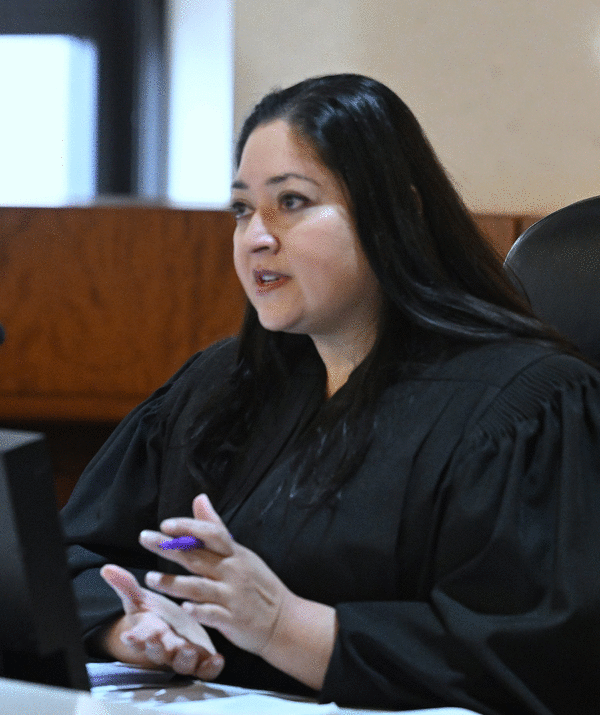
LANSING, Mich. — A Michigan judge has declared unconstitutional a provision of state law that limits a woman and her patient advocate's right to carry out end-of-life directives if the woman is pregnant.
The law, Court of Claims Judge Sima Patel wrote, violates a woman's right to reproductive freedom that was enshrined in the state Constitution in 2022. Patel's decision was based on stipulations agreed to between state leaders and the physicians who brought the suit against them in October.
"The court concludes that the personal decision whether to forgo life-extending care in the face of an incapacitating condition and to designate a patient advocate to protect one’s wishes in this regard while incapacitated, even if pregnant, is a fundamental right to make and effectuate a decision related to pregnancy," Patel wrote in the decision issued Thursday.
The lawsuit challenged a section of the Estates and Protected Individuals Code (EPIC) — a law that outlines rules for advance directives and patient advocates — that prohibits a patient advocate from carrying out an advance, end-of-life directive that requires life-sustaining treatment to be withheld or withdrawn if the patient is pregnant.
“No one should feel disempowered in health care decisions as consequential as those surrounding birth and death," said Jess Pezley, a senior staff attorney for Compassion & Choices, a group that helped bring the lawsuit. "The court’s decision is a win for patient-directed care, rightly recognizing that individuals and their loved ones hold the power to make these deeply personal end-of-life decisions.”
The law has been rarely, if ever, used over the years it's been in place in Michigan, said Genevieve Marnon, legislative director for Right to Life of Michigan. While the decision is another example of the "long reach of Proposal 3" passed in 2022, Marnon said, the ultimate ruling is "narrow" and preserves other key parts of the patient advocate law.
"I’m optimistic the patient advocate will still be able to exercise medical judgment based on the facts at hand at the time," Marnon said.
The lawsuit was filed on behalf of several physicians and patient advocates against Attorney General Dana Nessel, Secretary of State Jocelyn Benson, Gov. Gretchen Whitmer and her appointees in the Department of Health and Human Services and Licensing and Regulatory Affairs, all of whom agreed to stipulate various facts regarding the unconstitutionality of the law. Patel ruled there was still a genuine controversy that must be resolved because it's possible the next governor or attorney general decides to enforce the law as constitutional.
The law, Patel wrote, "overrides the decision of a pregnant patient who has executed a valid patient advocate designation expressing their decision to refuse life-sustaining treatment," creating uncertainty for health care providers, patients and patient advocates.
"Patients are unable to plan for their end-of-life care in the same manner as all others," Patel wrote. "They have potentially ineffective advance directives, and they face uncertainty as to whether their deeply personal end-of-life and pregnancy-related care decisions will be honored."
Patel ruled the provisions of the EPIC law "deny, burden, and infringe" on an individual's rights and, thus, are in violation of the Reproductive Freedom for All constitutional amendment passed by voters in 2022.
"Preventing individuals who are capable of becoming pregnant from making informed advanced decisions about their health care runs afoul of the fundamental right to reproductive freedom enshrined in the Michigan Constitution," Patel said. "Those provisions are unconstitutional and invalid and must be struck from the EPIC."
_____
©2026 The Detroit News. Visit detroitnews.com. Distributed by Tribune Content Agency, LLC.






Comments