Lawsuit over National Guard deployment in Illinois runs out of steam, judge dismisses it
Published in News & Features
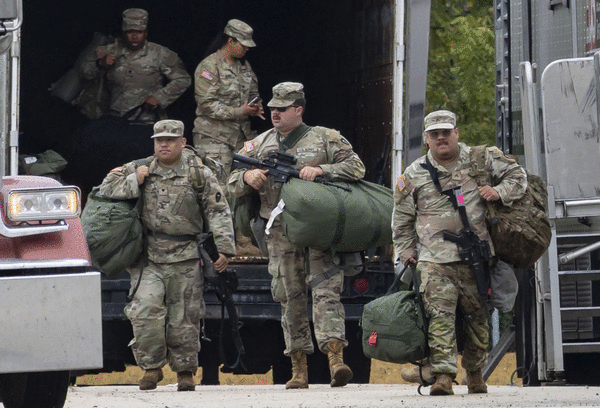
CHICAGO — Nearly seven months after federal troops were preparing to deploy to Chicago during Operation Midway Blitz, a federal judge on Monday granted a motion to dismiss the state’s lawsuit over the mobilization amid assurances that the presidential orders have been rescinded.
In making her ruling, U.S. District Judge April Perry said that even though President Donald Trump had threatened on social media to “come back” to Chicago with troops eventually, she cannot issue “advisory opinions” about hypothetical orders that might happen in the future.
The judge also noted that the “facts on the ground have changed substantially” since last fall, when hundreds of federalized troops were poised to help protect federal agents as they carried out deportation operations in the Chicago area.
“Things in Chicago are calm,” Perry said. “They have been calm for many many months, and while that certainly could change in the future, there is no threat of that happening anytime soon.”
The decision ends litigation that made national headlines in early October at the height of Operation Midway Blitz. After the Illinois attorney general and city of Chicago filed suit, Perry held a daylong, emotionally charged hearing on Oct. 9 that ended with her issuing a historic restraining order blocking the deployment.
Months later, the U.S. Supreme Court denied a request from the Trump administration to allow the Republican president to deploy troops to Illinois streets while the court battle played out, saying they had “failed to identify a source of authority that would allow the military to execute the laws in Illinois.”
On Monday, attorney Christopher Wells, who represents the state, argued that even though the original deployment orders have been revoked, Illinois was “still under threat” and subject to the whims of the president and Secretary of Defense Pete Hegseth.
“The president has not not rescinded the memoranda and has said he will come back,” Wells said, referring to a post Trump made on Truth Social in December. “They have never fully disavowed or stepped away from the course of conduct that gave rise to this case.”
Stephen Tagert, an attorney for the Department of Justice, said the lawsuit should not proceed to a final permanent injunction since the orders authorizing the National Guard deployment “will not be used again” given the Supreme Court’s decision.
“These orders are no longer operative,” Tagert said. “The National Guard is completely gone, and the case is moot.”
After the ruling, Attorney General Kwame Raoul said in a written statement he was “pleased” the court declared the Trump administration’s “unlawful orders defunct.”
“The American people, regardless of the city or state in which they reside, should not live under threat of military occupation simply because they live in a jurisdiction that has fallen out of a president’s political favor,” Raoul said. “I am proud of the attorneys from my office who diligently fought to uphold the rule of law, because in Illinois, we recognize that the Constitution is not merely a suggestion.”
Gov. JB Pritzker also issued a statement applauding Raoul’s efforts in court and claiming a win, saying he was “grateful” to the judge for “siding with our communities and slowing the erosion of our democratic norms.”
“While this is an important result, we know that the Trump Administration will continue to test the limits of its power no matter the cost to our communities,” Pritzker said.
When the lawsuit was originally filed in October, Operation Midway Blitz was in full swing, with near-daily clashes between immigration agents and protesters on the streets and outside the Immigration and Customs Enforcement facility in suburban Broadview.
At the time, National Guard troops from Illinois and Texas had already been “federalized” and were assembling at bases for imminent deployment. Since then all Illinois National Guard troops have been demobilized and sent back to their original assignments.
Since the Supreme Court’s ruling, both sides attempted to hash out a settlement to avoid a lengthy hearing on a permanent injunction, but none was ever reached.
In advance of Monday’s hearing on the government’s motion to dismiss, Perry asked the lawyers to address several key questions, including “to what extent a Presidential Memorandum is time-bound and/or capable of being rescinded” as well as any time limits on Hegseth for to implement such orders.
Tagert told the judge in court that Hegseth entered an oral command ending the federalization of Illinois troops on Dec. 31, followed by a written order a few days later that he said he could not put on the public docket because it contained sensitive information.
Perry then called the parties into her chambers for a brief review of the Hegseth order before making her ruling, in which she read part of it into the record. She said the memorializing of the defense secretary’s order in writing, along with the “time-bound” elements of the president’s original memoranda, meant there were “no viable” or active orders for the parties to litigate.
“The court cannot provide ongoing protection against hypothetical acts in the future,” she said.
The dismissal of the lawsuit was set in motion on Dec. 23, when a divided opinion handed down by the conservative-majority Supreme Court represented a significant political victory for Pritzker and other state Democratic leaders in their escalating battle with the White House’s plans to federalize troops on U.S. soil to assist in mass deportation efforts.
“At this preliminary stage, the Government has failed to identify a source of authority that would allow the military to execute the laws in Illinois,” the high court’s order said. “Thus, at least in this posture, the Government has not carried its burden to show that (the law) permits the President to federalize the Guard in the exercise of inherent authority to protect federal personnel and property in Illinois.”
Three of the court’s conservative justices, Clarence Thomas, Samuel Alito and Neil Gorsuch, lodged dissents, with Thomas and Alito writing that the court “has unnecessarily and unwisely departed from standard practice.”
But even those dissents seemed to indicate Trump would have a tough legal road should he try to invoke the Insurrection Act or other constitutional authorities to deploy the National Guard against the wishes of a state.
Gorsuch wrote in his dissent that while he would have granted a stay as a preliminary matter, there were “gravely consequential questions concerning what roles the National Guard and U.S. military may play in domestic law enforcement.”
“When, if ever, may the federal government deploy the professional military for domestic law enforcement purposes consistent with the Constitution?” Gorsuch wrote.
A week after the ruling, however, a defiant Trump posted on social media that he was ordering the National Guard removed from Illinois, but threatened to return.
“We will come back, perhaps in a much different and stronger form, when crime begins to soar again – Only a question of time!” the president wrote.
Perry said Monday that the president’s posts had no real bearing on her decision to dismiss the suit.
“I honestly don’t know what to make of those particular social media messages,” the judge said. “Given that the messages on the whole are about general crime control…I find that they are not helpful enough for me to find that any particular exception applies based on them.”
_____
©2026 Chicago Tribune. Visit chicagotribune.com. Distributed by Tribune Content Agency, LLC.




Comments