Potomac named most endangered river as sewage spill, data centers loom
Published in News & Features
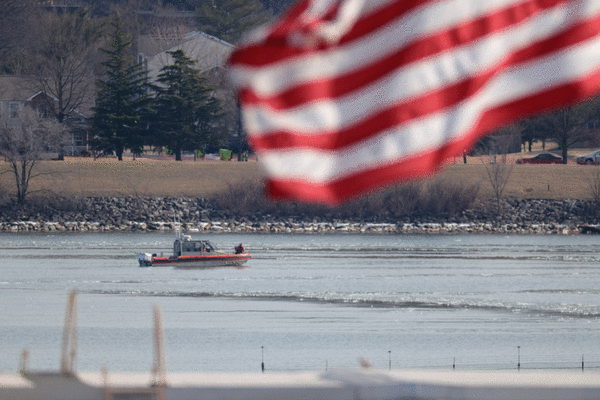
The Potomac River was named the most endangered river in the United States in a new report by American Rivers, which pointed to a massive sewage spill this winter and the growing footprint of data centers in Maryland and Virginia.
The report cited the Jan. 19 collapse of the Potomac Interceptor, which state and federal agencies have said released an estimated 243 million to 300 million gallons of untreated wastewater into the river. American Rivers and Potomac River advocates cast that disaster, along with fast-moving data center growth, as evidence that the river is under mounting strain.
“As the backdrop to our nation’s capital, the Potomac should reflect the highest standards of water health and stewardship,” Pat Calvert, Virginia conservation director for American Rivers, said in a release Tuesday. “The Potomac is at an inflection point and cannot continue to sustain the rapid expansion of water-guzzling data centers drawing from its waters. Act now or watch this river be detrimentally redefined for the everyday citizen that depends on it.”
Betsy Nicholas, president of Potomac Riverkeeper Network, said the sewage spill exposed broader vulnerabilities in a region that depends heavily on the Potomac for drinking water.
“What it did is spotlight to us how vulnerable we are, particularly with respect to our drinking water in this region,” Nicholas said. “This giant overflow happened just five miles below our drinking water intake for more than five million people … showing us that the infrastructure failure really does pose a significant threat to our health, our drinking water, our businesses.”
Nicholas also called the region “ground zero for data centers” and said Maryland and Virginia are allowing the industry to expand faster than regulators are studying its long-term effects on water quality and water supply.
But state and federal officials pushed back on the idea that the Potomac’s current condition is captured fully by the “most endangered” label.
In a statement, the Maryland Department of the Environment said the Potomac is “healthier today than it was a generation ago,” citing long-term pollution reductions tied to the Clean Water Act, wastewater treatment upgrades and restoration work across the watershed. The agency also pointed to Potomac Riverkeeper Network’s own 2024 “Swimmable Potomac” report, which found the river was safe for human contact more than 70% of the time on average across monitored sites over five years.
MDE said the interceptor collapse was serious but “an acute, localized incident,” and argued that data center growth is not happening without oversight. The agency said such projects face permitting and review tied to air quality, stormwater, wetlands, waterways and other environmental standards.
The U.S. Environmental Protection Agency likewise said ongoing sampling indicates contamination has remained localized near the collapse site and that drinking water for the D.C. metro area has not been significantly affected because water intakes are upstream. EPA says emergency repairs were completed March 14, ending use of the bypass, and that the agency took over daily sampling in mid-March, with testing set to continue through at least May 1 and results posted publicly through D.C.’s monitoring page.
The debate is also playing out in Annapolis.
Marc Korman, chair of the House Environment and Transportation Committee, said lawmakers in December overrode a veto of a 2025 bill requiring a statewide study of data center impacts, including environmental and water-quality effects. Under that law, the final report is due to the governor and General Assembly by Sept. 1.
Korman also pointed to this year’s Utility RELIEF Act, which passed the General Assembly on April 13 and includes new large-load customer registry requirements. Legislative analysts say that the registry will require disclosure to the Public Service Commission of information, including a data center’s intended energy source and estimated water use.
“I think I can safely say that we are open to further action based on the September 1 report and other developments that occur between now and a future legislative session,” Korman said.
_____
©2026 Baltimore Sun. Visit baltimoresun.com. Distributed by Tribune Content Agency, LLC.






Comments