Maryland session takeaways: Relief now, tough choices later
Published in News & Features
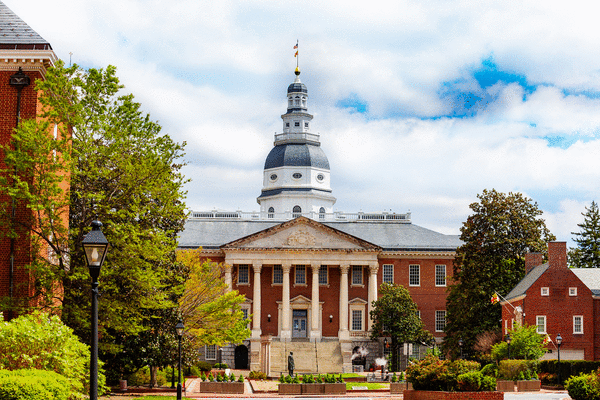
BALTIMORE —Maryland lawmakers probably face this question every January at the start of the General Assembly session: What can we bring home to our constituents in April to justify those 90 days in Annapolis?
This year, the question loomed particularly large for two reasons: The spiking utility bills that stand in for a broader affordability crisis concerning those constituents, and the coming election in November that could serve as a referendum on how well officeholders addressed those and other concerns.
“In the end,” said Todd Eberly, a political science professor at St. Mary’s College, “it’s about getting through the session without adding more pain.”
Eberly is among observers who think that Gov. Wes Moore and the Democratic-majority General Assembly can say that this year, they balanced the state budget, provided some energy relief, and took on national issues like immigration and redistricting — even if they saved for later years some bigger, structural funding issues.
“You put your head in the sand, and kick the can down the road,” said David Brinkley, a Republican and former budget secretary and state senator. “It’s like you’re at the bar, and it’s time to settle the bill. They left that for the next administration and the next legislature.”
The just-completed General Assembly session will likely be remembered for issues it spent the most time on, including a wide-ranging energy bill that promises at least $150 in annual savings for customers and more for those in lower income brackets, and limitations on how much local law enforcement cooperates with federal immigration agents, cracking down on those here without proper documentation.
While Maryland has not seen the level of immigration enforcement as, for example, Minnesota, it’s important to address the issue in a Democratic-majority state like Maryland now and for the future, said Flavio Hickel, an assistant professor of political science at Washington College in Chestertown.
“It’s like any policy issue: It’s always better to have a plan in place before an emergency happens,” Hickel said.
He said voters also want to see their elected officials acting on economic issues, even in a limited fashion.
“In broad strokes, there is only so much state and local government can do about the economy,” he said, with inflation, gas prices, and other pressure points as a result of federal policies and actions.
Michael Sanderson, executive director of the Maryland Association of Counties, said that while opinions differ on whether legislators did enough to contain costs, at least the issue was front and center in a relatively expensive state.
“Maryland is having some introspection on the cost of living here,” he said. “At the moment, electric bills are the most visible part of that.”
Sanderson said the governor and lawmakers made inroads on chipping away at the issue of housing affordability, and balanced the budget not by increasing taxes or fees but by shifting money from various funds that serve as “couch cushions” for finding extra millions.
David Lapp, who is the appointed people’s counsel, represents consumers’ interests in utility matters, said that while he didn’t get everything on his wish list, the energy bill will provide relief for ratepayers, particularly as it builds on last year’s session.
“I think it substantially improves aspects of last year’s bill,” Lapp said, citing aspects that would provide both short- and longer-term savings.
The surcharge that utility customers pay to help the state realize its greenhouse gas and energy efficiency goals will go down, although how much depends on factors like consumption, he said. The bill also addresses larger issues such as data centers, which put a strain on the energy system, and how utility rates are set, both of which should have payoffs down the road, Lapp said.
Environmental groups largely lauded the energy bill, although some expressed concerns about the effect on Maryland’s climate goals.
The Maryland organizer of the group, Food & Water Watch, decried the utility bill for facilitating the entry of data centers, which it criticizes for using too much energy and water.
“Governor Moore and the legislature traded short-term gains for long-term pains,” Jomar Lloyd said in a statement. Lloyd called the bill “counterintuitive to the aim of lowering electricity bills and will cost Marylanders much more over the long run.”
The Maryland Chamber of Commerce said it engaged in more than 150 bills this session, and pointed to successes in such areas as stopping minimum wage proposals and promoting long-term economic growth.
“But this moment is about more than what happened this session,” the chamber said in a session wrap-up email it sent out. “As we approach a new election cycle, the decisions ahead will shape Maryland’s economic future for years to come. And no matter the outcome, our role remains the same: To advocate. To engage. And to lead. Because if business can’t compete, Maryland can’t compete.”
Moore, Senate President Bill Ferguson, and House Speaker Joseline Peña-Melnyk, all Democrats, touted the session as successful, pointing to bills that advanced their affordability goals.
While it got less attention than the energy bill, Moore highlighted what he called a comprehensive economic development plan, including one that provides up to $2 million in matching grants to support high-growth industries, as well as protections for consumers against predatory pricing.
“This session we faced extraordinary pressures, but together with the Maryland General Assembly, we delivered real results for the people of Maryland,” Moore said in a statement.
State Republicans, however, called the session a lost opportunity, saying in a statement that the energy bill savings would be “minuscule” and Marylanders would get “no income or property tax relief.”
“This election-year budget simply moved money around and contained no spending reforms” to major the state’s Blueprint education initiative or Medicaid, said a statement from House Republicans, “both of which drive the bulk of our projected budget deficits.
“Maryland’s Democratic majority,” it said, “is far too focused on [Washington] and national politics.”
Whether or not that’s the case, Eberly said elections such as this November tend to turn on just that.
“Midterm elections,” he said, “become referendums on the incumbent president.”
________
©2026 The Baltimore Sun. Visit at baltimoresun.com. Distributed by Tribune Content Agency, LLC.






Comments