Israel hails Lebanon talks despite slim chances for breakthrough
Published in News & Features
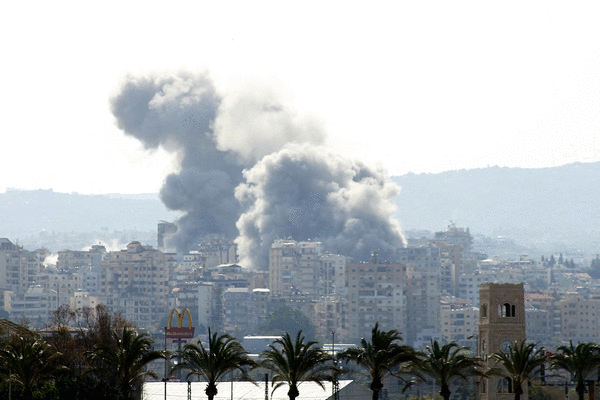
Israel and Lebanon met for their first high-level talks in more than 30 years in what the Israeli ambassador to the U.S. called a “victory for sanity,” even as officials played down hopes for an end to the war with Hezbollah.
The Israeli and Lebanese ambassadors to Washington met under U.S. mediation for “productive discussions on steps toward launching direct negotiations between Israel and Lebanon,” State Department spokesman Tommy Pigott said in a statement Tuesday. No date or time was set for another round.
The two sides hailed the fact that they were meeting face to face for the first time since 1993. But any hopes of Israel easing its military campaign against its neighbor were low given that Hezbollah — a political party that’s also one of the world’s most powerful militant groups — wasn’t involved.
A sustained war in Lebanon risks undermining U.S. President Donald Trump’s attempt to wind down a parallel conflict with Iran, the main sponsor of Hezbollah. But Israel has only escalated its campaign in the days since the U.S. and Iran agreed to a two-week ceasefire on April 7.
“This was a victory for sanity, for responsibility and for peace, because the head of Hezbollah warned the government of Lebanon yesterday not to participate in these talks,” Israeli Ambassador Yechiel Leiter told reporters in Washington. “This is the beginning of a very strong and fortified, consistent battle against Hezbollah.”
Secretary of State Marco Rubio said before the talks began that a solution would not be reached in a matter of hours but the talks could provide a “framework” for lasting security.
“This is a historic opportunity” to achieve not just a ceasefire, but “a permanent answer to 20 or 30 years of Hezbollah’s influence in this part of the world,” he told reporters on Tuesday.
Israel invaded Lebanon last month after Hezbollah fired rockets at Israel in solidarity with Iran, then under an intense U.S.-Israeli bombardment. The Israeli offensive has killed more than 2,000 people in Lebanon and displaced at least 1 million more, according to the Lebanese government.
Israel has said it will take control of large swaths of southern Lebanon and prevent more than 600,000 residents from returning. Two Israeli civilians and 13 soldiers have been killed in the fighting with Hezbollah. The group’s attacks have frequently forced Israelis in the north into shelters.
“There is now an available opportunity to reach a sustainable solution, which is what Lebanon wants,” Lebanese President Joseph Aoun said late Monday, referring to talks with Israel. “But this cannot be one-sided. Israel must respond to the Lebanese, Arab, and international calls to stop its aggression against Lebanon.”
Hezbollah’s strikes on Israel ended a fragile ceasefire between the Islamist group and the Jewish state that began in late 2024. The Lebanese government pledged to disarm Hezbollah as part of that agreement, though it hasn’t done so, a source of deep frustration for Israeli Prime Minister Benjamin Netanyahu and his government.
With the latest negotiations, Lebanon wants a ceasefire before discussing longer-term issues. Israel has refused to pause attacks on Hezbollah and demanded the group disarm.
_____
©2026 Bloomberg L.P. Visit bloomberg.com. Distributed by Tribune Content Agency, LLC.






Comments