Venezuelans detained in El Salvador face stigma, even after going home free
Published in News & Features
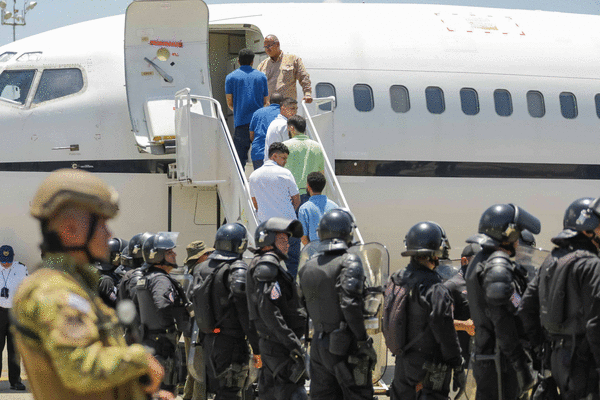
A year after being deported from the United States to a maximum-security prison in El Salvador, many of the 252 Venezuelans sent away are still dealing with stigma and uncertainty about their future, despite being back in their home country.
“People don’t trust us because of the way we were brought from El Salvador,” said Frengel Reyes, who was jailed in El Salvador after being arrested during an immigration check-in in Tampa, Florida.
The group was released and sent back to Venezuela as part of a prisoner swap between the Trump administration and the Venezuelan government in July.
The group was accused of being members of Tren de Aragua, a gang the United States designated as a foreign terrorist organization. The situation sparked concern in Florida, home to one of the largest Venezuelan populations in the country. About 400,000 Venezuelans live in the state, according to U.S. Census estimates.
Laura Quintero, a Venezuelan American immigration attorney who represents clients in Tampa and Central Florida, said the group was denied fundamental procedural safeguards and now should be allowed to defend their rights.
One of them is Luis Carlos José Marcano, 27, of Bradenton, Florida. He was sent to El Salvador after being arrested in Tampa in February 2025 during an immigration appointment. A friend of Marcano in Tampa, who preferred not to disclose their name because they do not have permanent legal status, told the Tampa Bay Times that he’s in contact with a local human rights group to clear his name. Marcano lives and works in construction on Margarita Island with his girlfriend and two daughters.
A report by Human Rights Watch and Cristosal found that the Venezuelans were abused almost every day in El Salvador. The report documented physical and psychological abuse and some cases of sexual assault. Noah Bullock, executive director of Cristosal, said the group of Venezuelans “disappeared into a legal black hole in El Salvador.”
In February, a federal judge ordered the Trump administration to allow the Venezuelans to challenge their cases. Two weeks ago, the League of United Latin American Citizens and the Democracy Defenders Fund filed a lawsuit on behalf of the first Venezuelan who was jailed in El Salvador, Neiyerver Adrián Leon Rengel, 28. He’s seeking more than $1.3 million in compensation.
The Department of Homeland Security didn’t immediately respond to a request for comment, but White House spokesperson Abigail Jackson called the ruling “absurd and unlawful,” The Associated Press reported.
Reyes, 25, entered the United States in December 2023 through the southern border with his wife and his stepson, who are still living in the U.S.
Reyes was detained in February 2025 and deported a month later. He told the Times that his wife is working with local nonprofits to build his legal case and try to bring him back to the United States.
Another Venezuelan, Edwin Meléndez, 30, was detained in October 2024 in Calexico, California, during an immigration raid. He was transferred to the Río Grande Processing Center in Texas and later deported to El Salvador.
From his hometown of Siquisique, in the Venezuelan state of Lara, Meléndez told the Times via WhatsApp he’s receiving assistance from human rights groups and an immigration lawyer in the U.S. to clear his name and those of others.
“We want the whole world to know that we are innocent,” Meléndez said. “We were just immigrants treated in a way that not even animals deserve.”
Meléndez carries the stigma of having been labeled a gang member. In his hometown, he said many discriminate against him because they know he was in prison and “still believe what those governments said.”
“Nothing that happens will change everything we went through, because it is something that will remain marked in our lives,” Meléndez said.
Juan Pappier, the Americas deputy director at Human Rights Watch, said they have no indication that the Trump administration has taken steps to return the Venezuelans to the United States. It has also not taken steps to ensure they have a “meaningful” opportunity to finalize their asylum proceedings, he said in an email.
“These men were subjected systematic torture in El Salvador and are entitled to redress,” said Pappier.
Reyes, the Venezuelan man arrested during a check-in in Tampa, has been living at his mother’s house for eight months. He’s unemployed and has been rejected many times while looking for a job because of the bad publicity the group faced, he said.
His neighbors and others in his town saw images of former Homeland Security Secretary Kristi Noem touring the prison in El Salvador last year. Many remember that. But he said he never saw Noem because she went to the area where criminals and members of Tren de Aragua and Mara Salvatrucha were held, not the group of immigrants.
“For all of us, it has been a bad experience,” said Reyes.
©2026 Tampa Bay Times. Visit at tampabay.com. Distributed by Tribune Content Agency, LLC.






Comments