Lawmaker blasts King Charles for avoiding Epstein victims on US trip
Published in News & Features
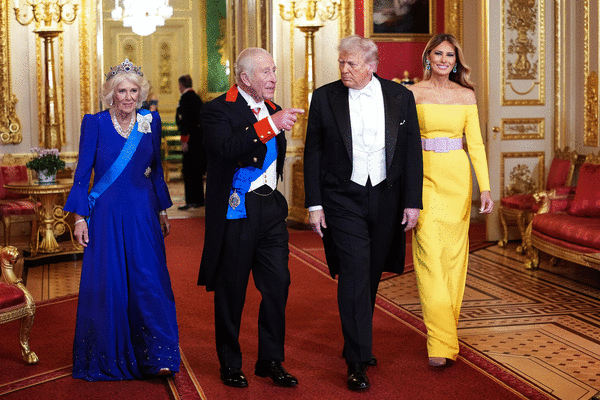
A California congressman has raised the diplomatic stakes for King Charles’ visit to the United States later this month by calling out the British monarch for refusing to meet with survivors of Jeffrey Epstein’s alleged sex-trafficking operation.
In an interview with the Times of London over the weekend, U.S. Rep. Ro Khanna, D-Calif., reminded the king of the royal family’s connections to the Epstein scandal, via his younger brother, the disgraced former Prince Andrew. Khanna told the Times that the king could have used such a meeting to show “that the modern monarchy is going to be a force for public good.”
“This could be a defining moment for the monarchy to keep it relevant to my generation in the 21st century,” Khanna said. “My grandfather was jailed by the British monarchy — he spent four years in jail in the 1930s and 1940s as part of Gandhi’s independence movement. My generation and those younger don’t have much tolerance for institutions that feel they’re apart from democratic society or above norms.”
Khanna introduced the Epstein Files Transparency Act last year to force the U.S. Department of Justice to release all unclassified records related to Epstein, the late financier and friend of the rich and powerful who was indicted on federal sex trafficking charges in 2019 before dying in a reported suicide. Last week, Khanna, a Silicon Valley Democrat, wrote an open letter to the king, calling on him to meet these survivors while he’s in the United States to visit President Donald Trump, attend a state dinner at the White House and help in celebrating America’s 250th year of independence.
Khanna said “survivors want this meeting” because it could lead to additional information about the sex-trafficking network led by the convicted pedophile and his accomplice Ghislaine Maxwell. Khanna also said it was important for the survivors to speak to the king “directly about the ways powerful individuals and institutions failed them.”
The meeting would furthermore ensure that “survivors are heard directly and that these matters are addressed with transparency, seriousness and accountability,” Khanna wrote. In his letter, Khanna also noted that he and other members of Congress have sought testimony from the king’s brother, Andrew Mountbatten-Windsor, regarding his ties to Epstein.
But the king’s office quickly declined Khanna’s request, the Daily Beast’s royal editor Tom Sykes reported. The official line coming from Buckingham Palace is that the king would not want such a visit to impact ongoing Epstein-related police investigations in the U.K., including those involving his brother, according to the Times. The king’s visit also is organized at the behest of the U.K. government.
Mountbatten-Windsor was a longtime Epstein friend who was accused of sexually assaulting Virginia Giuffre, one of Epstein’s teenaged victims, in 2001. Giuffre died by suicide last year. Mountbatten-Windsor has denied he sexually assaulted Giuffre. He also claimed in a 2019 BBC interview that he never met her and had cut off ties to Epstein in 2010.
But emails released in the Epstein files show that the former Duke of York continued to maintain contact with Epstein and that he allegedly shared confidential government information with Epstein while serving as a U.K. trade envoy from 2001 to 2011.
Mountbatten-Windsor was arrested on Feb. 19 on suspicion of misconduct in public office. Following his arrest, the king and his wife, Queen Camilla, issued a statement expressing concern about their relative’s “conduct” and offering their support for Epstein’s victims, People reported.
The king and queen said in the statement that they stood ready to support the police in their investigations and, “as was previously stated, their majesties’ thoughts and sympathies have been, and remain with, the victims of any and all forms of abuse.”
Khanna said he didn’t buy the excuse that the king and queen couldn’t meet with Epstein’s victims, especially after the king and queen publicly offered them their support.
“That’s typical staff,” Khanna told the Times. “The staff always says no. My hope is that the king will look at this from the perspective of his historical legacy.”
Khanna pointed out a major challenge the king is likely to face during his U.S. visit, especially if he’s in any situation where he must interact with the U.S. press or public. Trump also faces questions about his ties to Epstein, given that he was once a good friend of the financier through the early 2000s.
“(The king is) either going to come to America and half the questions are going to be about Epstein — what did the palace know and how often did Epstein go there and what are the documents and why didn’t they speak out earlier? — or he could come here and take a role as a global statesperson by meeting with these survivors privately and just acknowledging their pain, acknowledging that they were denied justice, and calling for accountability in Britain and around the world,” Khanna said.
If the king truly wants to be seen as a respected world leader who stands for justice, he should meet with the survivors, Khanna added. “I think if he doesn’t do that and he comes here on the 250th anniversary of America — that stands for fairness and equality and was a revolution against the idea that some people have more power than others — then he looks out of touch,” Khanna said. “And it diminishes the credibility of the monarchy for future generations.”
If it truly is not possible for the king to meet with the survivors, he could at least use his scheduled address to Congress to offer his support for them and for the cause of transparency on Epstein’s operation.
“One thing that the king could do in his remarks to Congress is to acknowledge the importance of the Epstein Transparency Act that we passed,” Khanna said. The king could also encourage the United States to take a leading role in pushing for transparency. “Him making those remarks as part of his address to Congress, I also believe would go a long way.”
The king’s visit is likely to be challenging in other ways, according to Sykes and other royal experts. On the personal front, the 77-year-old monarch is still undergoing treatment for cancer and will face questions about not seeing his estranged son, Prince Harry, who is now based in California.
But in terms of the monarchy’s reputation, the king’s visit also is risky because he could be allowing himself to be seen in a presumably friendly photo ops with Donald Trump, a divisive American president who has launched a war against Iran that the British public does not support. British politicians on all sides of the political spectrum have voiced opposition to the trip, as the Daily Mail reported.
A recent readers’ poll by the Daily Mail also showed that close to 60% of respondents opposed the trip, citing concerns about the king being used to flatter the “ego” of an “unstable” and “narcissistic” Trump.
As noted by Sykes on his Royalist Substack, Trump also was given lavish treatment during his state visit to Britain in September, but “the political return has been non-existent,” as Trump has continued to lash out at the British government and at Prime Minister Keir Starmer for refusing to support his war against Iran.
While the British government seems intent on preserving the “so-called special relationship” between Britain and the United States, Sykes said that sending the king to Washington “risks rewarding Trump’s volatile style at a moment when the war in Iran has made the wider international situation deeply dangerous.”
_____
©2026 MediaNews Group, Inc. Visit at mercurynews.com. Distributed by Tribune Content Agency, LLC.



Comments