Trump warns Iran it has 48 hours left as airman remains missing
Published in News & Features
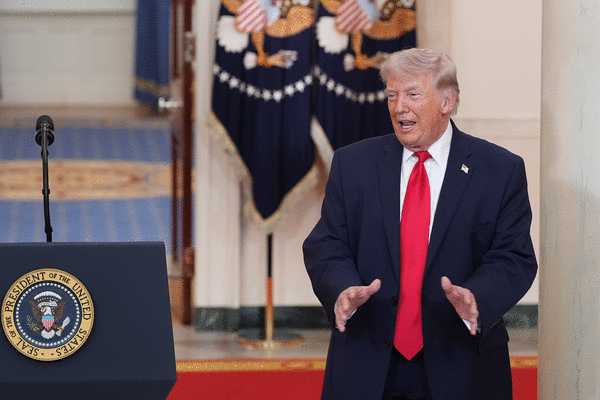
President Donald Trump said Saturday that time was running out on his 10-day deadline for Iran to make a peace deal with the U.S. and threatened that the Islamic Republic would face “all hell” in 48 hours.
“Remember when I gave Iran ten days to MAKE A DEAL or OPEN UP THE HORMUZ STRAIT,” Trump said in a social media post the day before Easter. “Time is running out — 48 hours before all Hell will reign down on them. Glory be to God!”
Trump had extended a five-day deadline to April 6 as preliminary discussions for peace talks got under way in late March. As attacks intensified from all sides, including Iran’s downing of two U.S. military aircraft, Trump’s rhetoric has hardened from his recent attempts to find a way out of the growing conflict.
Trump has warned that if Iran doesn’t agree to his terms — which the government has rejected — and open the Strait of Hormuz to all shipping traffic out of the Persian Gulf, the U.S. would bomb the country’s civilian energy infrastructure, strikes that would likely constitute a war crime under international law.
Missing pilot
In Iran, the U.S. continued search-and-rescue operations for a crew member from an F-15E fighter jet shot down by Iran on Friday, as Tehran kept up attacks on Gulf Arab states and Israel.
A second U.S. combat plane reportedly crashed in the Persian Gulf the same day. The incidents mark a significant blow for Washington as the war enters its sixth week with energy prices rising and little sign of an end to the conflict.
Trump declined to discuss the search-and-rescue operations in an interview with NBC News on Friday. He said the events wouldn’t affect any peace negotiations with Iran, according to a reporter who spoke to him on a call.
On Saturday, Iran said U.S.-Israeli strikes hit petrochemical plants and forced the evacuation of a large industrial zone. Other attacks targeting the perimeter of Iran’s Bushehr nuclear power plant left one security staff member dead, Iran’s semi-official Tasnim news agency reported. The main sections of the facility, where Russia’s state nuclear company Rosatom has workers, were unaffected, Tasnim said.
Iran continued to fire missiles and drones across much of the Middle East. Dubai authorities reported that debris from an aerial interception fell on the facade of an Oracle Corp. building in Dubai Internet City on Saturday morning. They also reported debris hitting a building in the nearby Dubai Marina area. No fire or injuries were reported.
Iran fired more missiles at Israel. There was damage to a parking lot in Tel Aviv and to buildings in several outlying towns, authorities said, describing the impacts as caused by debris from interceptions. There were no immediate reports of casualties.
The downing of the U.S. jet came despite Trump’s claim in a prime-time address on Wednesday that Iran no longer had anti-aircraft equipment. His military commanders, as well as Defense Secretary Pete Hegseth, have previously touted U.S. air superiority over Iranian territory.
It’s the first known combat loss of a U.S. or Israeli plane since the two countries began attacking Iran on Feb. 28. Three U.S. aircraft were downed by friendly fire in Kuwait early in the war, while others have been destroyed or damaged at airbases by Iranian drones and missiles.
The U.S. rescued one of the F-15 crew members, according to an American official who asked not to be identified discussing sensitive information. The status of the second person is unclear and Iranian media said Tehran offered a reward of about $66,000 to citizens who capture the person alive.
The lone pilot of the second plane — an A-10 Warthog — was safely rescued, the New York Times reported.
Iran hits energy plants
Iran has continued to hit key energy infrastructure in the past two days.
The UAE’s largest natural gas processing facility, Habshan, suspended operations after debris from a projectile interception sparked a fire. A drone attack set ablaze Kuwait’s Mina Al-Ahmadi oil refinery, which can process almost 350,000 barrels a day of crude.
The United Arab Emirates, of which Dubai is a member, said it detected 79 projectiles fired from Iran on Saturday, including 23 ballistic missiles. That was the highest number of projectiles since March 8, according to data published by UAE authorities, and continued a trend of more numerous attacks over the last three days.
The UAE, like other Gulf states and Israel, has intercepted the vast majority of Iranian attacks.
Israel’s military said it hit air defense sites and missile storage facilities in a wave of airstrikes on Tehran on Friday. Iran said U.S.-Israeli strikes hit a petrochemical zone in Mahshahr, in the southwestern Khuzestan province on Saturday. Authorities ordered the evacuation of all personnel and said any potential pollutants don’t pose a risk to nearby cities, the semi-official Fars news agency reported.
Peace efforts stall
Iran has shown little sign of accepting Trump’s demands for peace and has laid out its own conditions — most of them unacceptable to the U.S. and Israel.
The New York Times, citing U.S. intelligence reports, said Iranian personnel have been digging out underground missile bunkers and silos struck by American and Israeli bombs and returning them to operation hours after attacks. That casts doubt on the U.S. and Israel’s ability to destroy Iran’s missile capability — one of their key war goals.
Despite Trump’s weekend threat, the president signaled this week he may be willing to pull U.S. forces out of the conflict in two to three weeks, even if the Strait of Hormuz is still effectively shut.
U.S. allies are stepping up efforts to ensure the waterway — through which one fifth of the world’s oil and liquefied natural gas supplies normally flow — is reopened soon.
More than 40 of their foreign ministers met virtually on Thursday to discuss plans, signaling to Trump their concern about the closure.
On Saturday, Turkish President Recep Tayyip Erdogan said in a social media post that he spoke by phone with Mark Rutte, secretary-general of the North Atlantic Treaty Organization saying the situation was heading for a deadlock and “urged the international community to step up efforts to end the war.”
The group, convened by the U.K., was clear that any ceasefire talks with Iran needed to include a solution for Hormuz, people familiar with the discussions said. Still, the meeting, which the U.S. and Iran were not part of, showed the coalition of countries deem it necessary to prepare for having to reopen the strait without Washington.
Nations such as France and the U.K. have said military options are unlikely to work until there’s a ceasefire.
Bahrain, supported by Jordan and Arab Gulf states, is proposing a United Nations Security Council resolution aimed at helping reopen Hormuz, according to the UAE. It would provide “a clear legal basis for all states to mobilize and support safe passage,” the UAE said in a post on X.
It’s unclear when a vote on the resolution will take place.
Russia, an Iranian ally, pushed back on the initiative, with Foreign Minister Sergei Lavrov saying it would “legitimize aggression against Iran.” The comments signal Moscow may use its veto power, as one of five permanent members of the Security Council.
Ships trickle through strait
Iran appeared to tighten its grip on the strait on Thursday, when its media reported that the government is drafting a protocol with Oman to monitor traffic. That would require shippers to pay tolls to Iran, according to its deputy foreign minister.
The passage is officially in international waters and any attempt by Iran to assert control over traffic will be opposed strongly by Western powers and Gulf Arab states.
A trickle of ships is managing to pass through. A French container ship and a Japanese-owned tanker have crossed the Strait of Hormuz in the past two days, in what appear to be the first such transits since the war in Iran shuttered the crucial waterway.
The energy shock, which has seen gasoline pump prices in the country jump to more than $4 a gallon on average carries political risks for Trump and his Republican Party in the November midterm elections.
U.S. benchmark oil prices, or WTI futures, closed at more than $111 a barrel last week and have almost doubled this year.
More than 5,000 people have been killed in the conflict, almost three-quarters of them in Iran, according to government organizations and the U.S.-based Human Rights Activists News Agency. Just over 1,300 people have been killed in Lebanon, where Israel is fighting a parallel war against Iran-allied Hezbollah.
———
(With assistance from Dan Williams.)
©2026 Bloomberg L.P. Visit bloomberg.com. Distributed by Tribune Content Agency, LLC.






Comments