California sues to stop Trump's order curbing vote-by-mail
Published in News & Features
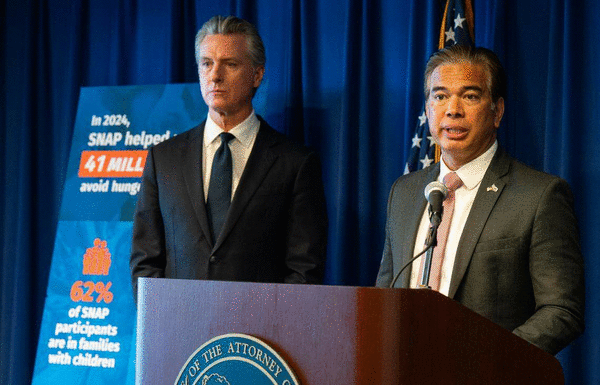
SACRAMENTO, Calif. — California filed its 66th lawsuit against President Donald Trump since he took office 62 weeks ago, this time challenging his executive order to create lists of federal voters to curtail mail-in voting.
On Tuesday, Trump ordered the Department of Homeland Security to create lists of eligible voters in every state and ordered the U.S. Postal Service to send mail-in ballots only to voters DHS and Social Security Administration officials deem eligible. On Friday, California Attorney General Rob Bonta and a coterie of 23 states and Pennsylvania Gov. Josh Shapiro filed a lawsuit in Massachusetts federal court challenging that order.
Trump has repeatedly taken aim at vote-by-mail, which he claimed is vulnerable to fraud, even as he recently cast his own Florida ballot via mail. He has pushed Congress to take up the SAVE Act, which would require people to show a U.S. passport or birth certificate when registering to vote. Elections experts say the bill would disenfranchise voters without ready access to those documents and married women whose documents reflect their names given at birth.
Bonta told reporters he was worried about where DHS would source its data to fulfill Trump’s order, which requires the agency to use “federal citizenship and naturalization records, SSA records, SAVE data, and other relevant federal databases” to create a list of eligible voters. DHS would then share those lists with state election officials and determine if every person on them is a citizen who maintained a residence in the state they’re registered to vote.
“Trump’s goal is clear: to upend our election system, create voter confusion, impose enormous costs on state agencies and undermine public trust, which is why we’re asking the court to put a stop to the specific provisions of Trump’s executive order,” Bonta said during an online news conference. “Every eligible voter should be able to vote, and every state and local elections official should be able to administer elections without fear of federal overreach or threats of prosecution.”
In a statement, Gov. Gavin Newsom said Trump was “lighting democracy on fire.”
“California will not sit idle while he tries to limit which American citizens can participate in our democracy,” he said. “No one is above the U.S. Constitution — see you in court, Mr. President.”
The federal administration has previously targeted some of the states that are suing to block Trump’s latest executive order. He has ordered probes or seized election records from states like Arizona and Georgia as part of an investigation into his 2020 election loss to Joe Biden.
Some of Trump’s election conspiracies have touched parts of California politics.
FBI Director Kash Patel recently reassigned agents in the bureau’s San Francisco office to prepare to publicly release files from a decade-old investigation about potential ties between a Chinese spy and Rep. Eric Swalwell, D-Calif., who is leading Democrats in the governor’s race. Swalwell, who the bureau previously cleared of wrongdoing in 2015, claimed Patel is carrying out Trump’s wishes to influence the governor’s race, a claim Bonta found “perplexing.”
“I don’t understand how that’s election interference,” he said.
Last month, Riverside County Sheriff Chad Bianco, a Trump supporter who is running for governor, seized 650,000 ballots from the 2025 special election. He claimed to be on a “fact-finding mission” after a local group of election skeptics claimed the local registrar of voters had inflated vote tallies. Bonta sued to stop Bianco’s probe, which is currently being litigated in a Riverside County court.
Riverside County Superior Court Judge Jay Kiel sealed the warrants to seize the ballots at Bianco’s request, which Bonta and a host of news outlets took issue with. Bianco previously endorsed the judge during his 2022 election campaign, and the two share political advisers and overlapping donors.
“We are very concerned about our observation that there appears to be no adequate basis for a search warrant, that there is no potential criminal conduct being identified, and no potential criminal perpetrator being identified in the search warrant or by the Riverside sheriff,” Bonta said.
“You cannot have a search warrant and a criminal investigation if you can’t identify a crime and a potential criminal. That is criminal law and criminal procedure 101.”
_____
©2026 The Sacramento Bee. Visit sacbee.com. Distributed by Tribune Content Agency, LLC.



Comments