TV magnate Raul Gorrín, wanted in Miami, detained in Venezuela's dreaded 'Tomb' jail
Published in News & Features
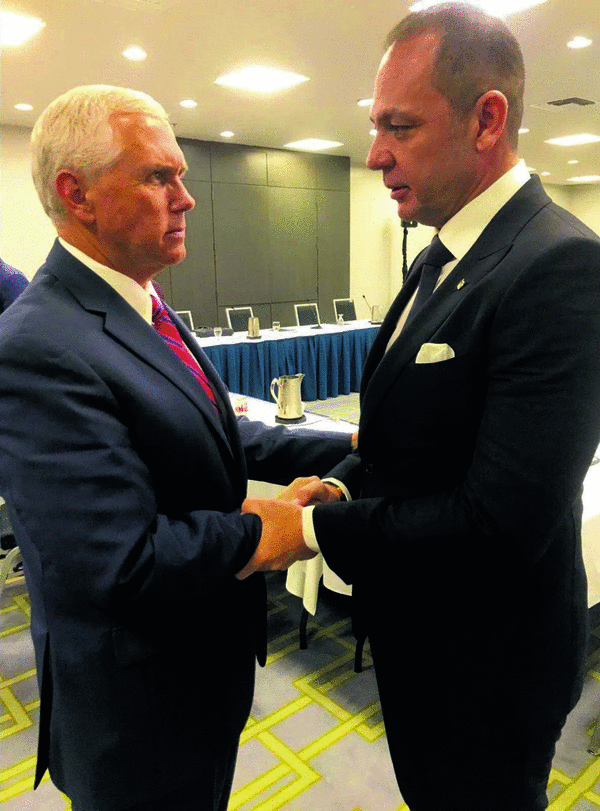
MIAMI — Raúl Gorrín, a wealthy Venezuelan businessman wanted for years in Miami on foreign corruption and money laundering charges, has been detained for several weeks in one of Venezuela’s most secretive and widely denounced detention facilities, three sources familiar with the situation told the Miami Herald.
Gorrín is being held in underground cells under a building run by Venezuela’s Bolivarian National Intelligence Service across from Plaza Venezuela — a site widely known as "La Tumba" — The Tomb.
“They’ve had him there for about three or four weeks,” one source said, speaking on condition of anonymity for fear of reprisals.
Gorrín’s detention in the facility, historically reserved for politically sensitive or high-profile detainees, has raised questions about the reasons behind his arrest and the internal dynamics of power in Caracas.
It remains unclear whether Venezuelan President Delcy Rodriguez, who replaced Nicolás Maduro after he was seized by U.S. forces in early January to face drug-trafficking charges, will allow his transfer to Miami, where he’s charged in two indictments. Venezuela and the United States do not have an extradition agreement, but the Trump administration has pressured Rodriguez to carry out several U.S. directives on oil, immigration and other key issues since she assumed the country’s leadership.
La Tumba is an unconventional prison. The complex is located five levels underground — roughly 50 feet below the surface — inside a structure originally designed as office space for the Caracas Metro system.
Since being converted into a detention facility following anti-government protests in 2014, it has been repeatedly denounced by national and international human rights organizations. Former detainees, lawyers and activists consistently describe it as a space of extreme isolation.
The cells, measuring roughly 6 by 10 feet, are completely sealed, with white walls, no windows and reinforced metal doors. Artificial lighting remains on 24 hours a day, while silence is nearly absolute — broken only occasionally by the distant rumble of passing subway trains.
Those conditions have led to the facility being associated with “white torture,” a term used to describe psychological pressure techniques designed to break detainees mentally without leaving visible physical marks.
Unlike the tropical climate above ground, temperatures inside the facility are kept deliberately low through centralized air conditioning systems, according to multiple testimonies cited in past reports. The cold environment, combined with constant lighting and minimal human contact, creates conditions that human-rights advocates say may amount to cruel, inhuman or degrading treatment.
Organizations such as Human Rights Watch and Amnesty International have previously documented cases of detainees describing extreme anxiety, depression, insomnia and cognitive deterioration after spending weeks or months in such confinement.
Gorrín’s detention adds a new chapter to the trajectory of one of the most influential — and controversial — businessmen in modern Venezuela.
The owner of television network Globovisión and long linked to financial operations involving the Venezuelan state, Gorrín has been identified by U.S. authorities as a central figure in large-scale corruption schemes.
For years, his name has surfaced repeatedly in investigations into transnational corruption, even as he maintained a visible presence within Venezuela’s media and business landscape.
In 2019, the U.S. Treasury Department sanctioned him for his alleged role in a money-laundering scheme involving billions of dollars tied to state oil company Petróleos de Venezuela, PDVSA. Federal prosecutors in South Florida later charged him with conspiracy to launder money and pay bribes to Venezuelan officials.
In October 2024, Gorrín was charged with conspiring to launder $1.2 billion that federal authorities say he and other associates stole from Venezuela’s government to invest in Europe and the United States, including luxury real estate in South Florida.
Gorrín is accused of plotting to bribe top officials at Venezuela’s state-owned oil company in exchange for access to lucrative government loan contracts, according to an indictment in Miami federal court.
Prosecutors say the loan payments were routed through the government’s preferential currency-exchange system, producing windfall profits.
Gorrín, once a close ally of the late President Hugo Chávez and of Maduro, was charged in Miami with one count of conspiracy to commit money laundering, which carries a maximum sentence of 20 years in prison if convicted.
His case grew out of a broader Miami indictment filed in 2018 that charged eight associates with looting PDVSA, including senior executives and lawyers. Since then, five additional defendants — including Gorrín — have been charged. About half have pleaded guilty and been sentenced, including several who provided evidence against Gorrín. Others remain at large in Venezuela or Europe.
Separately, in late 2018 Gorrín was charged in another massive money-laundering racket to drain more than $1 billion from Venezuela’s government and move the illicit money through U.S. banks and luxury real estate investments in Miami, Coral Gables and New York, according to another indictment in Miami.
The indictment charged Gorrín with conspiring to bribe Venezuelan officials, including former national treasurer Alejandro Andrade, who pleaded guilty and served prison time in the United States.
Gorrín has even played an absentee role as a potential witness in the ongoing Miami federal trial of former Miami-Dade Congressman David Rivera, who is accused of failing to register as a foreign agent for the government of Venezuela. According to trial evidence, Gorrín allegedly helped Rivera gain access to high-ranking Venezuelan officials, including Rodriguez, to land a $50 million contract representing the U.S. subsidiary of PDVSA in 2017.
Gorrín’s defense attorney, Howard Srebnick, could not be immediately reached for comment.
©2026 Miami Herald. Visit at miamiherald.com. Distributed by Tribune Content Agency, LLC.





Comments