Four months after record-setting hurricane, Jamaica prepares to move to reconstruction
Published in News & Features
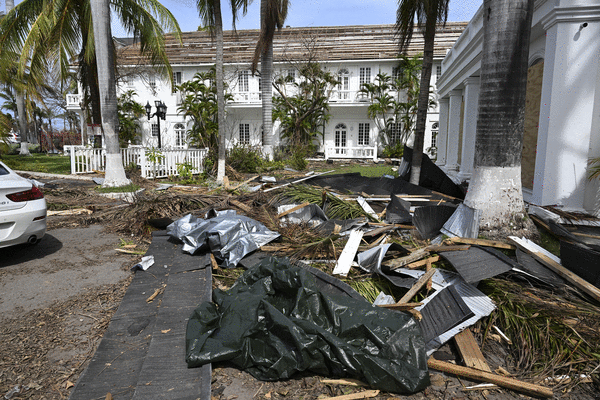
A battered Jamaica, which saw widespread damage and destruction from a record-setting Hurricane Melissa four months ago, will soon transition from recovery to rebuilding, Prime Minister Andrew Holness said.
“We’re going to close the recovery stage and move into the reconstruction phase,” he told the Miami Herald. “The reconstruction phase is where we will rebuild damaged infrastructure, build new infrastructure, and build or rebuild strategic infrastructure.”
Melissa killed 45 people and damaged tens of thousands of homes as well as health facilities and schools after making landfall a sa Category 5 hurricane near the town of Black River on Oct. 28, 2025. The storm also damaged or destroyed critical infrastructure, including roads and the power grid.
An estimated 1.6 million people—nearly half the population— across six parishes were affected. Preliminary estimates put the losses to infrastructure at $8.8 billion, about 40% of the country’s 2024 gross domestic product.
In addition to Jamaica, the storm left a trail of destruction elsewhere in the Caribbean as it battered southern Haiti and dumped 35 inches of rain over several days. The country experienced the highest rainfall totals associated with Melissa, with the most significant impacts concentrated across the southern peninsula, according to the National Hurricane Center’s post-storm analysis.. The storm also dumped rainfall in Puerto Rico, the southwest portions of the Dominican Republic, eastern Cuba, the Turks and Caicos Islands and the southern Bahamas.
Melissa made two landfalls in The Bahamas, the hurricane center said. The first was on Long Island near Buckley’s Settlement on Oct. 29 and the second was the following day on San Salvador Island.
In addition to unleashing intense winds, Melissa produced catastrophic flooding, destructive storm surge and widespread economic devastation. At least 95 deaths were recorded: 45 in Jamaica, 43 in Haiti; four in the Dominican Republic; one in Cuba and two deaths reported elsewhere.
Last week, as Holness attended a meeting of the Caribbean Community known as CARICOM in Saint Kitts and Nevis, the National Hurricane Center confirmed Melissa registered peaked sustained winds of 190 mph, tying Hurricane Allen’s 1980 record for the strongest winds ever measured in an Atlantic hurricane.
Holness said while a lot of progress has been made in helping the country recover, housing remains a significant challenge. He noted that more than 90,000 homes were damaged, and that repairs are “going to take some time.”
Among the programs launched to help storm victims are cash grants the government has put in place for homeowners. Restoration efforts are largely completed elsewhere, Holness said.
“We are 97% recovered in electricity and in water; 97% of all roads are open and areas are accessible, except those roads that had massive landslides or breakaway,” said the prime minister, who also shared the updates with members of Jamaica’s diaspora during a town hall meeting on Friday before departing Saint Kitts.
“Our repair program has started in earnest. So that situation should be rectified in the coming weeks,” he said.
Schools have reopened, although Holness acknowledged some children are learning in less than ideal conditions, and between 500 and 1,000 have still not been able to fully return to classes due to the destruction of their buildings.
During the opening of the CARICOM summit, Holness told regional leaders that “Melissa tested our people, our institutions, and our infrastructure.
“Yet the recovery now underway stands as a testament not only to Jamaican resilience, but to the strength of the Caribbean family,” he said, as he made an appeal for a more systematic approach to addressing climate shocks in the region and thanked fellow Caribbean governments for their aid after the storm.
©2026 Miami Herald. Visit at miamiherald.com. Distributed by Tribune Content Agency, LLC.






Comments