Minnesota autism center owner pleads guilty in massive social services fraud
Published in News & Features
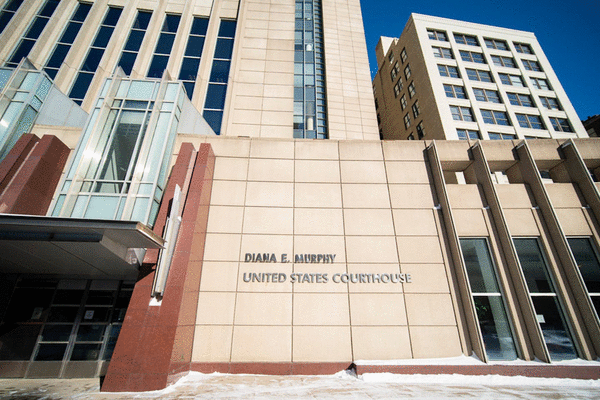
MINNEAPOLIS — Only a few months after opening Star Autism Center in St. Cloud, the business was billing millions of dollars in services.
But on Monday, March 2, its owner and founder Abdinajib Hassan Yussuf said the St. Cloud health care provider made up fraudulent claims to take advantage of one of the Minnesota social services programs now at the center of national controversy.
Yussuf, 28, pleaded guilty to wire fraud in federal court in Minneapolis — the fifth defendant to plead guilty out of 15 people charged so far in the Medicaid fraud case since last September. His plea agreement with prosecutors marked the latest development in a sprawling Justice Department investigation that has upended the state’s social service system, but other fraud cases could face delays owing to unprecedented turnover in the Minnesota U.S. Attorney’s Office.
Prosecutors said Yussuf founded Star Autism in August 2020. His business started charging for services by February 2021 to provide care for those 21 and younger with an autism or related diagnosis.
It was run by Yussuf, a community college dropout, plus other unqualified behavioral technicians with no relevant experience, according to prosecutors. Some of the employees were teenage relatives.
After starting Star Autism, prosecutors alleged, parents whose children did not have autism were recruited to sign up for services. Those parents received kickbacks to keep the children enrolled.
So far, no other charges have been filed against others with ties to the Star Autism Center.
It’s part of the massive federal investigation that outlines $34.2 million in social programs fraud. Authorities have said the dollar figure and the number of defendants will rise with time.
Officials with the Department of Human Services designated 14 programs as high risk after discovering issues with the state’s social services programs. One program was eliminated last year. Then, last month, a third-party study by UnitedHealth Group subsidiary Optum revealed $1 billion in vulnerabilities within those programs in a four-year period.
The scope of the fraud remains unknown. In December, Joe Thompson, formerly the lead white-collar crime prosecutor before his departure from Minnesota’s U.S. Attorney’s Office, estimated that more than half of the $18 billion spent over the course of seven years across 14 high-risk Medicaid programs could have been fraudulent. State officials dismissed the idea of $9 billion in fraud as speculation.
President Donald Trump has alleged that $19 billion has been stolen from Minnesota programs, without clear evidence, foundation or context.
Public attention has been consumed lately with the federal government’s deployment of thousands of immigration enforcement agents to Minnesota — dubbed Operation Metro Surge — and the fallout from it. As a result, the federal court system has been inundated with immigration cases. Nearly half of the lawyers in Minnesota U.S. Attorney’s Office have quit or retired since Trump’s return to office, stalling fraud investigations.
U.S. Attorney Daniel Rosen said during a news conference last week that his office is well equipped to handle fraud cases and its other regular duties. He also said such investigations are currently “increasing in pace” after the federal government sent reinforcement lawyers to help.
Meanwhile, some state leaders noticed signs of stress coming out of the federal prosecutors’ office. As the state Attorney General’s office asks Minnesota lawmakers for more money to fund its own specialized Medicaid fraud unit, Medicaid Fraud Control Unit Director Nick Wanka said last week his office continues to work cases in concert with the federal government.
“Some of them that we previously believed may be charged by the U.S. Attorney’s Office are in a little bit more of an uncertain state now,” Wanka said, adding that the state would help if necessary.
In all, Yussuf billed Minnesota’s Department of Human Services and nonprofit health insurer UCare more than $6 million, according to court documents. Prosecutors said Yussuf bought a semi-truck worth more than $100,000 and sent $200,000 to Kenya.
Yussuf admitted in court March 2 that the business submitted fraudulent and inflated figures. Among the examples: One employee claimed to work 270 consecutive days; another logged working 23 hours in a single day on two occasions.
During his plea hearing, Yussuf said “people that I know” approached him with the idea of starting a St. Cloud area autism care center. Yussuf did not know anyone who personally needed such services, he said, and personally did not pay kickbacks to parents.
“I was doing the paperwork and (working)] in the office,” Yussuf told the judge of his involvement with Star Autism Center.
Deborah Ellis, Yussuf’s lawyer, said Yussuf learned of the kickbacks only after the government brought its case against him. She said some of those conspirators were also partly responsible for paying back the more than $6 million federal investigators say Yussuf owes the government.
U.S. District Judge John R. Tunheim allowed Yussuf to remain free pending his sentence, with travel restrictions, except for delivering packages to the Hudson, Wis., area as part of his full-time job.
Yussuf could face up to more than five years in prison. Prosecutors said Yussuf’s sentencing hearing will need to wait until after charges are brought against his conspirators.
_____
©2026 The Minnesota Star Tribune. Visit startribune.com. Distributed by Tribune Content Agency, LLC





Comments