Starmer urges Europe to end reliance on Trump's America
Published in News & Features
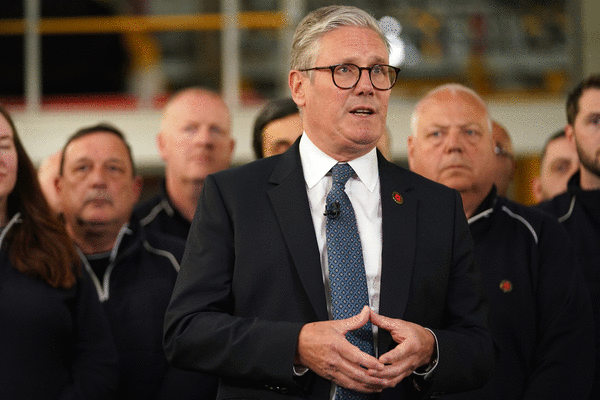
After a year of refusing to choose between Washington and Brussels, Keir Starmer will shift tone in Munich by edging Britain closer to the European Union and calling for an end to over-reliance on American military support.
In a speech he’s scheduled to make to the Munich Security Conference on Saturday, the U.K. prime minister will urge Europe to deepen its interdependence and sovereign deterrence in light of less support from across the Atlantic since Donald Trump returned to the White House.
British officials told Bloomberg that his language marks a sharper and more assertive stance than previously.
“I’m talking about a vision of European security and greater European autonomy, that does not herald U.S. withdrawal but answers the call for more burden sharing in full, and remakes the ties that have served us so well,” Starmer will say, according to excerpts of his speech provided by his office.
“We are not the Britain of the Brexit years anymore. Because we know that, in dangerous times, we would not take control by turning inward — we would surrender it. And I won’t let that happen. There is no British security without Europe, and no European security without Britain.”
Britain has acted as a bridge between the U.S. and EU since Trump reentered office last year. Starmer has attempted to balance good relations with the unpredictable president — to avoid the most punitive of tariffs and persuade him to continue supporting Ukraine — with the Labour government’s desire for a closer trading relationship with the EU six years on from Brexit.
However, Starmer’s strategy has been tested by Trump’s recent hostility toward Britain over his desire for Greenland, the temporary withdrawal of support for its Chagos agreement and the dismissal of its role in supporting the U.S. in Afghanistan. Although Starmer and other European leaders persuaded Trump to backtrack on his threats, the weeks of high stakes diplomacy sowed deep worry about the durability of the transatlantic alliance.
Starmer will double down on his promise of closer economic ties to the EU. He will say in Munich that the U.K. is eager to participate in joint projects alongside European partners to accelerate defense investment and integrate capabilities, arguing that Europe’s fragmented defense industrial base has contributed to gaps and duplication.
The U.K. is in talks with European allies about multinational defense borrowing as part of longer-term plans to help raise military spending, Bloomberg reported last month. They’re considering proposals to keep joint borrowing off the U.K.’s books especially in relation to stockpiling. That’s in the face of doubts over Britain’s ability to speedily ramp-up defense spending.
“As I see it – Europe is a sleeping giant. Our economies dwarf Russia’s, 10 times over,” Starmer will say. “We have huge defense capabilities. Yet, too often, all of this has added up to less than the sum of its parts.”
“Across Europe, fragmented industrial planning and long, drawn out procurement mechanisms have led to gaps in some areas – and massive duplication in others,” he will say.
There’s growing concern within the U.K. government that more protectionist policies being pursued by the EU — chief among them the bloc’s Industrial Accelerator Act with its “Made in Europe” provisions — could exclude British companies from supply chains in key sectors.
Chancellor of the Exchequer Rachel Reeves took a swipe against European Union plans for a “made in Europe” law, urging her counterparts on the continent to broaden the concept out to other like-minded countries.
©2026 Bloomberg L.P. Visit bloomberg.com. Distributed by Tribune Content Agency, LLC.




Comments