Gov. Josh Shapiro pitches Pa. skill games regulation as potential $2 billion revenue boost
Published in News & Features
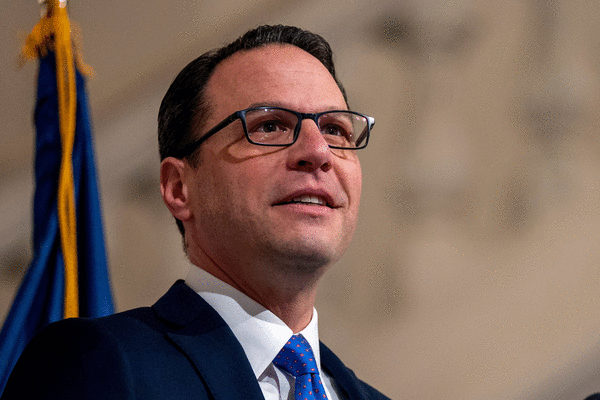
HARRISBURG, Pa. — Within the myriad of initiatives contained in Gov. Josh Shapiro's 2026-27 budget proposal is what amounts to a $2 billion-a-year plug to stick in the gaping hole of Pennsylvania's finances: skill games regulation.
The 70,000 or so devices that resemble video slot machines and are found in many conveniences stores, bars and clubs have no formal state oversight, even though lawmakers have tried for years. But the lure of a massive infusion of new revenue is particularly appealing in a state that spends — by one formal estimate — at least $3.6 billion more than it receives, and Shapiro indicated this could be the year a deal is reached.
The Democratic governor, putting a need to regulate skill games in the same category as a need to legalize recreational marijuana, said, "We're putting our communities at risk and losing out on billions of dollars in revenue by doing nothing on both."
Some of the details of his plan include a 52% tax rate; a maximum of 40,000 total skill games and Video Gaming Terminals, which already are regulated by the state Gaming Control Board; and a maximum of five machines per establishment. The ultimate haul for the state from that combination, he said, could be more than $2 billion a year.
Success for the Democratic governor will hinge on making a deal with the Republican-controlled state Senate. Republican Sen. Frank Farry of Bucks County, sponsor of one of the most high-profile bills on the issue, said Shapiro's concept is similar to his own.
His bill, too, had a 52% for a tax rate, Farry said. And, the scope of the potential industry was similar, setting the regulated number of machines at 30,000 with the potential for an increase to 35,000.
"There certainly is a solution to be had," Farry said.
The legal murkiness the law enforcement challenges associated with the industry were underscored this week, when a former executive of a dominant company in the industry, Pace-O-Matic, pleaded guilty to money laundering.
According to state Attorney General Dave Sunday, Ricky Goodling made the plea in Cumberland County Court after being accused of receiving payoffs from people involved in the distribution and operation of gaming machines. The plea deal followed a joint investigation by Pennsylvania State Police and Sunday's office.
The most significant fork in the road in the minds of lawmakers might be a pending state Supreme Court decision involving the question of whether skill games are actually gambling. Arguments were heard in late November, and for Farry, the court decision will be major.
"If the courts rule these things are legal, I think people will think they need to be controlled," Farry said. But if the court decision goes the other way — issuing a decision that casts the machines as illegal gambling devices — then, Farry said, there will be reason "to shut them down."
Farry said his proposal was cobbled together after input from a massive number of stakeholders, and were it to be put in place it could "functionally work in the community."
It's not the only proposal. Late last year, a bipartisan pair of lawmakers pitched a concept in which the main revenue drawn from skill games would be generated by a $500-per-month, per-machine fee. One of the sponsors of that bill, Philadelphia Sen. Anthony Williams, a Democrat, said he was encouraged by Shapiro's presentation.
He, too, has an eye on the state Supreme Court.
"Whatever they do gives clarity to what we do legislatively," he said.
One of Williams' key reasons for seeking legislation is numerous "stop-and-go" venues that have popped up in his district, with the play of unregulated skills games, alcohol sales, and candy sales — to children — all happening in the same place.
Another Democrat who has offered a bill on skill games, Rep. Danilo Burgos of Philadelphia, said he hopes the Legislature can tackle the issue this budget cycle. Burgos said adoption of state regulations would "end of the reign of black box games" — referring to games that are not manufactured by a reputable company but arrive at unregulated locations in a black box.
Farry said he believed it would take 18 months from the point of final approval to get a government regulation system created, set in motion, and then brought up to full implementation. Along the way, there would be Gaming Control Board temporary regulations, licensing of establishments and vendors, background checks, and many other aspects that would play out.
"It doesn't happen overnight," he said.
_____
© 2026 the Pittsburgh Post-Gazette. Visit www.post-gazette.com. Distributed by Tribune Content Agency, LLC.




Comments