He spent seven months in ICE detention in Florida. Now, he's a permanent resident
Published in News & Features
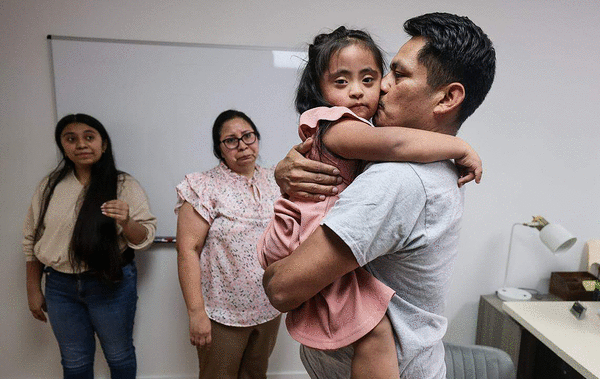





MIAMI – Rogelio has lived in the United States for nearly half of his 39 years, but the life he and his family have built together was at risk of coming to an end when he was taken into custody last summer as part of President Donald Trump’s immigration crackdown.
The Guatemalan immigrant is married to a U.S. citizen and has two children and three stepchildren – four girls and a boy, ages 5 to 18, all born in the United States.
Since his detention in La Belle, a small rural city 30 miles east of Fort Myers, Rogelio – who asked to be identified by his first name because of the sensitivity of his immigration proceedings – had been trying to gain legal status in the country under a law that grants people a path to citizenship if they have been in the country for at least 10 years and meet certain conditions.
Rogelio spent more than six months at the Broward Transitional Center in Pompano Beach fighting the government’s efforts to have him removed from the country, after he’d been stopped by local police in La Belle, Florida for the tints on the windows of his truck.
But Rogelio’s story, unlike so many other recent examples, has a happy ending.
Rogelio is now firmly on the path to becoming a U.S. citizen after a judge approved his application to cancel the government’s attempt to have him removed from the country.
That puts him in rare company.
Nationally, only 4,000 cancellation of removals are granted each year, and only 500 of those are usually reserved for people in detention, like Rogelio, according to immigration attorneys.
In termination proceedings in Fiscal Year 2025, only about 6% percent of people ended up receiving some form of relief– either cancellation of removal or asylum, according to Congress data. Just in December 2025, deportation was ordered by a judge in almost 80% of all cases that were closed that month, according to data compiled by TracReports.
Rogelio is now awaiting his green card, which puts him on the path to becoming a U.S. citizen.
In prior administrations, Rogelio, who has no serious criminal history, would have been unlikely to be arrested and detained solely on the basis of his immigration status, but under the current administration and with Gov. Ron DeSantis’ mandate for all state and local agencies to cooperate with ICE, thousands of immigrants like him have been arrested and detained for months on end.
Multiple attorneys told the Herald that they have clients who gave up on their efforts to win the same relief as Rogelio after their detention stretched on for months with no end in sight.
Cancellation of removal has three requirements: physical presence in the U.S. for at least 10 continuous years, good moral character during that time, and showing that deportation would cause “exceptional and extremely unusual hardship” to a U.S. citizen or permanent resident spouse, parent, or child.
Arrested, detained
Rogelio had just left for work on June 25 of last year when he was pulled over by the Hendry County Police Department in La Belle, allegedly for the tints on his side windows of his truck.
Quickly, an officer asked if he had a license. He said he did not and handed over his Guatemalan passport. Then, Immigration and Customs Enforcement showed up, he later told the Miami Herald.
He spent that night at the Collier County Jail. A few weeks later, he was transferred to Broward Transitional Center. He was held there for almost seven months.
Rogelio’s detention put a strain on his entire family, particularly his five-year-old daughter Daniela who has down syndrome and was born with a heart condition.
While Rogelio was in detention, Daniela could only be taken to her treatment once a week, rather than her recommended three, the family shared during the hearings.
Before Rogelio was detained, Daniela received physical and occupational therapy once a week and speech therapy twice a week. She also received support at her school.
The two eldest of the three stepdaughters who live with him and his wife started therapy soon after Rogelio was detained. His wife, Yolanda, also shared during her testimony that she had to borrow money from her brother to keep up with the bills.
In Rogelio’s final hearing, which spanned two days, his attorney and expert witnesses argued it would not be feasible to continue Daniela’s extensive treatment plan if her father was deported and his wife Yolanda and Daniela were forced to relocate to Uspanthan, Quiche, in Guatemala, where Rogelio is from. They also argued if Daniela and her mother were to stay without Rogelio, both Yolanda and Daniela would be caused extreme hardship because he helps in getting Daniela to some of her treatments.
Like many other detainees, Rogelio’s detention was long and grueling, in part because of changing immigration enforcement since President Donald Trump took office in January 2025.
Previously, undocumented immigrants that had no serious criminal history were able to ask a judge for a bond hearing and if the judge determined they were not a flight risk or a danger to the community they could be released and allowed to continue their case from home.
In July 2025, the Trump administration announced that all undocumented immigrants who entered the U.S. undetected or illegally were no longer eligible for bond, regardless of their criminal history, how long they had been in the U.S., community ties or U.S. citizen relatives. But in February, a U.S. district judge overturned the decision that had supported the Trump administration’s broad policy of detaining undocumented immigrants without bond hearings.
But before that, immigration Judge Siegel denied Rogelio’s bond stating he did not have jurisdiction to issue a bond to Rogelio because he had entered the U.S. undetected in 2007. Victor Martinez, Rogelio’s attorney, appealed Siegel’s denial without success.
Rogelio’s detention dragged on. He told the Herald the conditions at the Broward Transitional Center were better than those at the Collier jail, but he still longed to be home. He shared with Martinez that one day, one of the inmates told him he wanted to commit suicide, seeing no way out.
Attorneys who spoke to the Herald shared countless examples of delays in the legal process that have only gotten worse amid the administration’s mass deportation campaign. The attorneys said that many of their clients have ended up signing deportation orders or asking for voluntary departure before finishing out their cases since Trump took office, because the clients don’t want to be detained any longer.
Tamika Jude, a South Florida immigration attorney, told the Herald about her most recent client who told her he was very depressed, and decided to opt for voluntary departure, rather than continue fighting his case.
“Some people will choose to go back to a country that they haven’t been to since they were, like two years old, just to avoid it, having to remain here,” she said.
Rogelio’s process continued, slowly. Months went by without a final hearing scheduled.
When one was finally on the books for December, the assigned judge was behind schedule and could not start it.
Rogelio spent Christmas and New Years in detention, about two hours away from his family.
‘¡Gracias a Dios!’
Finally, Rogelio got a hearing on Jan. 21.
But when his attorney and family arrived at the Pompano Beach detention center, they learned that it would be virtual, presided over by Judge Robin Donato, in Virginia. Martinez, the attorney, wouldn’t be able to sit with his client during the hearing.
The hearing went on for about two and a half hours, delayed at times by technical difficulties.
Two expert witnesses spoke on Rogelio’s behalf, but the hearing came to an end before Rogelio or his wife could give testimony.
The hearing resumed two weeks later, on Feb. 5.
An attorney for the Department of Homeland Security argued that Rogelio should be denied the cancellation of removal, arguing that he had lied on his application, when he said he had not committed any crimes, and saying that because Rogelio had not paid any taxes, he was not showing “good moral character.”
Those arguments didn’t persuade Donato, who said it was reasonable for Rogelio to not understand his prior charge for driving without a license in 2013 would be considered a crime for the purposes of the application. She also said she understood Rogelio’s reasoning for not having paid taxes: no social security number. But she said she expected him to pay them once his documents were squared away.
Judge Donato spent about 20 minutes delivering her decision, explaining how Rogelio met the requirements for the 10-year law in detail, while noting some of the faults in his case.
“But in this case the court is very pleased, very pleased, to exercise its discretion. And the court wishes this family the best of luck,” she concluded.
Both Rogelio and Yolanda appeared a bit confused.
Martinez, the attorney, asked the judge if he could address them in Spanish to explain what happened.
“The judge has approved the cancellation or removal,” Martinez said.
“¡Ay, gracias a Dios!” “Oh, thank God,” Yolanda exclaimed, while fighting back tears.
DHS had 30 days to appeal. According to Martinez, they asked for proof that Rogelio had made an effort to pay his taxes. He authored a letter signed by Rogelio and his wife promising that as soon as he had a social security number, he would start the process. That was enough for DHS not to appeal.
He was released about two weeks after Judge Donato’s decision.
Most cancelation of removal hearings are not as successful, according to attorneys who spoke to the Herald. Only 4,000 people are approved yearly, and about 500 of those are allotted to people in detention.
Magdalena Cuprys, the immigration attorney who also worked on Rogelio’s case, told the Herald she had a very similar case that was denied in December.
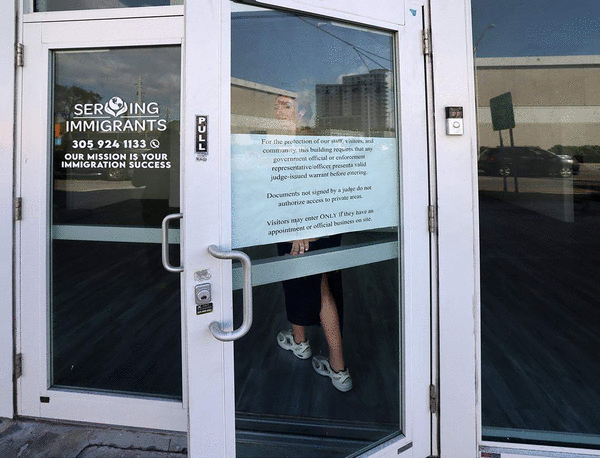
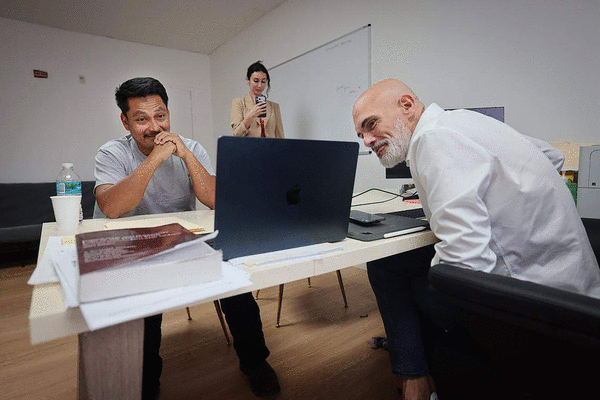
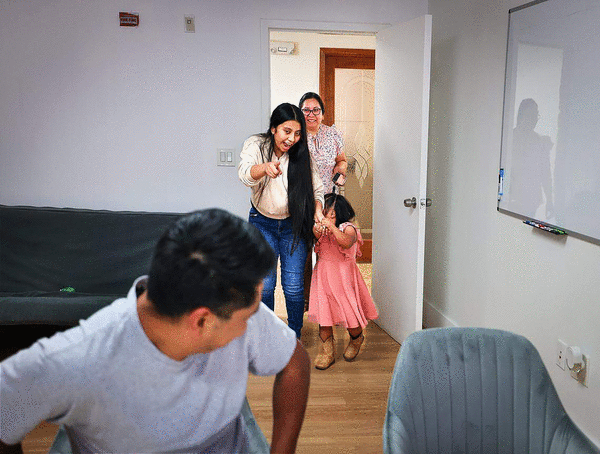
Rogelio was informed of his release while he attended Ash Wednesday Mass at the detention facility in Pompano Beach, he told the Miami Herald. He was picked up by one of his attorney’s assistants from Serving Immigrants, the immigration law firm that represented him. She drove him down to their Little Havana office to reunite with his family.
“I’m so thankful and will always remember what you all did for me,” Rogelio told Martinez, one of his attorneys, shortly after arriving at the office, carrying a mesh black bag holding his belongings.
Just three days after his release, Yolanda and Rogelio spoke again with the Herald. Rogelio shared that he was very happy to be home, and has felt very loved by his daughters and wife. He is anxious to get his permanent residency card. Until then, he plans to avoid leaving the house.
“We don’t want him to go out because he doesn’t yet have a licence or anything,” Yolanda said. “This is a very small town but there are a lot of police out there.”
©2026 Miami Herald. Visit at miamiherald.com. Distributed by Tribune Content Agency, LLC.






Comments