California bill would make fossil fuel companies help pay for rising insurance costs
Published in News & Features
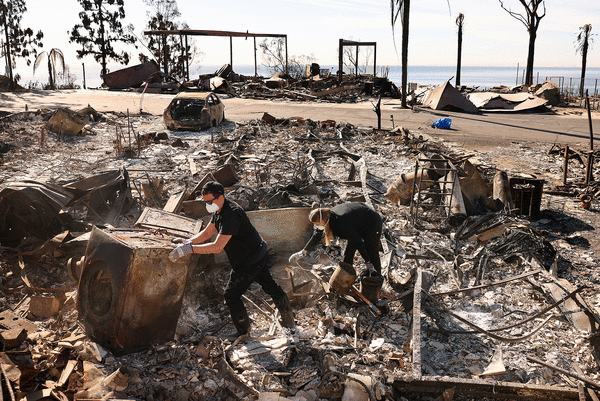
A bill that would make oil and gas companies pay for rising insurance costs due to climate-related disasters was introduced this week in the California Legislature.
SB 982, the Affordable Insurance Recovery Act, would authorize California's attorney general to file civil litigation against fossil fuel companies to recover losses from climate-induced disasters suffered by policyholders and the state's insurer of last resort.
California home insurance premiums have been rising by double digit rates following a series of devastating wildfires across the state over the last decade. The Jan. 7, 2025, Eaton and Palisades fires alone are expected to result in up to $45 billion in insured damages.
"With California's paying such a massive cost for climate related disasters, we have to ask who is not paying?" state Sen. Scott Wiener, a San Francisco Democrat, said at a Thursday press conference held outside the State Capitol.
"We know who is — the survivors, taxpayers, policyholders, whose rates are going up throughout the state. But the answer in terms of who is not paying is fossil fuel corporations," said Wiener, the bill's lead author.
The recovered funds would compensate policyholders for rising premiums and other expenses, including the cost of fire-proofing their properties.
The California Fair Plan Association would be eligible for compensation, too. The insurer of last resort, operated and backed by the state's licensed home insurers, has seen its rolls skyrocket as member insurers have dropped policyholders in wildfire-prone neighborhoods.
The plan expects to pay some $4 billion for claims stemming from the Jan. 7 wildfires and has had to assess member insurers $1 billion to meet its obligations.
About half of that is being paid through a surcharge on residential policyholders statewide. The plan also is seeking to raise rates 36%. It declined to comment.
State Sen. Ben Allen, a Pacific Palisades Democrat whose district includes the Palisades fire zone, is a co-author of the bill, which is supported by groups such as the Consumer Federation of California, California Environmental Voters and the Eaton Fire Survivors Network, a community group in Altadena.
Jim Stanley, a spokesperson for the Western States Petroleum Association, an industry trade group, said the bill is bad public policy that would raise gas prices.
"This is a political stunt that will kill jobs and increase costs for consumers ," he said. "This bill would essentially make oil and gas companies financially liable for every natural disaster impacting California — creating a never-ending web of litigation and claims with no foundation in fact or science."
This is not the first attempt in California to hold energy producers liable for the costs of natural disasters that environmentalists say are caused or worsened by climate change.
Attorney General Rob Bonta sued Exxon Mobil, Shell, Chevron, ConocoPhillips and BP in 2023, accusing them of engaging a a "decades-long campaign of deception" about climate change that has forced the state to spend tens of billions of dollars to address environmental-related damages.
Two bills last year, known as the Polluters Pay Climate Superfund Act, would have required the largest oil and gas companies doing business in the state to pay into a Superfund to help the state adapt to climate change.
Similar legislation was passed in New York and Vermont but California's bill, facing strong industry opposition, stalled in the Legislature.
California also is not alone in seeking to pass legislation that would hold fossil fuel companies responsible for higher insurance costs.
A bill being considered in the New York would allow that state's attorney general and property insurers to bring actions against parties responsible for climate-related disasters.
There is a similar bill under consideration in Hawaii, where the 2023 Maui wildfires caused an estimated $3 billion or more in losses.
_____
©2026 Los Angeles Times. Visit latimes.com. Distributed by Tribune Content Agency, LLC.






Comments