FAA dismisses airline, sonic boom concerns in signing off on SpaceX Starship plans from KSC
Published in News & Features
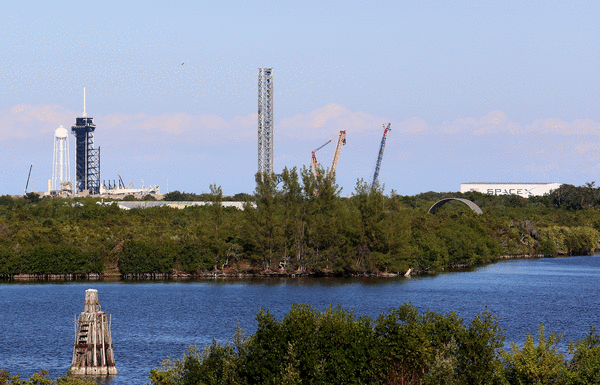
SpaceX’s path to launching its massive Starship rocket from Florida's Space Coast passed another hurdle Friday after the Federal Aviation Administration released results of its nearly two-year long environmental review for launch plans from Kennedy Space Center.
The FAA’s “Record of Decision” on a final Environmental Impact Statement for the KSC site at Launch Complex 39-A outlined mitigation plans across several concerns, but recommended SpaceX could pursue up to 44 launches a year.
This is on top of a previously EIS released for two SpaceX Starship launch pads to be built at Cape Canaveral Space Force Station’s Space Launch Complex 37 that was run by the Department of the Air Force. SpaceX’s plans call for up to 76 launches from the Canaveral site.
In the statement signed by the FAA’s Katie Cranor, the executive director of its Office of Operational Safety, it said not approving the Starship plans would “impede the FAA’s ability to assist the commercial space transportation industry in meeting projected demand for services and expansion in new markets.”
In approving SpaceX’s path forward, she wrote she “has determined that all practicable means to avoid or minimize environmental harm from the selected alternative have been adopted.
The FAA would still need to approve a launch license, and SpaceX has several other mitigation efforts that need to be completed that are outlined in the environmental impact report. But it’s likely Elon Musk’s Starship could be launching from KSC later this year, something the Space Force has already been preparing for.
SpaceX is amid a $1.8 billion infrastructure project to build out a Starship and Super Heavy manufacturing site called Gigabay on KSC property that will feed the rockets to both sites.
Combined, the KSC and Canaveral plans could mean up to 120 launches a year. That also means up to 240 landings a year, as Starship’s Super Heavy booster is designed to return to the launch site to be captured by the launch tower using swiveling arms called “chopsticks.” Meanwhile, the upper stage could also return to the site after making at least one orbit of Earth.
Plans call for half of the launches and landings to take place during traditional sleeping hours.
The rocket is the most powerful to ever make it off the pad with nearly 17 million pounds of thrust, almost twice as powerful as the Saturn V rockets used during Apollo as well as NASA’s Space Launch System rocket.
The Super Heavy booster, similar to Blue Origin’s New Glenn, uses liquid oxygen and methane-based propellants, which for now is being considered as powerful as TNT.
That has led to a much larger no-fly zones for launch, which will require significant temporary disruptions to airline routes. The return trajectory of the Starship upper stage has its own no-fly zone requirements, including Orlando International Airport, that would affect even more airline traffic as it will fly over Florida from west to east.
The most dire predictions in two federal reports on the proposal could mean nearly 12,000 delayed commercial flights each year, while the fishing industry also decried maritime areas that will be off limits.
Starship launches will fly out over the Atlantic with airspace closures ranging from 40 minutes to two hours that could affect the Bahamas and Canada in addition to U.S. routes. That could affect 133 to 400 aircraft during peak travel periods and equates to as much as 8,800 commercial flights a year, although half the launches are expected to fall during overnight hours.
Landing approaches would prompt a minimum of 40 minutes and up to one hour of airspace closure, impacting 400 to 600 commercial aircraft during peak daily travel periods, which is from 8,800 to 13,200 per year.
The FAA, though, said claims made by representatives out of both industries were not enough to alter the recommendation.
“Any present attempt to estimate the long-term economic impact of airspace and maritime closures for the proposed action may be overstated and unreliable and, as such, too speculative to reasonably inform the decisionmaker’s choice among potential alternatives,” the FAA stated in the Record of Decision.
It also said it’s likely operators will make adjustments as the actual SpaceX flight rate and times become normalized.
“Economic theory also recognizes that self-interested entities whose decisions are primarily driven by gain, logical analysis and preferences may adjust their behavior to recurring, predictable constraints,” the FAA stated. “As such, airlines and other users of the airspace may incorporate known operational constraints from repeated launch and reentry operations as they become more reliable and predictable into their routing, scheduling, and pricing decisions.”
Another big concern from residents comes from the increase, strength and timing of sonic booms created both by the returning booster on the Space Coast and returning upper stage across the Florida peninsula, will be particularly noticeable during the sundry nighttime launches and landings.
“The likelihood of people exposed to noise being awakened indoors would be as high 82 percent during late-night operations, which would make up approximately half of total annual events,” the FAA stated.
It didn’t say anything more than normal SpaceX sonic boom advisories would be needed. Already, the company issues warnings about the booms created by returning Falcon 9 boosters noting they could be heard potentially across most of Central Florida.
Unlike the Canaveral launch site, the KSC site also would lead to the closure some public areas including Playalinda Beach in the Canaveral National Seashore.
The National Parks Service looks to lose between $239,000 and $423,000 from the closures, an annual average revenue loss from 13% to 24%.
The FAA acknowledged this financial hit and could affect thousands of visitors a year, but again stuck with its recommendations.
“Advance notification to the public of launch schedules would help some visitors plan accordingly and find substitute recreation sites on closure days and would help to reduce the number of people turned away who are unaware of the closures,” the statement reads.
---------------
©2026 Orlando Sentinel. Visit at orlandosentinel.com. Distributed by Tribune Content Agency, LLC.





Comments