Ramping up pressure, Trump signs executive order to impose tariffs on Cuba's oil suppliers
Published in News & Features
President Donald Trump signed an executive order Thursday threatening tariffs on countries providing oil to Cuba, in an effort to press the island’s communist government to engage in negotiations that could lead to regime change.
The executive order declares a national emergency with relation to Cuba, calling the island’s government “an unusual and extraordinary threat” to the national security and foreign policy of the United States” because of its alignment with U.S. adversaries.
The order allows the secretaries of Commerce and State to add “an additional ad valorem rate of duty to goods from countries that directly or indirectly sells or otherwise provides any oil to Cuba.” Trump can modify the order if the Cuban government or other governments affected by the tariffs “align sufficiently” with the United States on national security and foreign policy matters.
“The Cuban regime aligns itself with numerous hostile countries and malign actors, hosting their military and intelligence capabilities,” the White House said in a fact sheet accompanying the executive order. “For example, Cuba hosts Russia’s largest overseas signals intelligence facility focused on stealing sensitive national security information from the United States.”
The executive order also accuses Cuba of providing safe haven for transnational terrorist groups, such as Hezbollah and Hamas. And it called the Cuban government’ s human rights violations “repugnant to the moral and political values of democratic and free societies and conflict with the foreign policy of the United States to encourage peaceful change in Cuba and to promote democracy, the principle of free expression and press, the rule of law, and respect for human rights throughout the world.”
The measure is the most aggressive step yet in what the administration early on labeled as a tough Cuba policy. It could hasten the collapse of Cuba’s economy, already facing an energy crisis after shipments of subsidized Venezuelan oil came to halt following the capture of Venezuelan strongman Nicolas Maduro by U.S. forces.
Cuba depended on the Venezuelan oil not just to generate electricity. According to a U.S. analysis, Cuba was also reselling as much as 60% of the oil it received from Venezuela in Asia to get cash.
In a post on Truth Social after the U.S. raid on Venezuela, Trump said that Cuba has for many years survived economically thanks to an arrangement to provide security services for Venezuelan leaders Hugo Chavez and Maduro, “BUT NOT ANYMORE,” he said. He also urged the Cuban government to negotiate with the U.S. “BEFORE IS TOO LATE.”
The executive order will increase pressure on the Mexican government and President Claudia Sheinbaum, who has been defending oil shipments to Cuba by the Mexican state oil company Pemex as a sovereign decision.
Without oil coming from Venezuela or Mexico, the situation on the island will deteriorate even further in the short term. Already, Cubans have been enduring hours-long daily electricity cuts all around the country and gasoline rationing. Prime Minister Manuel Marrero has repeatedly referred to a “war economy” to describe the current situation.
Some experts and Cuban-American activists are worried that turning the screws on the Cuban government at a time the country is already facing its worst economic crisis in decades and the population is suffering deprivation might nudge the island into a failed state or a migration crisis. They also say the administration does not seem to have a plan for how to manage a potential humanitarian crisis in Cuba. They also questioned whether such pressure might be effective in dislodging a regime with ample experience in surviving sanctions while the population suffers.
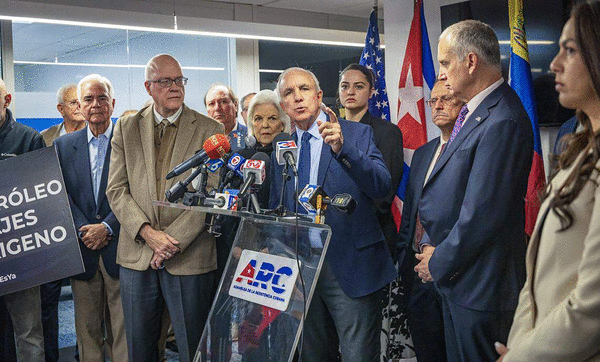
In a press conference Thursday in Miami, Cuban American Republicans in Congress took the opposite view, saying now was the time to exert “maximum pressure” and cut flights and remittances to Cuba in what they say could be the final push.
“”We know it will be difficult for many families, but no transition has ever been easy,” the lawmakers said.
“That regime is a cancer,” U.S. Rep. Carlos Giménez said. “And the way that you cure cancer, sometimes the cure is painful, but in the end, the patient survives.”
Gimenez had previously urged Sheinbaum to stop Mexico’s oil shipments to Cuba. He also asked the Treasury and State departments to demand that Mexico to halt the shipments during upcoming trade negotiations.
In a statement, Gimenez said Trump’s executive order “is a decisive and historic step towards ending the Castro regime once and for all” that sends a message to foreign governments “propping up tyranny in our hemisphere.
“I again call for the immediate end of oil shipments, travel and remittances that bankroll repression and suffering in Cuba.,” he said. “Every dollar and every barrel sent to Havana only prolongs the misery of the Cuban people and strengthens a failed communist state.”
In a Senate hearing Wednesday, Secretary of State Marco Rubio did not rule out the administration was seeking regime change in Cuba. He added that the 1996 Helms-Burton Act requires the U.S. government to push for a democratic transition in Cuba in order to lift the decades-old U.S. embargo.
“I think we would like to see the regime there change,” he said. “That doesn’t mean that we’re going to make a change, but we would love to see a change.“
©2026 Miami Herald. Visit at miamiherald.com. Distributed by Tribune Content Agency, LLC.





Comments