Faith leaders raise concerns over Florida bill about religious freedom in schools
Published in News & Features
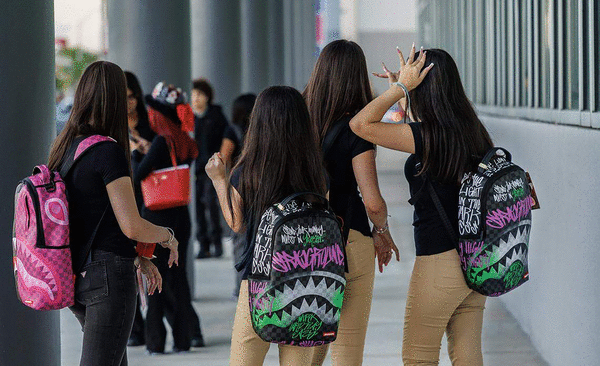
MIAMI — Religious leaders and interfaith advocates from across the state are sounding the alarm on a bill aimed at protecting religious freedom and expression in Florida public schools, arguing that it could lead to special protections for the dominant religious groups — such as Christianity — and weaken the lines between church and state.
The bill called “Protection of Religious Expression in Public Schools,” would amend Florida’s constitution to add language protecting students and staff from facing discrimination for expressing their religious beliefs in public schools, specifically in a student’s school work, clothing, prayer, moments of silence, and opening remarks at a high school events.
The bill also allows students to organize prayer groups, religious clubs and other religious gatherings to the same degree secular groups function. If the bill gets approved by the Legislature, Florida voters will see it on the ballot in the next general election.
The bill was discussed at a House Education and Employment Committee Meeting last week and a few groups, like the Christian Family Coalition Florida and Florida Family Voice showed up to support the bill. The majority of the groups who showed up to speak at the meeting spoke in opposition of the bill, including groups like Interfaith Alliance, Florida Council of Churches and the National Council of Jewish Women.
Faith leaders opposing the bill argued that the bill could risk privileging certain religious or ideological viewpoints over others. They also warned that the bill could allow students or teachers to embed religious or political ideology into classrooms under the guise of free expression and expose schools to litigation.
“What happens if a Muslim wants to lead the prayer before the football game, or there’s a Hindu expression that a student wants to provide? Are they going to protect those freedoms as much as the Christian freedoms that were verbally talked about in the meeting?” Rev. Rebekah McLeod Hutto, the director of interfaith and cultural programs at OneJax, who was in Tallahassee last week to testify against the bill, told the Miami Herald.
“To me, it’s a waste of time with the majority of needs that Florida has,” Hutto said. “Why are we trying to codify something that already exists unless you have a hidden agenda to prioritize a small section of Christianity?”
Prayer before games
At the committee meeting last week, Rep. Yvonne Hayes Hinson, D-Gainsville, also questioned why the resolution is needed, given that religious freedom is already protected under the Florida Constitution and the First Amendment of the United States.
Rep. Chase Tramont, R-Port Orange, one of the bill’s sponsors, said it would protect specific expressions that are not currently named in the constitution — though he directed Hinson to “go to the bill” to see the specifics — adding that it is a person’s “God-given right” to have those protections.
The bill addresses a longstanding rift going back to 2015 between the Florida High School Athletic Association and religious schools regarding prayer before sports events.
In November, the Florida Supreme Court handed the FHSAA a victory when it declined to take up an appeal by a Tampa Christian school that argued that the school’s free speech rights were violated because it was prevented from offering a prayer over a stadium loudspeaker before a state championship football game.
The new law specifically allows high schools participating in a championship contests or series to pray using the public address system at the event.
‘Cherry-picking’
Speaking on behalf of American Atheists and Interfaith Alliance at the meeting, Devon Graham argued that the current administration has been “cherry-picking” which religions get protections.
Graham, who spoke as an opponent of the bill, said it was unfair that, for example, two Islamic schools that received taxpayer funded vouchers were recently being scrutinized while the majority of the private Christian schools that receive the funds received no public backlash.
“You can’t complain that there’s a war on our children, that they are not allowed to freely express their own religious beliefs and then be the one to shut them down when they do,” she said.
Rev. Russell Meyer of the Florida Council of Churches, which represents at least a million people of faith, said that his concern with the bill is that it could interfere with a student’s education, giving priority to a student’s “religious opinion” over their ability to learn scientific-based facts.
John Labriola, a lobbyist from Christian Family Coalition — a group that supports the bill — said that despite the fact that religious freedom protections exist, many school districts continue to discriminate against students in the areas of dress code, coursework and bringing a Bible to school.
“Because of this, students feel harassed,” he said. A former media aide for the Miami-Dade Commission, Labriola was fired in 2021 for writing a transphobic and anti-gay opinion column, a decision that was upheld in the 11th U.S. Circuit Court of Appeals last year.
At the end of the meeting, Rep. Taylor Michael Yarkosky, R-Clermont, said if there was one thing he could do legislatively it would be to “put God back in everything we have taken God out of since the 1980s.”
The committee voted overwhelmingly to support the bill with an 18:1 vote.
©2026 Miami Herald. Visit at miamiherald.com. Distributed by Tribune Content Agency, LLC.






Comments