They helped design the President's House in Philadelphia. Now part of the site's 'heart has been ripped out' after orders from Trump administration
Published in News & Features
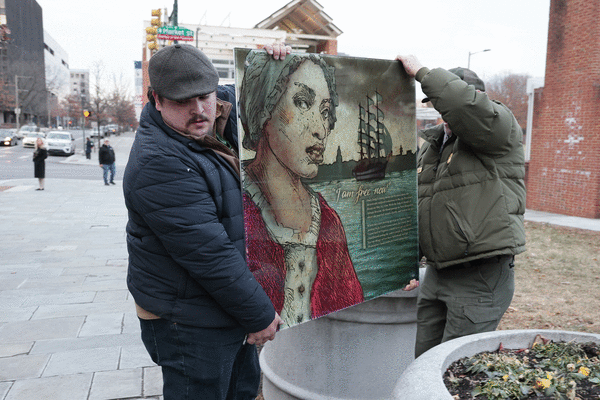
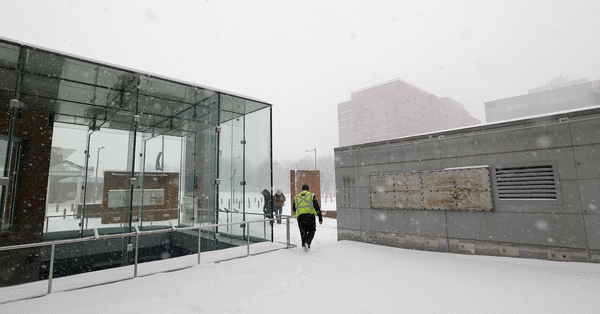
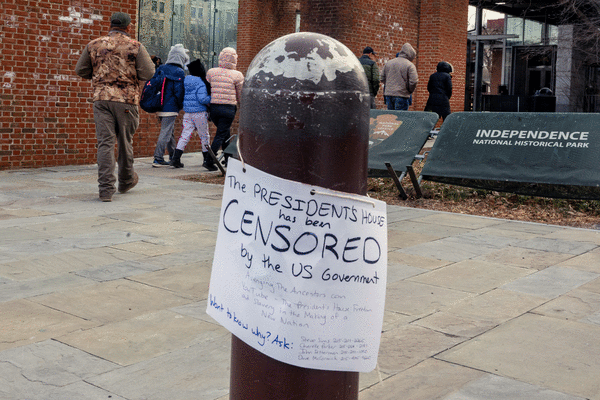
PHILADELPHIA — When the National Park Service dismantled educational exhibits about slavery at the President’s House Site at Independence National Historical Park last week, it required wrenches, crowbars, and the drudgery of four men.
In the span of a roughly an hour and a half, years of hard work from a group of artists, architects, historians, attorneys, and writers who helped create the President’s House in the early 2000s were ripped off the walls and hauled into the back of a pickup truck to be dropped off who-knows-where.
This brazen demise of the exhibits, which memorialized the nine people George Washington enslaved at the site, was never supposed to happen, said Troy C. Leonard, partner and principal at the Philadelphia-based Kelly Maiello Architects, who helped design the President’s House almost two decades ago.
During the project, the firm, which describes itself as minority-owned, was led by the esteemed Emanuel Kelly, who died in 2024.
“Because the panels were not meant to be removed, they were very violently taken down, you know, ripped from their backgrounds,” Leonard said in an interview Monday.
“I would suspect that they did a lot of damage, physical damage, to the site in taking those panels down,” he added.
Leonard is one of many stakeholders who helped create the President’s House and are now grappling with its sudden removal last week after a monthslong review by President Donald Trump’s administration.
In the early 2000s, the site was developed at Independence National Historical Park as a memorial intended to highlight the horrors of slavery that took place during the founding of a nation based on liberty. It featured numerous educational exhibits. Everything at the site was historically accurate.
“Just sort of slithering onto the site was a very cowardly way of doing it without any mention that it was going to happen, notifying anyone, just coming in and starting to take the panels down,” Leonard said.
The Trump administration also ordered the takedown of exhibits from other national parks. Signs about the mistreatment of Native Americans and climate change were removed from parks including the Grand Canyon and Glacier National Park, according to the Washington Post.
It’s all in connection with orders from Trump and Interior Secretary Doug Burgum, who called for the review and potential removal of content at national parks that could “inappropriately disparage Americans past or living.”
Independence Park employees were also given talking points that evade visitors’ questions about the site.
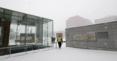
At Independence Park, Leonard said he is concerned about the future of the site. After last week’s takedown, the open-air exhibit is now a bunch of blank, faded brick walls. All that is left of the memorial is the site’s original archaeological dig from the 2000s and a wall with the engravings of the names of the nine people Washington enslaved.
The City of Philadelphia has sued Burgum, acting National Park Service Director Jessica Bowron, and their respective agencies to restore the panels. Gov. Josh Shapiro’s office filed an amicus brief in support of the city’s suit Tuesday.
“To leave it the way that it is, I mean, to me, it’s sort of now a memorial to the death of democracy and truth,” Leonard said. “That’s what it is now. It’s sort of just these blank walls that are just sitting there. It’s sort of a ruin, but it’s a pathetic ruin because part of its heart has been ripped out.”
History is ‘lost and found’
Around two decades ago, more than 1,000 miles away from the Sixth and Market home of the President’s House, a Kansas City-based exhibit design firm crafted the illustrations and graphics seen throughout the site.
All of which were torn down last week.
Gerard Eisterhold, president of the firm, Eisterhold Associates Inc., said in an interview that he got a slew of texts and emails when the exhibits were taken down. He said this incident proves a “thesis” that designers were trying to portray to the public through the President’s House — that history goes through cycles of being lost and then found.
His firm has worked on historical exhibits throughout the country, including at the African American Museum in Philadelphia, the International Civil Rights Center and Museum in North Carolina at the site of the Greensboro sit-ins, and the National Civil Rights Museum in Memphis.
“There were the history of the enslaved that was sort of forgotten for a long, long, long, long time, and that’s a conscious thing that people do. … There’s a heck of a lot more people that are aware of the history of President’s House this week than there was last week,” Eisterhold said.
In fact, there was a sign at the President’s House called “History Lost + Found,” which outlined the juxtaposition of liberty and slavery during the early days of the United States.
Washington would rotate out people he enslaved at his Philadelphia residence to evade Pennsylvania’s 1780 emancipation law, according to the website for Mount Vernon, Washington’s estate in Virginia.
“History is not neat,” the History Lost + Found panel at Independence Park read. “It is complicated and messy.”
This panel was one of dozens that were taken down last Thursday. Others were titled “Life Under Slavery” and “The Dirty Business of Slavery.” And there were illustrations of important figures, like Oney Judge, who was enslaved as Martha Washington’s personal maid before she escaped. Hercules Posey, who was enslaved as a cook, also later self-emancipated.
“But here we are. Because how dare we write their names, the nine enslaved Africans at the first American presidential residence. … How dare we encode instructions to the future by writing about the two who escaped?” author Lorene Cary, who helped with storytelling at the President’s House along with documentary filmmaker Louis Massiah, wrote on her Substack last week. “The names are still there, carved into stone.”
The creation and display of these panels were the product of collaboration across disciplines, Cary wrote.
“So many people — scholars and passionate non-scholars — worked, argued, met, studied, wrote, agitated, and created art for this unique and necessary American project."
Leonard said his firm has been working with Michael Coard, attorney and leader of the Avenging the Ancestors Coalition, which has been helping lead efforts to defend the President’s House from the Trump administration. The coalition, through its advocacy, helped shape the President’s House roughly 20 years ago.
If the city wins its lawsuit and the panels are restored, the site will likely need a refurbishment and stakeholders will need to ensure that the panels are still in good condition.
Some Philadelphians have floated the idea of moving the displaced panels to another location if the site faced the ire of the Trump administration. But for Leonard, Sixth and Market is the rightful, historically important home for the exhibits.
“The place is equally important,” Leonard said. “It is not complete without being located at that site. So it’s important to the fight to make sure that that memorial is restored at that location. It cannot be relocated.”
©2026 The Philadelphia Inquirer, LLC. Visit at inquirer.com. Distributed by Tribune Content Agency, LLC.




Comments