San Diego County supervisors to vote on $4.75 million plan to address Tijuana River pollution
Published in News & Features
SAN DIEGO — San Diego County supervisors will vote Wednesday on a $4.75 million funding proposal aimed at studying health impacts and reducing toxic emissions from the ongoing Tijuana River pollution crisis.
The proposal, presented by the Ad Hoc Subcommittee on the Tijuana River Sewage Crisis, includes funding for epidemiological studies and a temporary infrastructure fix at Saturn Boulevard, identified as a major hot spot for airborne pollutants.
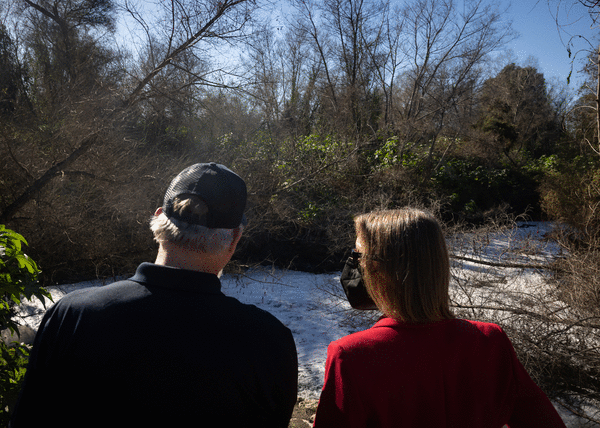
Supervisors Paloma Aguirre and Terra Lawson-Remer announced the plan Thursday at a news conference near the affected area, where raw sewage and industrial waste have flowed for years.
“South Bay residents, myself included, have been living through, actually surviving this crisis for far too long,” Aguirre said. “We aren’t just talking about an eyesore or a passing bad smell. We’re talking about a public health emergency that has disrupted our lives, is hurting our small businesses, and is impacting the well-being of our children.”
The funding, which would be drawn from county reserves, includes $2 million for a long-term health study, contingent on $4 million being raised from other sources such as state and federal partners. An additional $250,000 for a retrospective health study is being called for, along with $2.5 million for infrastructure improvements at Saturn Boulevard.
Although contingent on other funding sources, Aguirre said she is confident federal and state partners will provide the additional $4 million needed, describing the county’s contribution as a catalyst for securing matching funds from other entities.
The long-term study would follow 1,000 to 2,000 residents over multiple years to assess health impacts from varying exposure levels. The retrospective study would analyze existing health records to identify patterns linked to historical pollution exposure.
According to a November 2024 study by the Centers for Disease Control and Prevention and the county, nearly two-thirds of surveyed households in South Bay reported physical health symptoms and declining quality of life linked to contamination from the Tijuana River Valley.
“While previous reports and surveys provided a baseline, there hadn’t really been a study that fully captured the cumulative scope of the health issues South Bay residents face with the Tijuana River sewage crisis,” Aguirre said.
The proposed Saturn Boulevard project would extend existing culvert pipes below the water surface to reduce turbulence that sends hydrogen sulfide and other toxic gases into the air. Currently, sewage and industrial waste drops from culvert pipes onto rocks below, creating splashing that releases airborne pollutants.
“By extending these pipes below the water surface, we can stop the churn, the turbulence that is sending or rather shooting up into the air hydrogen sulfide and other toxic gases and toxic pollutants into the air,” Aguirre said.
Richard Whipple, deputy director of the county’s Department of Public Works, said the temporary pipe extension could be implemented within two years and was selected for its relatively simple approach and reduced difficulty in obtaining environmental permits.
If alternative funding sources are identified for the Saturn Boulevard project, the county’s $2.5 million allocation would be redirected to other immediate needs in the Tijuana River Valley, according to the board letter.
Implementation would require agreements with the City of San Diego, which owns the land at Saturn Boulevard, and the U.S. Navy, which owns land adjacent to the site.
Lawson-Remer emphasized the need for immediate action while longer-term solutions are developed.
“Standing here, we do not need any more reports to know what’s at stake,” she said. “We can see it, we can smell it. If your home or your work is nearby, you live it every single day.”
_____
©2026 The San Diego Union-Tribune. Visit sandiegouniontribune.com. Distributed by Tribune Content Agency, LLC.






Comments