Trump threatens 100% tariffs on Canada if it does China deal
Published in News & Features
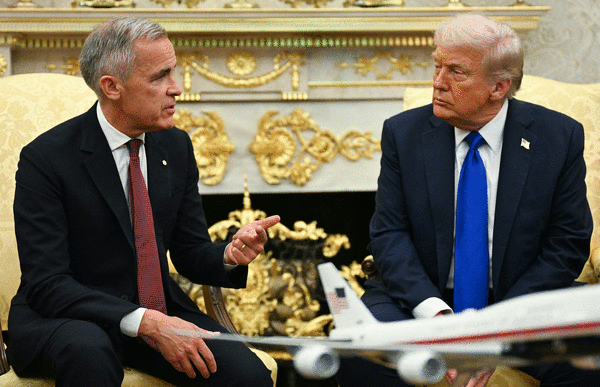
President Donald Trump threatened Canada with 100% tariffs against all its exports to the U.S. if it makes a trade deal with China, escalating tensions between the U.S. and its northern neighbor.
Trump, referring to Prime Minister Mark Carney as “Governor Carney,” said the Canadian leader was “sorely mistaken” for opening up his country to more business from China, including a recent deal allowing an increase in Chinese electric vehicle exports. Trump has trolled Canada about his desire for it to become the 51st U.S. state.
“China will eat Canada alive, completely devour it, including the destruction of their businesses, social fabric, and general way of life,” Trump said in a social media post. “If Canada makes a deal with China, it will immediately be hit with a 100% Tariff against all Canadian goods and products coming into the USA.”
While the emerging deal between Beijing and Ottawa is limited in scope, Trump warned in a subsequent post that “the last thing the World needs is to have China take over Canada. It’s NOT going to happen, or even come close to happening!”
Spokespeople for Carney did not immediately respond to messages requesting comment Saturday morning.
The move comes as Trump and Carney have launched a war of words over the U.S. president’s actions to shake the world order, including his efforts to seize control of Greenland. Carney has said Greenland’s future should be decided only by the people of Denmark and Greenland, a Danish territory.
China and Canada reached an agreement last week to lower some trade barriers and rebuild ties, signaling a pivot in Canadian foreign policy and a break from alignment with Trump’s trade agenda.
Carney said he expects China to cut tariffs on Canadian rapeseed, also known as canola, after meeting Chinese leader Xi Jinping on Jan. 16. It was the first visit by a Canadian leader to Beijing in eight years.
In return, Canada will allow 49,000 Chinese electric vehicles into its market at a tariff rate of about 6%, removing a 100% surtax. Canada had put the large tariff on Chinese EVs in 2024 to align with U.S. policy.
China will also offer visa-free travel to Canadians, Carney said.
Soon after the deal was signed, the Canadian leader delivered a withering speech at the World Economic Forum in Davos, Switzerland, in which he warned against coercion by great powers — an implicit denunciation of Trump’s approach to foreign affairs, though he did not mention Trump by name.
The U.S. president responded by accusing Canada of ingratitude for American military protection and asserting that the country “lives because of the United States” — a claim Carney rejected. Trump also withdrew an invitation for for Canada to join his so-called Board of Peace a week after Carney had agreed in principle to be part of it.
Trump said Canada opposes his planned “Golden Dome” missile-defense project being built over Greenland, though it’s unclear if that is actually Ottawa’s position. Treasury Secretary Scott Bessent said this week that Trump had asked Canada to take part in the project.
Carney has previously indicated a willingness for Canada to be involved in the Golden Dome. He’s also in the process of sharply raising Canada’s military and security spending — including the procurement of new fighter jets and submarines — partly because of Trump’s pressure on NATO allies to do so.
Carney made waves at the annual gathering of global financial elites in Davos, when he called on so-called middle powers to band together to resist intimidation from great powers. The prime minister attacked several of his policies by condemning using “tariffs as leverage, financial infrastructure as coercion, supply chains as vulnerabilities to be exploited.”
It is not immediately clear what would meet Trump’s threshold of a deal — Canada and China’s agreement earlier this month was essentially a limited trade pact, focused on agriculture and electric vehicles. The White House didn’t immediately respond to a request for comment.
Also unclear was what any change would mean for how U.S. tariffs apply to goods traded under the U.S.-Mexico-Canada Agreement. Currently, goods under the deal are typically tariff-free, an exemption that means the vast majority of what the U.S. buys from Canada faces no tariff.
The current import tax for non-excluded goods is 35%, with different rates for certain sectors, including steel, aluminum and automobiles.
Executives in the auto industry have warned the Trump administration that tariffs on auto parts — one of Canada’s major exports — would quickly disrupt manufacturing activity at American factories.
“The president seems to have flip-flopped on his position once more and this reaction does not represent any level of rationality,” David Adams, president of Global Automakers of Canada, said in an emailed statement Saturday. His group represents a number of companies that assemble and sell vehicles in the U.S. and Canada, such as Toyota Motor Corp. “We would hope that those around the president would have some appreciation of the damage executing on this statement would have for the American economy, American jobs and American consumers.”
Energy imports
The U.S. imports about 4 million barrels a day of oil from Canada, which is the major source of crude that serves refineries in the Midwest. The U.S. is also a major buyer of metals and fertilizer from its northern neighbor.
Trump has frequently threatened tariffs that don’t materialize.
One week ago, he threatened Europe with tariffs over Greenland that he has since shelved. And earlier this month he threatened secondary tariffs on any country trading with Iran, but has never elaborated and has yet to enact any. China is among Iran’s major trading partners.
The president also said said in October he would place an additional 10% tariff on Canadian goods because he was upset about a television ad opposing the levies that was commissioned by the government of Ontario. But he never followed through on that.
“If there were 100% tariffs on Canada it would be a disaster. I guess my question would be, what’s the likelihood of that happening?” said Randall Bartlett, deputy chief economist with Canadian financial institution Desjardins Group. Trump has a habit of issuing warnings about huge tariffs then walking them back, “so the likelihood of that is very small.”
Relations between Washington and Ottawa have soured since Trump’s return to the White House. The president’s decision to raise tariffs on goods from Canada triggered widespread outrage, with many Canadians boycotting American products and skipping travel to the U.S.
Canada, which historically has routed much of its trade south to the U.S., has responded by aggressively looking to increase trade ties east to Europe and west to Asia — including sealing a trade deal with China and seeking new links with India, two countries that openly feuded with Carney’s predecessor, Justin Trudeau, in recent years.
Trump, as part of his 51st state taunts, repeatedly referred to Trudeau as “Governor Trudeau.” But he had stopped doing so after Carney came into office.
———
(With assistance from Derek Decloet, Mathieu Dion, Erik Hertzberg and Jordan Fabian.)
©2026 Bloomberg L.P. Visit bloomberg.com. Distributed by Tribune Content Agency, LLC.





Comments