These brothers were the last to be released by Hamas. Hear their story in Miami
Published in News & Features
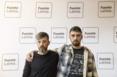

MIAMI — Eight members of the Cunio family, an Israeli Argentine family living in southern Israel, were abducted by Hamas terrorists on Oct. 7, 2023, making them the largest single family taken hostage that day.
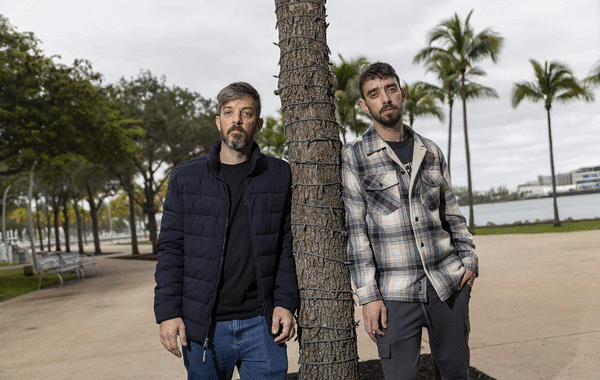
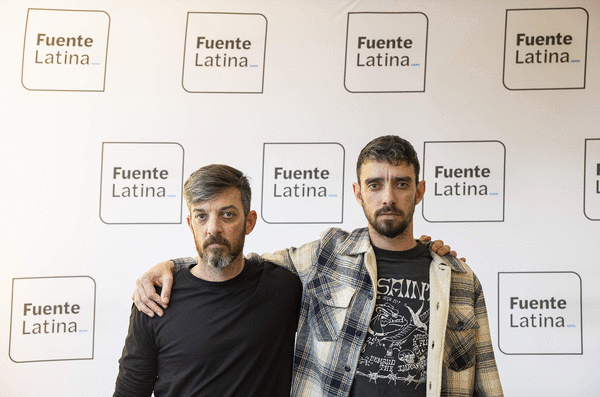
This week, two of the brothers came to Miami to talk about their experiences. After spending more than two years captive in Gaza, brothers David and Ariel Cunio were among the last living hostages to be released, and for the first time publicly, are sharing their stories of survival.
The Cunio brothers traveled to South Florida to attend an upcoming film premiere of “A Letter to David,” making its Florida debut at the Miami Jewish Film Festival this weekend.
The documentary, directed by Israeli filmmaker Tom Shoval tells the story of David, who was kidnapped by Hamas, and twin brother Eitan, who was left behind, waiting over 700 days for his brother’s return.
The film documents David’s life before Oct. 7, 2023, in his village, Kibbutz Nir Oz — a place he viewed as his personal paradise where he raised his children and lived a happy life before his home was destroyed in the attacks.
“It was like a heaven,” David said about Nir Oz. “Now if you go to the kibbutz, it looks like Vietnam ... it’s a war zone.”
Many of the people in the old footage — David’s best friend’s wife and children — were murdered during the Hamas assault. David’s twin brother, Eitan, who survived the initial attack and was later released, had no information about his brother’s well-being for two years.
“It shows the both sides of life, the good side and the bad side. It’s a really strong message to see that life can change in the blink of an eye,” David said.
Two years of terror
Though the film focuses primarily on the twins and their prolonged separation, another Cunio brother, Ariel was also held hostage for two years, and traveled with David to share his experience.
In an interview with the Miami Herald, David and Ariel described two long years marked by starvation, isolation and psychological abuse.
Both brothers were kidnapped along with their families from their homes. Kibbutz Nir Oz, an Israeli settlement near the Gaza border, had the highest number of casualties in the Hamas attacks, with a quarter of its residents either kidnapped or killed during the Palestinian militant group’s rampage through southern Israel.
After they were separated, the Cunio brothers had very different experiences in captivity.
Ariel, 28, spent most of his time being hidden in plain sight by his captors, moving among houses and businesses in Gaza. He said he was forced to remain silent most of his days — not even being allowed to cough. As he was being held, he said he heard horrible things being said about his people to other civilians in Palestine.
“It was upsetting, seeing that. That’s what they’re teaching them. To hate us,” Ariel said. “Innocent children are getting taught that hate is the way.”
David, 35, was held captive with his wife and daughters, but they were released in the first ceasefire deal in November 2023. It’s a moment he describes as “the most horrible goodbye you can imagine.”
For the next two years, David spent most of his time held captive in underground tunnels built beneath the Gaza Strip. Though he was in contact with other hostages and his captors, he was completely isolated, and knew nothing about the outside world, including whether his family was alive or dead.
“It was really difficult to be there ... you don’t know nothing about your family, about your brothers, your wife,” David said. Other hostages received news about their families, he said, but news about his wife and children never came.
His captors, he said, would often tell him lies — his wife abandoned him and that no one was coming for him. He said they found his weak points psychologically.
“In the beginning, you don’t believe all this, but as time passed, you start to think that maybe it’s true,“ he said. “All the time they were playing with my brain like that, all the time.”
For Ariel, the lowest point of captivity was when he heard the news about his girlfriend’s brother who died.
“That broke me. For a week I couldn’t eat, I stopped praying. It just got to me real bad,” he said. But, he said, what gave him strength was the thought of returning to his girlfriend, Arbel, and supporting her through her loss.
“I always thought to myself, I need to survive this. I need to go back. I need to be with her. And I always thought to myself, I’ll be there to glue all the pieces back.”
‘Everything is new’
Both brothers wouldn’t describe themselves as religious, but, they admit, they spoke to God every day while in captivity.
“In those extreme scenarios, when you have nothing, you talk to God a lot,” Ariel told the Herald. During the seemingly endless hours of waiting and uncertainty, Ariel said he made a deal with God.
“I told him that if I go back to Israel alive, and all my family is alive, I’m going to do the tefillin ... and I’m going to fast every Kippur,” he said.
Ariel was referring to the Jewish ritual where men — often Orthodox or Conservative — will bind black leather boxes, or tefillin, containing certain passages of the Torah on to their bodies. It’s an act that often brings a deeper connection to God.
Now, sitting in a hotel room in downtown Miami, the brothers discuss how the strangest part of being free is, well, the freedom.
“Inside you don’t have control ... When you come back you don’t understand that you can do whatever you want,” David said.
“You can open the door to the outside and look at the sky. Everything is new. I forgot about everything inside there,” Ariel said.
They recall the first moments after they were released when they made the call, hands shaking with fear of what they would find out. And when they were finally reunited with their families.
“You see them, and you don’t believe that you see them in front of you physically,” David said, “You touch them, you hug them. It’s like... wow.”
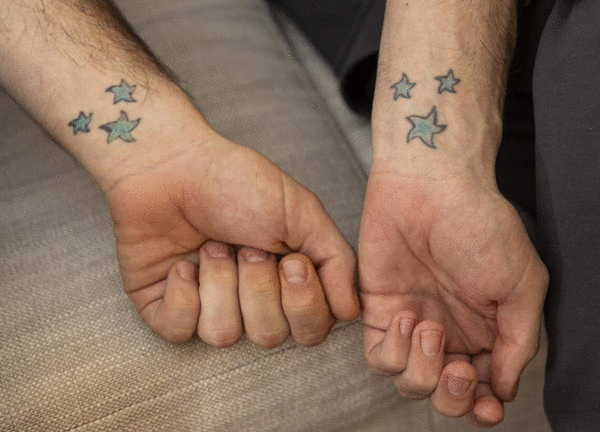
The Cunio brothers sit side-by-side, not wanting to be apart for too long these days, and raise up their wrists, adorned with matching tattoos. Every day in captivity they kissed the tattoos, three blue stars, the same one all four brothers have.
David and Ariel agree that despite everything they went through, revenge is not something they yearn for.
“Seeking revenge is wrong,” Ariel said. “I prefer living in the present, thinking of the future.”
©2026 Miami Herald. Visit at miamiherald.com. Distributed by Tribune Content Agency, LLC.





Comments