Illinois family piecing life and restaurant back together after father deported to Pakistan
Published in News & Features
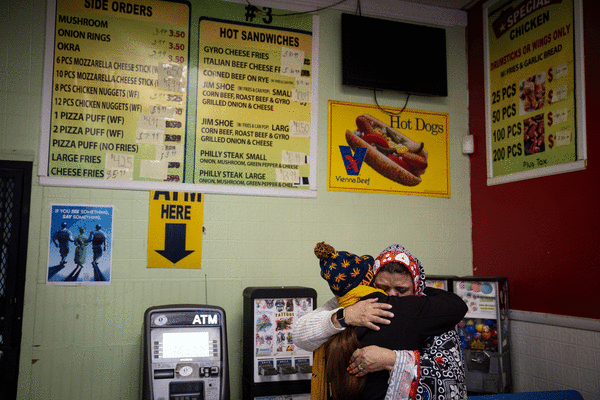
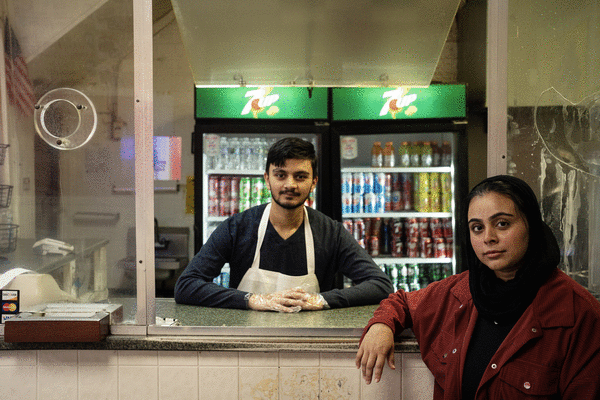

CHICAGO — In Chicago’s Humboldt Park neighborhood on the city’s West Side, a sandwich shop on North Avenue stands as it has for more than 20 years — menu prices taped over and over again on the wall, a door that squeaks and sticks in its groove, a bulletproof service window separating servers slinging Philly subs with a pile of fries and a crisp, cold orange soda. But now, without its beloved owner, an undertone of lifelessness lingers.
Asif Amin Cheema, owner of Best Sub #2, was deported to Pakistan on the first day of the new year, leaving behind a beloved customer base and a business he had started from scratch in 2003.
Nooraan Amin, Cheema’s 19-year-old son, was behind the counter last Thursday afternoon, filling shifts in between college classes and another part-time job. Cheema has been away from the shop for more than three months since Border Patrol agents arrested him in September. Nooraan said it feels like years have passed.
“When my dad was here, he really only taught me cashier duties, which was just staying in the front, but he was slowly getting me into how the cooking process works,” Nooraan said. “But now, I have to help with everything, including stocking and inventory.”
Nooraan’s mother, whose name the Tribune is keeping private, came by the restaurant with her daughter. She would often stop by to spend time with her husband as he whipped up a sandwich or put on the kettle for chai.
“It used to be a time where we could spend alone, he loves to cook for me here,” she told the Tribune in Urdu. She cupped Nooraan’s chin and asked him if he ate.
They’re a tight-knit family, grappling with a new normal. Best Sub #2 is the family’s primary source of income, but it’s also Cheema’s legacy, Nooraan said. They’ll never get rid of it.
Cheema’s wife recalled how he manually placed each tile in a checkerboard pattern on the restaurant’s floor. She smile as she pointed out how some blue tiles are mistakenly touching each other. He also built the blue and yellow booths with help from a few handymen, she said.
Rabia Amin, Cheema’s 27-year-old daughter, looked up at the fading pictures of the menu items, now comically indiscernible. She said she took most of those pictures when she was in sixth grade. Her dad had plans to upgrade the menu boards to replace the hand-scribbled pricing, with many 2s turned to 3s thanks to inflation.
Rabia, a writing and research clerk for a law firm overseeing family and criminal defense cases, has been vocal about her father’s arrest. She helped her family make several last-ditch efforts to halt Cheema’s removal, a process that started on Sept. 17 when Border Patrol agents arrested him.
A few weeks into Operation Midway Blitz, Cheema was driving across the street from La Huerta, the Mexican grocer on Lake Street in his hometown of Addison, when two Border Patrol cars started flashing their high beams at him. He pulled over, then two more cars arrived and blocked him in, Rabia explained.
“Obviously, he has never been arrested before, so he just complied,” she said. “And I found out because that morning on Facebook, I saw that ICE (Immigration and Customs Enforcement) was in Addison, specifically in that same intersection as La Huerta. I was like, that is so strange. And I don’t know how to describe it, but I just felt like something was wrong … so I checked his location, and saw he was in Broadview. That’s when I put the pieces together.”
Cheema was deported due to a 1991 removal order, but he had learned of its existence only last April, when he went in for a green card interview.
Cheema’s attorney, William McLean, said the situation is complicated. McLean recently came on as his legal counsel, while Cheema was being held at the Broadview ICE processing facility. McLean said ICE identified Cheema through fingerprints and biometric information he had provided when applying for his green card.
“Your biometrics is a 360-degree photo of your head, so when ICE invades Chicago a year later with their facial recognition technology, they see you in your car, and they know exactly who you are and your entire immigration history,” McLean said. “And that’s what happened to him. They identified him and arrested him with no warrant.”
Rabia suggested that had her father not tried to secure a legal pathway, the removal order wouldn’t have even been flagged for immigration officers, as it hadn’t yet been enforced.
“That’s the problem — people are trying to go about it the right way and still suffer consequences. And they let him go home after the interview, after seeing a removal order. They didn’t deport him then,” she said. “Doesn’t that make you wonder?”
Rabia said her dad wondered if he had reason to worry as word spread in early September of immigration enforcement across Chicagoland.
“Things like this, you just don’t think it’s going to happen to you. And the government kept saying, ‘We’re only getting the worst of the worst, we’re only getting criminals who are illegal,’” Rabia said. “I was like, ‘Well, Dad, you had your green card interview this year, you have a valid work permit. You are not a criminal. You’re not the worst of the worst.’”
After Cheema’s arrest, the family’s attorney at the time filed a motion to reopen the removal order case with the Board of Immigration Appeals, the first movement on that order in 30 years. If the motion had been approved, Cheema would have been able to stay in the country temporarily.
But court records show every attempt the Amin family made to halt his deportation was denied.
A week before his scheduled deportation, McLean filed an emergency temporary motion seeking a restraining order on his removal. This led to a hearing on Jan. 1, just hours before Cheema’s scheduled flight to Pakistan. An emergency judge in the Northern District of Illinois decided not to grant a temporary restraining order. McLean said the judge was reasonable and gracious, but it was a gut punch to the family.
That same day, before the hearing, Cheema collapsed while at O’Hare International Airport. He was taken to Resurrection Hospital for evaluation but was sent back to the airport after three hours. Rabia said they presented Cheema’s hospital discharge papers to the 7th District Court of Appeals judge, hoping the court would weigh in favor of keeping an unwell Cheema at home with his family. Rabia said her father has a history of ill health, having previously suffered two heart attacks.
With the TRO denied, Cheema would be on the next flight to Pakistan. Rabia said her mom and her siblings raced to the airport on the off chance that they’d get to see him before takeoff, and at the very least, to hand off some of his personal belongings and extra medications to an immigration officer. They weren’t able to see him. But an officer did eventually grab his stuff, Rabia said.
“What’s crazier is that because my dad’s not a criminal, he’s not dangerous, they put him on a commercial Qatar Airways flight back to Pakistan,” she said. “He was at the gate, waiting in public — so he’s obviously safe enough to sit with all these random people while he’s waiting for his gate to open, but his own family can’t even say bye to him? It’s just cruel.”
A week after Cheema’s deportation, the restaurant wasn’t busy, but the few customers who stopped by shared well-wishes and prayers for the family.
Sales have dropped since the COVID-19 pandemic, when the restaurant could no longer stay open 24 hours a day. Then last year, Best Sub #2, like many other restaurants in heavily Latino areas, faced a new reality with fewer customers dining in and workers afraid as intense immigration enforcement rippled across the Chicago area.
In December, the immigration crackdown briefly went to Charlotte, North Carolina, and then moved to New Orleans, before returning to Chicago. Most recently, the Department of Homeland Security announced it was sending more than 2,000 federal agents and officers to Minnesota, following a fatal shooting of a woman by an immigration officer.
Rabia said that up until his arrest, Cheema would often be the one to lock up each night, even though he employed four full-time workers and a store manager. His regulars knew he’d always be around.
“We’d come in here, late at night and just sit down if we had nowhere else to go — he’d let us get warm, never kicked us out,” said Lawrence Davis, a longtime customer who has known Cheema for 20 years.
Davis is a member of the Alliance of Local Service Organizations, whose mission is to prevent the transmission of violence locally. He and his colleague, William Estrada, were in the area passing out flyers about their outreach efforts, when they saw Cheema’s wife sitting in a booth near the window.
“We grew up in the neighborhood. … He’s a great man, a great man. If you were ever short or didn’t have anything, he’ll still give (food) to you,” Estrada said. “It’s terrible. … A nonviolent person. They started using that excuse about violence. (Cheema) is furthest from being a criminal. He’s an outstanding businessman in the community.”
Other customers stopped by for lunch and lingered a little longer after ordering gyro sandwiches and chicken fingers.
Rabia said a lot of locals developed a safe space with her father. Over the years, many in the Desi community who had precarious legal status but families to feed and provide for turned to Cheema for a small job around the restaurant. Cheema’s wife said even college students who came from India or Pakistan with little or no work experience often found themselves working a few hours at Best Sub #2, just enough to make some pocket money.
“He’d try his best to find something for someone to do, if they needed a job,” Rabia added. “He gave money, food, … his time. He gave so much, and now I think the community can give back to him.”
Rabia and her older sister started a GoFundMe campaign to help them navigate recent financial strains, including costly legal fees. The funds will go toward Cheema’s essential living expenses and medical needs. Rabia’s eldest brother, who is 29, is special needs and depends on his father for financial and emotional stability, and the funds will also help with his care.
The family video calls Cheema every day. Rabia’s sister flew out to Pakistan last week with a suitcase full of items from home. Currently, Cheema is staying with a relative but the family is hoping to set up a more comfortable living arrangement if they’re able to afford it.
The goal ultimately is to bring him back, Rabia said.
McLean said that while it is difficult to return to the United States after deportation and not a realistic pathway for most people, some can successfully return after several years. In Cheema’s case, his children could petition for him to immigrate to the country.
The day Cheema was deported, McLean filed a Bivens action — which seeks damages against federal officers for violating constitutional rights while acting under federal authority — against local and national leaders and “multiple unknown ICE agents.” The action alleges that Cheems was denied his due process rights.
The suit also alleges that agents withheld medication from him for at least three days before his deportation, which led to his collapsing at the airport. McClean sued the director of ICE’s field office in Chicago, Homeland Security Secretary Kristi Noem and Attorney General Pam Bondi for personal injury damages for $250,000.
McLean said officials also violated the Geneva Convention Against Torture by subjecting Cheema to “no less than three mock deportations” where law enforcement informed him of impending removal and transferred him to O’Hare and back.
Those appeals remain pending.
In an email to the Tribune, the Department of Homeland Security said any allegations that Cheema was denied medication are false.
“At the airport on Dec. 17, when officers attempted to board him for his flight, he claimed chest pains. Out of an abundance of caution, Cheema was immediately transported by ambulance to a hospital, where he was medically cleared within hours. Conveniently, during this brief hospital stay, a stay of removal was filed, but rejected by the 7th Circuit Court of Appeals,” the Department of Homeland Security said.
In a brief phone call with Rabia, Cheema told the Tribune that he has every intention of returning to his wife and children, as well as to his employees and customers.
“We have no intention of selling the shop,” Rabia said. “That’s my dad’s blood, sweat and tears. … The reason why my dad was able to pay for my law degree and my other siblings’ education; all our living expenses, our cars, our house. It’s 30 years of his life.”
Rabia said her father was orphaned at a young age and came to America to give his family a more secure future.
“How could you fault someone for wanting better?”
©2026 Chicago Tribune. Visit at chicagotribune.com. Distributed by Tribune Content Agency, LLC.






Comments