Illinois Supreme Court Justice Mary Jane Theis retiring after four decades on the bench
Published in News & Features
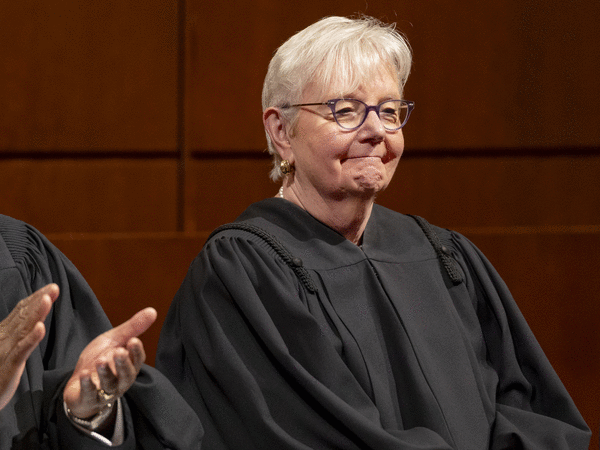
SPRINGFIELD — Mary Jane Theis became a judge in 1983, a few weeks before the biggest, most sweeping judicial corruption scandal in Cook County history came to a head.
Operation Greylord resulted in about 100 indictments and the conviction of more than a dozen judges. And throughout a career that eventually saw Theis elected to the Illinois Supreme Court and serve as chief justice, she said the scandal was a constant reminder that the judiciary in Illinois had once been a national disgrace and that judges must approach their roles with integrity, humility, and honesty.
“Judges must be competent and committed to the highest ethical standards,” she wrote in a letter to her colleagues on the high court. “We know that being a judge is not just another job — it is an awesome responsibility.”
On Monday, Theis, 76, announced that her historic judicial career was coming to a close and that she will retire from the state Supreme Court on Jan. 29 after serving more than four decades as a judge on all levels, including more than 15 years on the high court. One of five Democratic justices on the seven-judge panel, Theis served as chief justice of the Supreme Court from 2022 until her term for that role expired last year and she returned to being a regular justice.
Theis’ retirement allowed the high court to appoint 1st District Appellate Court Justice Sanjay T. Tailor, also a Democrat, as Theis’ successor, making him the first Indian American to serve on the state’s Supreme Court.
“I am grateful to Justice Mary Jane Theis and the other justices of the Illinois Supreme Court for their confidence and trust in appointing me Justice of the Illinois Supreme Court,” Tailor said in a statement. “I also look forward to continuing the work of the Illinois Supreme Court to ensure that our system of justice serves all people fairly and equitably.”
The Supreme Court has constitutional authority to fill interim judicial vacancies. Tailor’s term will start Jan. 30 and run through Dec. 4, 2028. Supreme Court justices serve 10-year terms, and Theis was up for reelection in 2032.
Theis became the fourth woman to serve on the state Supreme Court when she succeeded now-retired Justice Thomas R. Fitzgerald in 2010. She also was the fourth woman to serve as chief justice of the high court in 2022 when she succeeded Justice Anne Burke.
Born in Chicago in 1949, Theis was the only child of Cook County Judge Kenneth R. Wendt and his wife, Eleanore. Though her father also served as an Illinois state representative, Theis’ memories of him as a judge stood out. In a news release announcing her retirement, she recalled that while in high school, she would watch legal proceedings in her father’s courtroom.
“It was a time when the law was changing very rapidly. He heard a lot of narcotics cases, and it was a time when issues about the Fourth Amendment (meant to protect people from unlawful searches by law enforcement) were not only on the front pages of the newspapers, but also were important cases in the United States Supreme Court, and it seemed so compelling and exciting,” she said in the statement.
Former Illinois Senate President John Cullerton said he met Theis when they applied for work as assistant Cook County public defenders in the 1970s, and they became good friends before she became the godmother of his daughter. He said her father’s influence as a judge and legislator helped Theis navigate the judicial and political worlds.
“I would say that (in) observing her rise through the court system that I was particularly proud of the fact that she became a chief judge because then I had an opportunity to interact with her in a professional manner as the Senate president,” said Cullerton, a Chicago Democrat who served in the Illinois General Assembly from 1979 to 2020 as a member of the House and later as a senator, including 11 years as Senate president. “She, in addition to her really great judicial background, also had kind of a political background in her mind, and that was an advantage when she was a chief judge, because as the chief judge, she had to actually interact with the legislature in a number of matters.”
Theis earned her bachelor’s degree from Loyola University Chicago in 1971 and her law degree from the University of San Francisco’s law school in 1974. She returned to Chicago and served as an assistant Cook County public defender until 1983, when she became an associate Cook County judge. She was elected to the bench in 1988 as a circuit judge, was assigned to the 1st District Appellate Court in 1993, and was elected to the panel the following year.
As chief justice of the high court, Theis authored the 2023 opinion rejecting legal challenges from county prosecutors seeking to invalidate a controversial provision that eliminated cash bail as part of Illinois’ sweeping overhaul of the state’s criminal justice system, known as the SAFE-T Act.
The state Supreme Court upheld the provision 5-2 along party lines, with dissents coming from the two Republican justices, David Overstreet and Lisa Holder White.
“The Illinois Constitution of 1970 does not mandate that monetary bail is the only means to ensure criminal defendants appear for trials or the only means to protect the public,” Theis wrote in the majority opinion. “Our constitution creates a balance between the individual rights of defendants and the individual rights of crime victims.”
“Statutes enjoy a strong presumption of constitutionality because the legislature is principally responsible for determining the public policy of our state,” she also wrote.
In 2012, Theis also wrote the opinion in People v. Wrice regarding the 1983 conviction of Stanley Wrice for the abduction, rape and sexual assault of a Chicago woman. Wrice’s lawyers claimed he had been severely beaten into a confession by two police detectives who worked under Jon Burge, a Chicago police lieutenant who was later promoted to commander before being fired on allegations stemming from the torture of Black criminal suspects.
Wrice was convicted by a jury and spent three decades behind bars after prosecutors introduced his alleged confession, despite there being no physical evidence linking him to the crime. But after a special prosecutor investigated beatings at the hands of Chicago police, the Illinois Appellate Court ordered a hearing on Wrice’s torture claim.
Prosecutors appealed to the Supreme Court before Theis wrote in a ruling in Wrice’s favor that “use of a defendant’s physically coerced confession as substantive evidence of guilt is never harmless error. The defendant has satisfied the cause-and-prejudice test for successive postconviction petitions,” a news release said. Wrice was eventually exonerated.
In a statement on Monday, Illinois Attorney General Kwame Raoul thanked Theis for her years of service.
“Justice Mary Jane Theis’ unwavering leadership has been the hallmark of her term as a Supreme Court justice,” Raoul said. “During frequent arguments before the Supreme Court, attorneys from my office have experienced the professionalism with which the court conducts itself under her leadership. I am grateful for Justice Theis’ service to the people of Illinois.”
____
©2026 Chicago Tribune. Visit at chicagotribune.com. Distributed by Tribune Content Agency, LLC.






Comments