U.S. slaps visa charges on Cuba, Venezuela. Experts call it anti-immigrant red tape
Published in News & Features
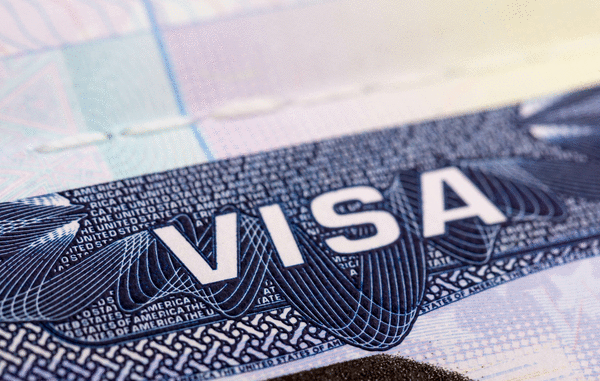
Travelers from several countries visiting the United States for tourism and business purposes are now being required to pay a “visa bond” between $5,000 to $15,000 that experts say is designed to drown immigrants and travelers in bureaucracy.
The State Department expanded its visa bond program this week to more than three dozen new countries, including Cuba, Venezuela, Antigua and Barbuda and Dominica. Under the pilot program, consular officers set hefty fees on people applying for B1/B2 visas, used to travel the U.S. for tourism and business.
But the policy’s impact will be minimal for countries whose students, tourists, and professionals are already banned under a presidential proclamation in June blocking Cubans, Venezuelans, Antiguans, Barbudans, Dominicans and nationals from over a dozen other countries. Instead, the overlapping policies are part of an overarching strategy of layering bureaucratic hurdles to reduce legal immigration altogether, especially from certain nationalities, lawyers told the Miami Herald.
“The door that’s immediately in front of you is closed, and if you somehow manage to open that one, you encounter another door that is also shut that you then have to deal with,” said Jorge Loweree, managing director of Programs and Strategy at the American Immigration Council. Loweree added that the visa bond might also be the Trump administration’s insurance in case the federal courts stop the travel ban.
The presidential proclamation, announced in June 2025 and expanded in December, suspends a person’s ability to enter the United States. Some countries are subject to a partial ban, others to a full ban. The State Department has stopped issuing many visas altogether for the 39 countries listed under the travel ban, save for limited exceptions.
Under those narrow limitations — like the person’s entry into the U.S. being in the national interest or a professional athlete coming for a major sporting event— someone could still be issued a visa and subjected to the bond, said Shev Dalal-Dheini, senior director of Government Relations at the American Immigration Lawyers Association.
“These exceptions are going to be in very rare instances,” Dalal-Dheini said. The June proclamation included exceptions for immediate relatives of U.S. citizens such as spouses, foreign adopted children, and others. The December proclamation did not have those exceptions.
The development comes days after the United States snatched Venezuelan leader Nicolás Maduro and as President Donald Trump foreshadows that the Cuban government will soon collapse on its own. It also comes as Dominica and Antigua and Barbuda brokered agreements to accept deportees from the United States as part of the Trump administration’s aggressive expansion of third country deportations.
The Trump administration announced the visa bond program last year. It runs through August 2026. The original list focused on African countries. After its expansion, the list continues to be dominated by nations in the African continent, but also includes Asian nations like Bangladesh, Bhutan, Kyrgyzstan, Nepal, Tajikistan and Turkmenistan; and island nations within Oceania, like Fiji, Tonga, Tuvalu and Vanuatu.
“The administration has clearly identified countries that they deem to be undesirable, and they are targeting very intentionally and carving their citizens out of our immigration system,” said Loweree.
Travelers from the countries with visa bond requirements can only fly in and out of Boston Logan International Airport, John F. Kennedy International Airport, and Washington Dulles International Airport. A Herald review of future flights in the coming month shows no direct flights from the capital cities of Havana in Cuba and Rousseau in Dominica. There is one daily nonstop flight to JFK from St John’s in Antigua and Barbuda, but no directs to Boston and Washington D.C. There have been no direct flights from Venezuela to the U.S. since 2019.
To enter the United States, travelers must clear customs at the first airport where they land, even with connecting flights to the U.S. That means travelers subject to the visa bond who make it past the travel ban will need to first travel to other countries with nonstop connections to those three U.S. airports and have the required visas to enter the other country— adding burdensome airfare and travel time.
Under the visa bond program, the federal government returns the bond amount to applicants whose visas are denied, if visas expire before travel, or if a traveler leaves before their visa expires. However, the State Department breaches of the visa bond program include overstaying in the United States and claiming asylum on a non-immigrant visa.
According to the Federal Register, the rule targeting certain foreign nationals is based on factors including visa overstay rates, whether foreigners can acquire citizenship in those nations through financial investments, and gaps in screening and vetting information. Data from the Department of Homeland Security’s Fiscal Year 2024 Entry/Exit Overstay Report, which the Federal Register cites, show that Cuba and Venezuela do not have the highest overstay rates. Antigua and Barbuda nationals had a B‑1/B‑2 visa overstay rate of 1.19%, Dominicans nationals had a rate of 4.09%, Cuban nationals had a rate of 6.84 percent, and Venezuelan nationals had a rate of 8.42 percent. Other countries reported higher rates.
Sir Ronald Sanders, the ambassador of Antigua and Barbuda to the United States, said in a statement that no government included in the expanded visa bond list had been notified of their inclusion.
“The record shows that our country’s visitor overstay rate is consistently low, significantly below that of many countries not subject to bond requirements,” said Sanders. “Discussions are ongoing on removing restrictions for visas on legitimate Antigua and Barbuda travelers.”
Neither the visa bonds nor the entry suspension apply to existing visa holders already in the United States. The Trump administration must periodically review the travel ban. If the administration removes the ban from certain countries, then the visa bonds would apply to more travelers from currently banned countries. That hasn’t happened so far.
“It’s just continuing to make life difficult for individuals from these countries,” said Dalal-Dheini.
©2026 Miami Herald. Visit at miamiherald.com. Distributed by Tribune Content Agency, LLC.






Comments