NJ adopts 'bell-to-bell' cellphone ban policy for public schools
Published in News & Features
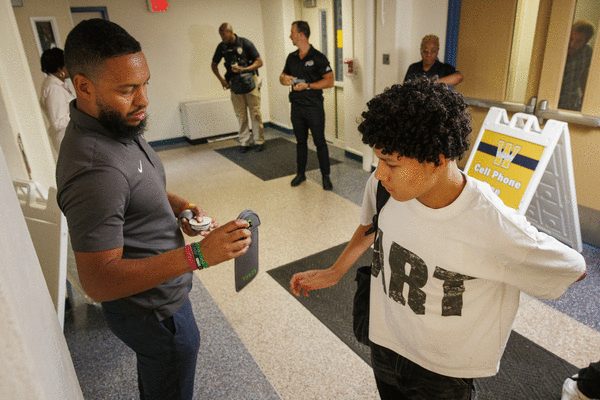
New Jersey Gov. Phil Murphy signed a law Thursday banning cellphones in New Jersey public schools from “bell to bell” in an effort to help students focus on learning.
New Jersey joins a growing number of states that have enacted tighter cellphone restrictions in schools to remove distractions. Pennsylvania is considering a similar measure, and 17 states have banned the devices in schools, according to ABC News.
Murphy proposed the restrictions last year during his annual State of the State address. Legislation then won bipartisan support in both houses.
During a bill-signing event at Ramsey High School in Bergen County, Murphy said the law would promote improved academic performance and student mental health.
“By getting rid of needless distractions, we are fundamentally changing our schools’ learning environments and encouraging our children to be more attentive and engaged during the school day,” Murphy said. “This is a sensible policy that will make a world of difference for our children.”
Murphy, who said he refrains from bringing his phone into meetings, borrowed a phone to use as a prop for the news conference because his was locked in his car.
“That will be locked up until I’m no longer governor,” said Murphy, who leaves office Jan. 20.
The bill was heavily endorsed by principals and teachers, who said valuable instruction time is lost when they have to direct students to put away the devices during class.
Experts say cellphones have become a growing distraction and hinder learning. Students have been using their phones to text friends and even to watch movies during class. The devices have also been used for cyberbullying.
Bans will not go into place in schools around the state, however, until next school year. The law requires the state Department of Education to develop guidelines for districts to draft polices restricting the use of cellphones and devices by students in classrooms and during the school day.
Local school boards that operate more than 600 districts across the state must then adopt a new policy. The law takes effect for the 2026-2027 school year.
Many districts in South Jersey, including Cherry Hill, Deptford, Moorestown, Washington Township, and Woodbury, already restrict cellphone use in classrooms, but the policies have not been consistently enforced and punishments vary. Some require students to store their phones in lockers all day, while others allow phones during lunch and breaks.
Some districts only require students to keep their phones turned off, while others provide locations for the devices to be stored during the school day.
Under the bell-to-bell approach of the new state law, students will not be permitted to access their phones for the entire school day.
Woodbury Superintendent Andrew Bell said a cellphone-free campus policy at Woodbury Senior High School has drastically changed the culture. There are fewer disciplinary issues and students interact more with classmates and teachers, he said.
“Students are noticeably happier, engaged and present in their classrooms, and connected to one another,” said Dwayne Dobbins Jr., acting co-principal of Woodbury Junior-Senior High School.
What happens next?
Districts must adopt policies restricting cellphones during the entire school day. That may require students to lock up the devices when they arrive or secure them in locked pouches.
In December, the state awarded nearly $1 million in grants to 86 districts under a new Phone-Free Schools Grant Program to help districts implement the policy. Schools had to agree to restrict cellphone use during the entire day.
In South Jersey, 12 districts in Burlington, Camden, and Gloucester Counties received grants. The grant amounts varied depending on the size of each district.
Gloucester City Superintendent Sean Gorman said his district used a $10,823 grant to install cabinets in classrooms where students in grades 7-12 must lock up their devices when they arrive for homeroom. Younger students are instructed to leave the devices at home, he said.
“We know it’s right for kids,” Gorman said. “If you let them bury their head in their phone for a good portion of the day they will.”
Other districts, like Woodbury, have opted to use locked pouch systems to store students’ phones. They retrieve their phones at the end of the day.
In Pennsylvania, similar legislation has bipartisan support and advanced out of a Senate committee last month.
What about parental concerns?
Not everyone agrees with the bans.
Some parents have expressed concern that they will not be able to reach their children, especially in the event of an emergency. School officials say parents will still be able to contact their children through the main office.
There have also been arguments by opponents that states are overreacting with the cellphone bans and that the legislation is unlikely to have the intended impact.
But groups have parents have also mobilized to speak out against cellphone use, circulating pledges to wait until eighth grade or high school to purchase phones for their children.
Are there exceptions to the ban?
Districts will have some flexibility to allow exceptions. For example, some students use their phones for medical conditions such as glucose testing.
Exceptions may also be made for students with individual education plans or IEPs and use devices such as tablets and ear buds as part of their curriculum.
Before the law signed Thursday, some districts allowed students to retrieve their phones during breaks, in the hallways between classes or during lunch. The law no longer permits that.
Will students be penalized?
It will be left to districts to decide how policy violations should be handled. Some districts with policies already have opted for a progressive discipline approach.
Gorman said Gloucester City has had 60 violations at its high school since the new policy took effect in September, down from 130 the previous year. The school has 731 students.
First-time offenders are given a two-day, in-school suspension and their phone is confiscated, Gorman said. A second offense gets a four-day, in-school suspension; three-time offenders are given a three-day, out-of-school suspension and remanded to an alternative program, he said.
Gorman said students have largely accepted the policy. The school has had fewer disciplinary problems and conflicts typically escalated through text messages have decreased, he said.
“We barely had any repeat offenders,” Gorman said.
_____
©2026 The Philadelphia Inquirer. Visit inquirer.com. Distributed by Tribune Content Agency, LLC.






Comments