NC public health officials urge vaccination as measles cases, flu deaths rise
Published in News & Features
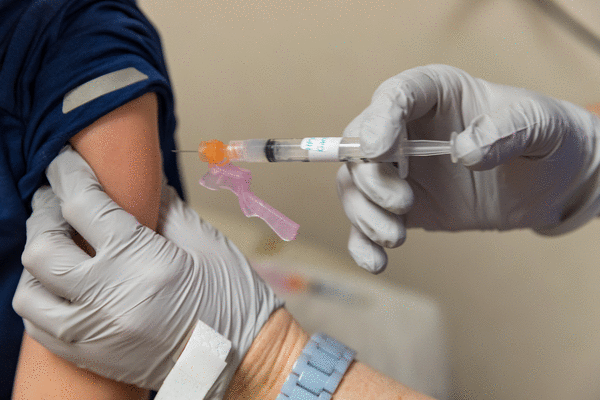
With multiple measles cases reported in North Carolina, rising flu deaths and shifting federal recommendations, state health officials stressed the importance of vaccination and urged people to contact their health care providers with questions.
“In North Carolina, we are seeing an increase in measles cases, an uptick in respiratory illnesses,” said North Carolina Health and Human Services Secretary Devdutta Sangvai, a member of Democratic Gov. Josh Stein’s Cabinet.
“It’s really important to reemphasize that vaccines are really the most effective means available to prevent illness, hospitalization and death,” he told reporters Wednesday.
The focus on vaccines comes as federal health guidance has shifted under the Trump administration, including changes coming from the U.S. Department of Health and Human Services, now led by Secretary Robert F. Kennedy Jr., a longtime vaccine skeptic.
The Centers for Disease Control and Prevention, part of Kennedy’s agency, changed its recommendations on childhood immunizations, reducing the number of vaccines it advises to be given to all children.
Sangvai said it is not too late to receive a seasonal flu vaccine and stressed that vaccination is especially important for young children and people with chronic health conditions.
“Sometimes people think it’s January and flu season is almost over. That’s not the case,” he said.
He also urged families to ensure they are up to date on the measles, mumps and rubella vaccine, warning that measles can be serious. The virus is highly contagious and can have long-term side effects. DHHS has a website to check measles immunity status and get guidance.
Flu cases
The flu outbreak in North Carolina eased a bit last week, but deaths continued to rise, with 22 additional fatalities bringing the season total to 71, The News & Observer previously reported. The majority of deaths are of people 65 and older.
Emergency department visits and hospital admissions for respiratory illness declined slightly from last year, though flu-like symptoms still accounted for more than 20% of ER visits statewide, The N&O reported.
In addition to vaccination, basic prevention steps can help limit the spread of respiratory viruses, said Kelly Kimple, the director of DHHS’s Division of Public Health. That includes frequent handwashing with soap and water, avoiding touching the eyes, nose and mouth, and cleaning and disinfecting commonly touched surfaces. She said people should cover coughs and sneezes with a tissue and stay home when sick, except to seek medical care or testing.
A state dashboard shows that about 20% of all people in the state have been vaccinated against the flu. Counties with the lowest vaccination rates are Clay, in Western North Carolina, and Currituck, in Eastern North Carolina, where under 7% of people are vaccinated.
“Even when vaccination rates across the state are high, having pockets where there are large groups of people who are unvaccinated or undervaccinated, does increase the risk for a larger outbreak,” said Erica Wilson, medical director of the Medical Consultation Unit in the Division of Public Health at DHHS.
Flu deaths are higher than at this point last year and the season appears to be starting earlier, Wilson said.
DHHS’ outreach includes a bilingual respiratory illness communications toolkit.
Measles cases
Several cases of measles in the state are tied to an outbreak in neighboring South Carolina.
“The risk of exposure is growing here in North Carolina,” said Kimple.
“We have been working to be prepared for this, and I’ve been working closely with Buncombe County to ensure we’re responding to this particular situation,” she said.
On Tuesday, DHHS announced that three siblings in Buncombe County had contracted measles. The family had visited Spartanburg County, South Carolina, where there is an ongoing measles outbreak, about one to two weeks before the children became sick, according to DHHS. Wilson said all three children had at least one dose of the measles, mumps and rubella vaccine.
Of the more than 2,000 measles cases reported in the U.S. in 2025, 93% involved people who were unvaccinated or had no documentation of immunity, Kimple said.
Another measles case was reported late last year in Polk County in an unvaccinated child and was likewise linked to exposure in Spartanburg County.
As of Tuesday, South Carolina is reporting 214 measles cases centered around the Spartanburg outbreak.
DHHS also reported a measles case last year involving a person who traveled through Gaston County while infectious. In December, another case involved an out-of-state resident who traveled through Terminal 2 of Raleigh-Durham International Airport while infectious.
A DHHS dashboard on measles vaccination rates among children shows low coverage in schools in Cherokee, Transylvania, Henderson and Polk counties, all in Western North Carolina.
Regarding counties with low vaccination rates, Wilson said the state has been working with local officials since measles cases began increasing to conduct outreach and prepare for potential cases.
The measles virus can remain in the air for up to two hours where an infected person was present, Kimple said, and symptoms can appear seven to 14 days after exposure. About 90% of unvaccinated people exposed to measles will become infected.
CDC recommendations change
Speaking on recent vaccine recommendation changes by the CDC, Sangvai said North Carolina does not anticipate changes to its childhood immunization guidance.
“I think (it’s) understandable that people are confused with changing guidance,” said Kimple.
“The scientific evidence around the vaccines has not changed. These vaccines are safe and effective to prevent serious illness and death, and it is normal to have questions, and so we encourage folks to talk with their health care provider.”
The CDC updated its immunization schedule for children on Monday. The update now recommends vaccines for flu, hepatitis A and B, meningococcal disease, rotavirus, RSV and COVID-19 for high-risk populations or through shared clinical decision-making, rather than for all children. Vaccinations against measles, mumps, rubella, polio, pertussis, tetanus, diphtheria, Haemophilus influenzae type B, pneumococcal disease, human papillomavirus and chickenpox remain recommended for all children, The Observer reported.
NC DHHS requires children to be vaccinated against measles, polio, meningococcal disease, chickenpox and other illnesses before they can go to school.
The federal government has said that previously recommended vaccines will continue to be covered by insurance and through the Vaccines for Children program that helps low-income families.
_____
©2026 Raleigh News & Observer. Visit newsobserver.com. Distributed by Tribune Content Agency, LLC.






Comments