Haiti police raids trigger deadly gang clashes, cutting off medical care in Port-au-Prince
Published in News & Features
The humanitarian aid group Doctors Without Borders, also known by its French name Médecins Sans Frontières, is once again suspending medical services at a clinic in Haiti’s gang-ridden capital of Port-au-Prince.
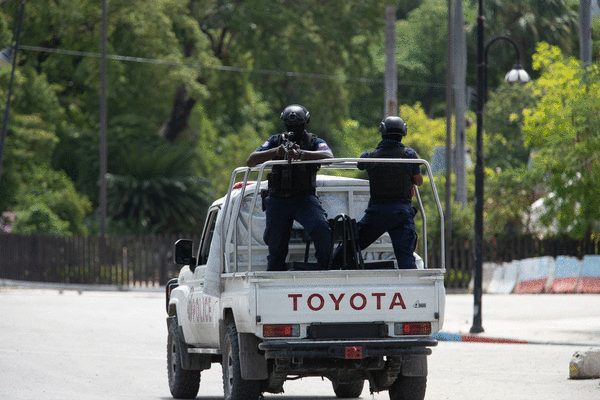
The latest suspension affects a clinic in the Bel-Air neighborhood, where residents report that intensified police raids — which have included the use of explosive drones — have led to increased deadly clashes between armed groups and the Haiti National Police.
Among those killed was a former Médecins Sans Frontières (MSF) community health worker who was unable to get medical attention after a building used by the aid group became a battleground during the intense fighting on Tuesday.
MSF said seven community volunteers were caught in the crossfire when they became trapped inside the former school building that they use as a clinic. After several hours, they escaped.
Minutes later, a community volunteer who had collaborated with MSF arrived at the building seeking medical attention for his injuries.
“Unable to receive first aid, he sadly died from his injuries in front of the building’s gate,” MSF said in a statement. “This situation is not an isolated case.”
The organization said the escalating violence is not only endangering the lives of thousands of civilians who live in the area of the ongoing police operations, but it’s “alarmingly compromising their access to health care.”
“The medical interventions we carry out in Bel Air and Bas Delmas provide essential care to several thousand patients every month,” said Nicholas Tessier, MSF head of mission in Haiti. “Without these clinics, they would be completely deprived of access to health care. Today, due to this new episode of violence, we are forced to suspend all our activities in Bel Air until further notice.”
In the last two years, MSF has been forced to temporarily close its clinics and in some cases, permanently shut down facilities because it has become too dangerous to operate. In its latest statement, the aid group called for all parties to respect medical facilities, healthcare personnel, patients and civilians.
Haiti National Police tout controversial anti-gang raids
Police have touted the operations, saying they have bulldozed homes of suspected gang members and seized firearms, including an M16. In the capital, where 1 in 4 individuals live in a gang-controlled neighborhood, according to the United Nations, reactions are mixed. While some see residents living in the targeted neighborhoods as being complicit with gang members who hide kidnap victims in homes and use children as lookouts, others are pleading for more compassion.
The police and the government need to rethink their operations so that they can target the real perpetrators of the insecurity so you are not “killing the poor people who have nothing to do with the violence, or the guns.,” Fritznel Pierre, a human-rights advocate said.
Pierre, who heads the Organization for Peace and Development, said his group estimates that at least 80 people have been killed since the security operations began at the start of the year. At least 40% of the deaths, he said, “were collateral damage” involving innocent residents who live in the areas being targeted because they have no other choice.
In Bel-Air alone, he said his group estimates there were at least 45 people who died, including a 12-year-old girl. In the La Saline neighborhood, where he was born, three deaths were recorded, including one of a 68-year-old woman who was shot in the stomach and died as she returned from buying plantains and meat to cook and sell and crossed paths with an armored police vehicle. The exact circumstances that led to her death are unclear.
Others, he said, were killed when bandits rounded up residents and forced them to dig holes to stop police armored vehicles from getting into the neighborhoods.
“Our position is clear, we cannot justify there being collateral damage because people live in these neighborhoods,” Pierre said. “There are a lot of factors for why people live in these neighborhoods, starting with they lack the economical means to live anywhere else.
“Imagine someone who is already being poor and is being asked to pay sums of money they’ve never touched in their lives to rent a house?” he said. “The people are often in a situation of resilience where they have no choice but to cohabitate with gangs not because they are complicit, but because they have no other choice.”
©2026 Miami Herald. Visit at miamiherald.com. Distributed by Tribune Content Agency, LLC.






Comments