DeSantis hails Maduro arrest while warning on asylum, TPS for Venezuelans
Published in News & Features
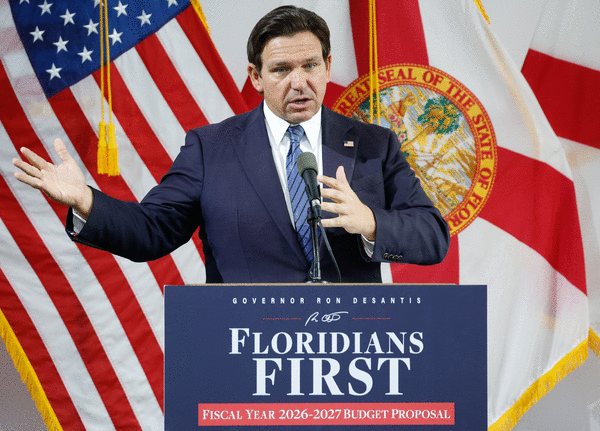
More than two days after U.S. forces apprehended Venezuelan dictator Nicolás Maduro, Gov. Ron DeSantis on Monday publicly endorsed the Trump administration’s move — tying the dramatic arrest to the lived experience of South Florida’s large Venezuelan exile community and his own hardline approach to immigration.
Speaking at a press conference, DeSantis said Maduro’s downfall marked the end of what he described as one of the most destructive regimes in the Western Hemisphere — a judgment he suggested resonates deeply in Miami-Dade and Broward counties, home to one of the nation’s latest Venezuelan populations.
“For many, many years, we’ve seen the country of Venezuela suffering under the yoke of Marxist ideology, first with Hugo Chávez and then with Nicolás Maduro,” DeSantis said. “We’ve had a lot of people in the state of Florida that have firsthand knowledge of that. There’s people that have fled to the United States. We have a big community in South Florida.”
Even as he invoked the plight of Venezuelan exiles, DeSantis appeared to support the Trump administration’s announcement that Venezuelans previously in the U.S. under Temporary Protected Status (TPS) can “go home to a country that they love,” as opposed to seeking asylum. The governor claimed that “90-something percent” of asylum seekers entering the country were “bogus,” adding that Congress should “really clean that up.”
Hundreds of thousands of Venezuelans nationwide lost TPS last year — leaving many of the roughly 230,000 Venezuelans with TPS living in Florida as of March 2025 vulnerable to deportation to a home country still mired in political and economic upheaval.
The comments marked DeSantis’ first remarks on Venezuela since Maduro’s capture on Saturday, as well as his most explicit embrace yet of the U.S. operation that brought Maduro into custody — and a notable shift in tone for the Republican governor, who for years urged caution on direct American military involvement in Venezuela’s internal crisis.
On Monday, DeSantis accused Maduro of squandering Venezuela’s oil wealth and plunging the once-thriving nation into poverty and oppression, echoing grievances frequently voiced by Venezuelan Americans in Miami.
“He took a country that had been prosperous and has an abundance of resources and basically destroyed it,” the governor said. “Making it miserable, repressed, and now one of the poorest countries.”
Without mentioning President Donald Trump specifically, DeSantis praised the legal and military actions that led to Maduro’s arrest, pointing to the U.S. indictments accusing the Venezuelan leader of narcotics trafficking. Maduro pleaded not guilty on Monday in federal court in Manhattan.
“Maduro was indicted, and he is the head of a drug cartel,” DeSantis said. “He was releasing people from his prisons and sending them to our southern border under the Biden administration. He deserves to be brought to justice.”
The remarks dovetailed with DeSantis’ broader immigration platform, which has been a cornerstone of his political brand and a key issue for South Florida voters ahead of the 2026 election cycle.
For much of his tenure, DeSantis has struck a more restrained public posture on Venezuela than some fellow Republicans, even as he cultivated strong support among Cuban and Venezuelan Americans. In 2019, shortly after taking office, he warned against U.S. “boots on the ground” and urged that regime change ultimately had to come from Venezuelans themselves.
More recently, however, DeSantis has signaled greater openness to military action linked to drug trafficking. At a recent event in West Palm Beach, he argued the U.S. had the right to treat “narco-terrorists” operating from Venezuela as a military threat, citing the reported death toll from cartel-driven drug trafficking.
For many in South Florida — where Venezuelan restaurants, civic groups and exile communities have flourished amid successive waves of migration — Maduro’s arrest has been welcomed as a moment of vindication. But questions remain about what a post-Maduro Venezuela will look like, and how U.S. policy under Trump could reshape the region.
Since seizing Maduro, Trump has sidelined Venezuelan opposition leader María Corina Machado, a Nobel Peace Prize winner and longtime Trump supporter, and questioned her support and respect inside Venezuela. Trump has instead backed Maduro’s vice president, Delcy Rodríguez, whom U.S. Secretary of State Marco Rubio has spoken with directly about cooperating with Washington’s transition agenda — even as Rodríguez publicly rejects U.S. claims and calls for Maduro’s release.
The Trump administration is signaling an explicitly interventionist U.S. role in Venezuela’s futures, particularly around its vast energy sector. He has publicly framed the country’s oil as central to economic recovery, promising that American companies will invest “billions of dollars” to rebuild the country’s crumbling oil infrastructure and tap into its massive crude reserves, with the goal of selling Venezuelan oil internationally to help stabilize the country’s economy.
_____
©2026 Miami Herald. Visit miamiherald.com. Distributed by Tribune Content Agency, LLC.




Comments