'Truly an amazing act': Idaho doctor donates year's salary to cure blindness
Published in News & Features
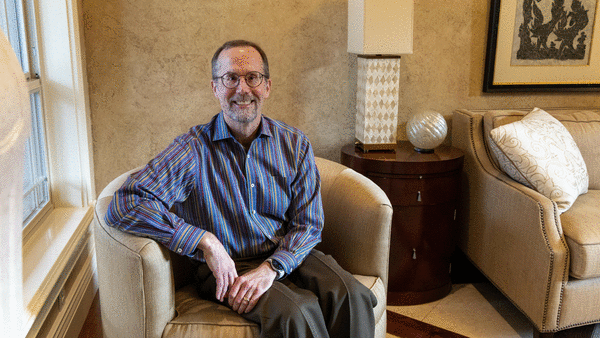
BOISE, Idaho — One Treasure Valley doctor is putting off his retirement and doing something “profound” with his last year in the emergency room.
Stuart Clive, who was a longtime St. Luke’s Medical Center emergency room physician, is donating an entire year’s salary in an effort to cure blindness for thousands of people.
Clive works at Weiser Memorial Hospital, and starting in November, with each 24-hour shift, he has been raising money for the Cure Blindness Project.
Clive didn’t wish to disclose his exact salary, but the amount will be enough to fund sight restoration surgery for more than 1,000 patients, among other things.
The doctor told the Idaho Statesman that after 17 years of working in emergency rooms, each day at work is more “meaningful.”
“Sometimes it feels like just another day, another shift, seeing another patient. But then when you stop and reflect, it can be really meaningful,” Clive said. “I had a shift where I was up all night, and it was up at 5 in the morning. It was rough, pretty continuous, all shift long. And I just sat, and I reflected, ‘Is there anywhere I’d rather be than this, and giving what is being accomplished by it?’”
The global nonprofit organization that Clive chose to dedicate his salary to works to build cost-effective and sustainable eye-care systems in underserved communities, according to the Cure Blindness Project website.
The organization says an estimated 43 million people worldwide suffer from blindness, yet 80% of those cases are treatable or preventable. Cure Blindness Project builds infrastructure for eye care, provides treatment for restoring or retaining sight, and sets up programs to train ophthalmologists.
Clive’s donation will fund the completion of an eye-care center and teaching facility in the West African nation of Ghana, and fund over 1,000 sight restoration surgeries, he told the Statesman in an interview.
The organization started construction after receiving a grant from the U.S. Agency for International Development in 2020. But completion of the center was halted when USAID was shut down and the grant was pulled in July 2025 as part of the Elon Musk-run Department of Government Efficiency’s targeted closures of agencies.
The organization’s CEO, Katherine “K-T” Overbey, said Clive’s donation will transform the region by bringing quality eye care that will change people’s lives.
According to Overbey, there are over 230,000 people in Ghana who need eye care, and doctors have access to operating rooms at the center once a week. This will be the only center in the region to provide necessary operations. The residency tied to the center will also create a “virtuous cycle” to train future ophthalmologists for the region.
“It’s truly an amazing act, the impact he’ll make around the globe, and I think he’ll serve as a role model for others to do something similar,” Overbey told the Statesman.
Cure Blindness Project documentary
Clive first heard about the organization years ago through a documentary, and said he was inspired by the organization’s ability to use what few resources it had to provide life-changing care for thousands of people. Ever since then, he’s been a regular donor to the nonprofit.
After many conversations with his family, Clive decided that dedicating a year’s worth of pay would be a tangible sacrifice to make a meaningful difference.
“It’s kind of a test of your charity. Just doing this for one shift would be a great donation. But I wanted to do it long enough that the luster would wear off and that I really would feel like I was sacrificing to make a difference,” Clive said.
Clive also said that the decision to donate that much money to charity came with the responsibility of trying to make the biggest impact on individual lives, and he found that in the Cure Blindness Project.
“They are believers that they are on a mission,” Clive said. “You know that when they communicate with me, they very much seem to believe that they are making a difference in these people’s lives, and they feel it.”
Clive’s donation is the first of its kind in the organization’s history, Overbey told the Statesman.
“I am always incredibly grateful when people are willing to give themselves for people they’ve never met, and completely change their lives,” Overbey said. “It restores my faith that there are so many people wanting to change the world.”
Clive said he’s unsure of what lies ahead after his official retirement, but he said he will probably continue working in some capacity. He and his wife are also making plans to visit the center in Ghana after its completion.
Clive said the work he is doing has been the culmination of why he wanted to become a doctor. He told the Statesman that his initial drive years ago came from wanting to provide health care to those who didn’t have adequate access.
“I would challenge someone to just ask that same question that I asked myself, ‘How long would you work to cure an utter stranger of blindness and make that permanent difference in their lives?’” Clive said.
_____
©2025 The Idaho Statesman. Visit idahostatesman.com. Distributed by Tribune Content Agency, LLC.






Comments