Analysis: Trump has not endorsed Venezuela regime change as Wiles stresses 'blowing boats up'
Published in News & Features
WASHINGTON — Two words have been missing from the Trump administration’s tough-talking, Navy-deploying policy toward Venezuela: or else.
While President Donald Trump and some top aides have expressed deep concerns about Venezuelan President Nicolás Maduro, who controversially rose to power in 2013 following the death of Hugo Chávez, they have stopped short of endorsing regime change or demanding he give up power no matter what, signaling a murky — at best — policy endgame.
The Trump administration, in recent months, has tried to weaken Maduro’s hand by slapping new sanctions on his country’s oil sector and members of his family. Trump has ordered American forces to “kill” drug traffickers in the Caribbean whom he claims have been moving illegal narcotics from Venezuela to the U.S. And last week, U.S. military forces took control of a sanctioned tanker off the Venezuelan coast — with Trump vowing to keep the oil inside the massive vessel. Administration officials have said additional tanker takeovers were possible if they determined that sanctioned oil was onboard.
Trump and some aides have described his Venezuela policy as “maximum pressure,” but there are signs of maximum containment. A White House official late last week would not say whether Trump desired new leadership in Caracas, even while describing Maduro as “not the legitimate leader of Venezuela.”
The transactional Trump has seemed mostly interested in trying to untether Venezuela from American foes such as China, Iran and Russia. What’s more, Trump’s order last week to seize the “Skipper” oil tanker, which U.S. officials contended was carrying oil from Venezuela and Iran, raised new questions about whether the White House was also looking for a way to get American energy firms back into the oil-rich South American country.
What White House press secretary Karoline Leavitt described Thursday was more of a sanctions enforcement crackdown aimed at weakening drug cartels rather than a regime-change operation. The president’s “No. 1” priority, she said, was to stop “the flow of illegal drugs into the United States of America.”
“The president promised on the campaign trail that he would demolish the foreign terrorist organizations and drug cartels around the world, especially right here in our own hemisphere. And you have seen that he is delivering on that promise,” she told reporters during a briefing, later adding: “I will just reiterate that the Trump administration is executing on the president’s sanction policies and the sanction policies of the United States and we’re not going to stand by and watch sanctioned vessels sail the seas with black-market oil, the proceeds of which will fuel narco terrorism of rogue and illegitimate regimes around the world.”
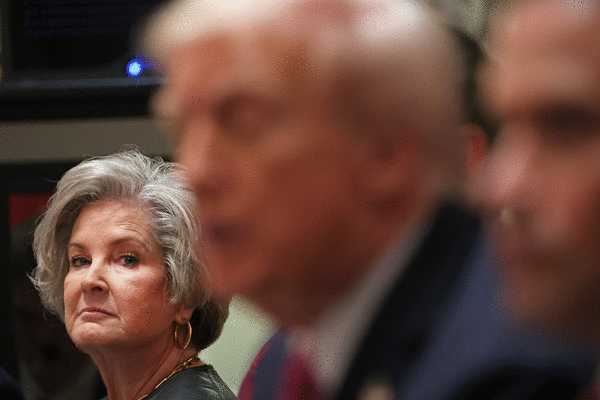
White House chief of staff Susie Wiles, in an article published Tuesday by Vanity Fair based on a series of conversations with journalist Chris Whipple, also stopped short of saying that Maduro must give up power.
“[Trump] wants to keep on blowing boats up until Maduro cries uncle. And people way smarter than me on that say that he will,” she told the magazine, which also reported at-times critical remarks from Wiles about Trump and top administration officials such as Vice President JD Vance. (Wiles slammed the magazine’s story in a Thursday X post, calling it a “disingenuously framed hit piece on me and the finest President, White House staff, and Cabinet in history.”)
For his part, Trump has mostly tried selling his Venezuela policy as targeting drug cartels and those who move their products into the United States. “I think we’re just going to kill people that are bringing drugs into our country, OK?” he told reporters during an October exchange.
Further muddying the president’s ultimate goal, Wiles also stressed her boss’s focus on cartels and traffickers in her remarks to Vanity Fair. “The president believes in harsh penalties for drug dealers, as he’s said many, many times,” she said. “These are not fishing boats, as some would like to allege.”
What’s more, Wiles said the commander in chief returned to office in a distinct anti-war mood.
“I cannot overstate how much his ongoing motivation is to stop the killing, which is not, I don’t think, where he was in his last term,” she said. “Not that he wanted to kill people necessarily, but stopping the killing wasn’t his first thought. It’s his first and last thought now.”
But some Democrats have their doubts.
“Let’s not mince words. Donald Trump wants to start a war in Venezuela on behalf of Big Oil,” Massachusetts Rep. Jim McGovern wrote in a Dec. 13 X post. “Our answer must be Hell No.”
The first Trump administration went hard at Maduro with sanctions, the formal recognition of opposition leader Juan Guaido as the country’s legitimate president and indictments of drug traffickers hailing from Venezuela.
While Trump has parked a U.S. Navy aircraft carrier strike group near the Venezuelan shore, the top Democrat on the Senate Intelligence Committee isn’t sure of his intentions.
“I do not know what this president’s goal vis-à-vis Venezuela is,” Virginia Sen. Mark Warner told ABC’s “This Week” on Sunday, while adding that “[American] boots on the ground in Venezuela could be a disaster.”
‘I’m not going to tell you’
For his part, the president has kept his cards close — and tried to focus his team’s messaging on efforts to curb narcotics flows from Venezuela.
“I’m not going to tell you that,” Trump fired back at a reporter Friday when asked if he had plans to seize more Venezuelan oil assets.
“It wouldn’t be very smart for me to tell you that. We’re supposed to be a little bit secretive,” he said. “I don’t think I want to tell a big-time reporter or a small-time reporter that, but we are knocking out drugs at levels that nobody’s ever seen before.”
On Capitol Hill, senior members of both parties have vowed to look into a Sept. 2 U.S. military strike on an alleged drug-ferrying vessel that included a second strike that killed survivors. The White House deployed Secretary of State Marco Rubio and Defense Secretary Pete Hegseth on Tuesday to brief lawmakers behind closed doors about that incident. Democrats, and some Republicans, have cautioned Trump against starting a war with the South American country.
As is the case on other policy issues too, there hasn’t been a groundswell of Republican criticism to what Trump has been doing on Venezuela or Maduro. Many GOP members have opted to take him at his word that paring drug flows is the primary motivation.
“The fact of the matter is that the president is doing exactly what he was elected to do: to take out and strike the narco terrorists who are flooding drugs into this country,” Senate Armed Services member Jim Banks of Indiana told Fox News on Sunday. “As far as I’m concerned, a member of not just the Armed Services Committee but as a United States senator, I know everything that I need to know — and that’s that President Trump is doing what he is supposed to do as commander-in-chief to save American lives.”
Like Trump and his aides, Banks did not call for Maduro’s ouster or resignation.
An analyst at the Center for Strategic and International Studies noted that the recent oil tanker seizure and any new ones would send a message to Moscow and Beijing.
“Russia and China would have outsized vulnerabilities in a world of greater sanctions enforcement that may include physical seizures, and not only by the United States. Washington’s seizure of Skipper could inspire other sanctioning authorities to implement similar operations, for example, in the Danish straits, through which close to half of seaborne Russian crude exports transit,” senior fellow Clayton Seigle wrote for the think tank.
“Introducing tanker seizures as a tool in Washington’s toolkit will certainly raise eyebrows in China, whose imports of oil from sanctioned suppliers, Russia, Iran, and Venezuela, constitute more than a quarter of its import supply chain,” he added.
In a Monday email, Seigle said the White House needed “to carefully weigh the potential costs and benefits of a military intervention to avoid the unintended consequence of cutting oil output.” He said that was especially the case “at a time in which new oil sanctions against Russian oil companies have, at least temporarily, reduced oil deliveries to Moscow’s main customers in India and China.”
©2025 CQ-Roll Call, Inc., All Rights Reserved. Visit cqrollcall.com. Distributed by Tribune Content Agency, LLC.




Comments