US payrolls rise after October drop, unemployment marches higher
Published in News & Features
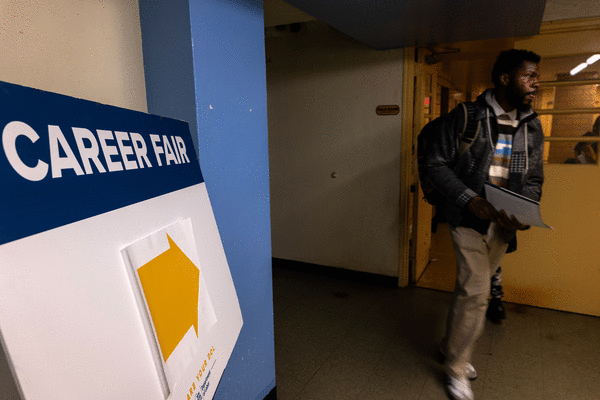
U.S. job growth remained sluggish in November and the unemployment rate rose to a four-year high, pointing to a continued cooling in the labor market after a weak October.
Nonfarm payrolls increased 64,000 in November after declining 105,000 in October, adding to the choppiness seen in the labor market in recent months. The unemployment rate rose to 4.6%, according to Bureau of Labor Statistics data out Tuesday, continuing its upward climb as many out-of-work Americans struggled to land new jobs.
The decline in October payrolls, which was the largest since the end of 2020, was due to a 162,000 plunge in federal government employment as workers who accepted the Trump administration’s deferred resignation offers officially dropped off payrolls.
While the data come with caveats, the report will help inform investors’ expectations for the path of interest rates next year. The Federal Reserve lowered rates for a third straight meeting last week to support what Chair Jerome Powell called a “gradually cooling” labor market with “significant” risks of a further slowdown.
However, Fed officials are split over whether more cuts are needed next year. The median Fed official penciled in just one reduction in 2026, according to rate projections released alongside the decision, but some policymakers see no further cuts. Traders, meanwhile, have been counting on two.
“The labor market remains weak, but the pace of deterioration probably is too slow to spur the FOMC to ease again in January,” said Samuel Tombs, chief U.S. economist at Pantheon Macroeconomics, referring to the Fed’s policy-setting Federal Open Market Committee.
The S&P 500 fell, along with the two-year Treasury yield. The dollar remained lower.
A separate report out Tuesday showed retail sales were little changed in October as a decline at auto dealers and weaker gasoline receipts offset stronger spending in other categories. And figures from S&P Global showed U.S. business activity expanded in December at the slowest pace in six months, while a measure of input prices jumped to a more than three-year high.
The advance in November payrolls was driven by health care and social assistance as well as construction. Private payrolls increased by 69,000 in November after adding 52,000 jobs the prior month. Employment fell in transportation and warehousing as well as leisure and hospitality.
“From the private sector point of view, it’s just about what we’ve been getting all year,” Kevin Hassett, director of the White House National Economic Council, said on CNBC. It’s a “solid upward trajectory.”
The rise in the unemployment rate from September to November reflected a surge in those returning to the workforce. The participation rate — the share of the population that is working or looking for work — also ticked higher. The rate for workers age 25-54, known as prime-age workers, edged up from September.
Meanwhile, the number of people who are long-term unemployed — or out of work for 27 weeks or more — rose to one of the highest levels since the end of 2021. Those working part time for economic reasons jumped by the most since the onset of the pandemic.
The unemployment rate for Black Americans jumped to 8.3%, the highest since 2021, in part reflecting increased participation. The jobless rate also surged for Black teenagers.
Other data also suggest the labor market is sluggish. U.S. job openings picked up in October, though there was less hiring and more layoffs. Planned layoffs have been high in recent months, reflecting announcements from U.S. companies like Verizon Communications Inc. and Amazon.com Inc. and subsequently weighing on consumer sentiment.
Shutdown impact
The BLS canceled the October jobs report and combined that month’s payrolls with the November release because of the record-long government shutdown. While it wasn’t able to conduct the household survey retroactively to produce an unemployment rate for October, the payrolls number is derived from a separate survey of businesses that many firms independently report online.
The government shutdown impacted the figures in other ways too.
Federal payrolls fell another 6,000 in November after the biggest one-month plunge since 2010. About 144,000 federal employees took the administration’s deferred resignation offer, the Office of Personnel Management said last week, which allowed them to leave early in the year but still be paid through the end of September.
The agency also extended the collection periods for both the household and establishment surveys for November. The November report was originally due Dec. 5.
BLS said the November household numbers are slightly more variable than usual, due to a lower response rate and analysis over a two-month period instead of the typical one. Because the government reopened before the end of the November reference week, federal government workers were counted as employed.
“It is not possible to precisely quantify the effect of the federal government shutdown on household survey estimates for November,” the agency said.
Technical factors
Speaking after the Fed’s decision last week, Powell said he and his colleagues think payrolls have been overstated recently by about 60,000 a month. He seemed to be alluding to an annual revision early next year that will benchmark the payrolls data to a more accurate but less timely series.
Powell also said officials are wary that the latest household survey, which informs the unemployment rate, may be distorted by “very technical factors.”
Separately, the employment report showed average hourly earnings rose 0.1% in November after jumping 0.4% in the prior month. Economists pay close attention to this metric as a driver of household spending, which has become even more bifurcated as the wealthiest Americans disproportionately propel spending.
Aggregate weekly payrolls — a measure that combines employment, hours worked and hourly earnings and serves as a proxy for total labor income — rose firmly. The average workweek lengthened slightly.
What Bloomberg Economics says...
“Both October’s and November’s jobs prints appear weak. There’s a glimmer of (very gradual) improvement in private-sector hiring, with AI data-center demand providing some hiring impetus for construction workers. But the concentration of hiring is worrisome — and in hindsight, the FOMC was correct to cut rates at the December meeting.” —Anna Wong, Stuart Paul and Chris G. Collins, economists
(With assistance from Chris Middleton, Jarrell Dillard, Vince Golle and Christopher Condon.)
©2025 Bloomberg L.P. Visit bloomberg.com. Distributed by Tribune Content Agency, LLC.






Comments