State officials meet to discuss sewage crisis. Residents want solutions. 'Don't talk about it; help us.'
Published in News & Features
Avery Korkorowitz said she’s been recovering from a recent asthma attack that lasted three days.
“I couldn’t breathe, I was gasping constantly,” said Korkorowitz, an Imperial Beach resident of four years. “It was terrifying. Maybe the scariest thing that’s ever happened to me.”
Speaking in Imperial Beach on Monday from her car after county staff loaded her trunk with an air purifier and two filters, Korkorowitz said her asthma attack was the direct result of polluted air stemming from an environmental and public health catastrophe many experts are calling the worst of its kind in the nation: the Tijuana River sewage crisis.
“I hadn’t had an asthma attack since I was a kid, since forever,” she said.
Earlier this year, when the San Diego County Air Pollution Control District launched a $2.7 million program to distribute 10,000 indoor air purifiers amongst three South Bay communities, it was intended to be a temporary solution to a much more pervasive threat.
This week, California state officials held a series of public meetings across the county to discuss public health responsiveness, wastewater infrastructure and U.S.-Mexico relations related to the crisis. And while residents like Korkorowitz expressed gratitude for all the attention finally being paid to the long-ignored problem, many said they wanted something more fundamental and yet painfully out of reach: to breathe easily again.
“I appreciate all the work that everyone is doing, but it just doesn’t feel like enough, not nearly enough,” Korkorowitz said. “I don’t even know what we can do. It’s like living next to an open sewer every day.”
The Hot Spot
Meetings ranged from Thursday’s State Senate Environmental Quality Committee hearing in La Jolla, chaired by Sen. Catherine Blakespear, to a three-day California Coastal Commission meeting in Imperial Beach from Wednesday to Friday.
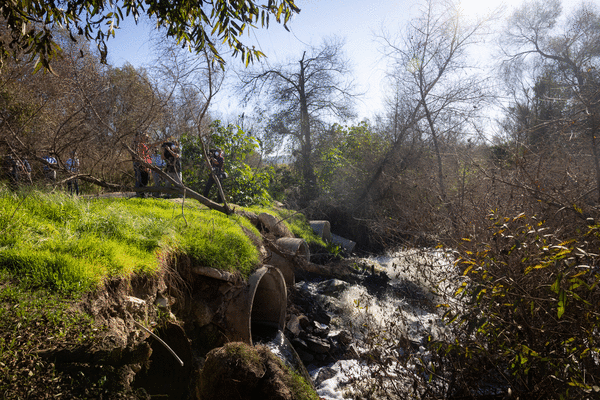
Though topics and discussions varied, one constant feature came up time and again. Officials repeatedly discussed the so-called “hot spot” on Saturn Boulevard, where raw sewage and industrial waste flowing from four concrete culverts create a toxic waterfall that aerosolizes pollutants and spreads them by wind into Imperial Beach, Nestor and San Ysidro.
The foam produced by the aerosolization is visible from space via satellite imagery. Eleven schools sit within 1.5 miles of the hot spot, exposing thousands of children to toxic pollutants on a regular basis.
One such pollutant is a gas known as hydrogen sulfide, which can cause breathing difficulty, skin and eye irritation, as well as other chronic health conditions.
The APCD has set a safe exposure threshold for the gas under 30 parts per billion (ppB) — a figure surpassed almost daily during the months of March to June, according to APCD monitoring data, with some days getting as high as 400-500 ppB.
Kimberly Prather, an atmospheric chemist at the Department of Chemistry and Biochemistry at UC San Diego, said during the Environmental Quality Committee hearing that establishing a universal safe threshold for hydrogen sulfide has been difficult. But she said the California Office of Environmental Health Hazard Assessment has set its standard to 7.3 ppB.
“If you’re breathing over 7.3 ppB every day, that’s not good,” Prather said, adding the U.S. Environmental Protection Agency showed levels above even 1.4 parts per billion can cause long-term health impacts over a lifetime of exposure.
Prather and her team found hydrogen sulfide levels exceeding 4,000 ppB in areas surrounding the river and up to 20,000 ppB directly at the hot spot.
“There should be no river. It’s not a river,” Prather said of the Tijuana River, a once seasonal water source that only flowed during periods of rain. “It is flowing wastewater, pure flowing wastewater. It’s not diluted by rain.”
Blakespear, who visited the hot spot after the hearing, addressed concerns from residents who feel that the state of California doesn’t care about them.
“We’re setting the policies around air standards and water standards, and we’re also figuring out what things to fund,” Blakespear said. “Having us know about (the crisis), focus on it, have it be a priority from the entire delegation in San Diego — I do think you’re seeing that, and that shows we care. The complexity around it being an international issue and a federal issue has added to the difficulties about who should act.”
Students recount losses
Since 2018, approximately 200 billion gallons of sewage has crossed the border, closing Imperial Beach for 296 days in 2024 alone — nearly 88% of the year — and impacting beaches as far north as Coronado and Point Loma.
The crisis stems from outdated and broken infrastructure on both sides of the border, insufficient treatment capacity at the South Bay International Wastewater Treatment Plant (IWTP), and massive population growth in Tijuana. The majority of the Tijuana River Valley watershed lies in Mexico, with gravity pulling untreated or partially treated sewage downstream into San Diego communities.
Officials are pursuing infrastructure fixes at the Saturn Boulevard hot spot, while others are working with the U.S. International Boundary and Water Commission on larger infrastructure improvements — like bolstering the IWTP to treat 50 million gallons of wastewater per day, as well as potential river diversion projects.
In the meantime, residents such as a dozen students who spoke at Wednesday’s meeting of the California Commission continue to suffer as they scramble to replace what the crisis has stolen from their daily lives.
Eric Camberos lost weekend beach trips with his mother, their tradition of collecting purple limpet shells abandoned as toxic foam piled up along the shoreline.
Millicent Bourne’s younger brother missed his sixth-grade Beach Day celebration in 2022, forced to stay on the sand while sewage-tainted waves crashed nearby.
And Kleber Toala can’t ride his bike or walk around his Imperial Beach neighborhood without breathing in the stench of sewage, robbed of one of the few activities he could enjoy for free: days at the beach.
These students and others from South County high schools brought their stories to the Commission, pleading with state officials to treat the decades-old Tijuana River sewage crisis with an urgency their generation has never known.
“We know that spotty and infrequent federal funding hasn’t brought an end to this poisonous crisis. We know that inconsistent data and messaging creates confusion instead of action, and we know that there are thousands of advocates ready to stand up for our beaches,” said Anika Talavera, a 16-year-old senior at Coronado High School.
The students asked the commission to make the Tijuana River crisis a standing monthly agenda item and to prioritize inter-agency coordination.
Bourne, a 16-year-old from Chula Vista, noted the environmental justice dimension of the crisis: while her North County peers can “put down their phones and meet up at the beach for a day in the sun,” South Bay teens instead meet monthly for beach cleanups with the Surf Rider Foundation, wondering how the toxic air and sand affect their health.
“This is a quality of life issue,” Bourne said. “We need to work together to solve this complex problem.”
A cycle of waiting
While broader solutions remain unfinished, South Bay residents remain stuck in a cycle of waiting for real fixes while relying on stopgap measures.
Thelma Llorens Corrao, another Imperial Beach resident who lined up for a free air purifier at Monday’s distribution event, described this cycle many South Bay residents endure.
“Most of the time, when you go outside, it’s really, really bad,” Corrao said. “But once you come back inside, you’re actually trapping it inside. So, in the morning when you go outside for fresh air — if it’s on a good day — after you come back inside your house, it stinks like it did on the outside. It’s bizarre. It really is bizarre. Then you have to air out your house and do all that.”
Corrao said she wasn’t aware of the state meetings held last week, but had a request for officials.
“I would like for them to be brave and do their jobs,” she said. “And help us — don’t talk about it — help us.”
©2025 The San Diego Union-Tribune. Visit sandiegouniontribune.com. Distributed by Tribune Content Agency, LLC.






Comments