DeSantis administration diverted child welfare and medical funds for consultants, ads
Published in News & Features
TALLAHASSEE, Fla. — Florida Gov. Ron DeSantis’ administration diverted more than $35 million in taxpayer funds — an amount far greater than previously known — as part of a brazen agenda last year to defeat two ballot amendments he staunchly opposed, a Miami Herald/Tampa Bay Times investigation has found.
Much of the state money was intended to assist needy Floridians, including children. Instead, it paid for political consultants, lawyers and thousands of advertisements that helped DeSantis and his supporters win at the ballot box.
The ads purchased with the diverted money blanketed TV, social media and radio stations in the weeks before the election. They defended Florida’s six-week abortion ban and made exaggerated claims about the dangers of marijuana without mentioning that both were the subject of ballot amendments last fall.
Along the way, the governor’s administration bent state spending laws and obscured millions in government spending, records and interviews show.
The findings shed new light on the DeSantis administration’s marshaling of state resources to finance his fight against political causes supported by a majority of Florida voters. Amendment 3 would have legalized recreational marijuana. Amendment 4 would have overturned the six-week abortion ban pushed by DeSantis. Both fell just short of the 60% needed to pass.
The most visible cog in his campaign — the use of the state’s Hope Florida charity — is the subject of a grand jury investigation. In that case, nearly $10 million from a Medicaid settlement was steered to a political committee controlled by the governor’s chief of staff.
The new findings show that the spending was more than three times greater.
Spokespeople for DeSantis and five state agencies that report to him did not respond to the Herald/Times’ findings and questions for this story.
The diversion of state money came at a time when the term-limited governor’s deep pool of donors had begun to dry up after a failed presidential campaign. Without the cash needed to wage the all-out blitz to defeat the amendments, he turned to taxpayer money to air what he called “public service announcements” to educate Floridians.
Such announcements are common for broad, state campaigns that encourage people to wear safety belts or to avoid texting while driving — topics that tend to steer clear of politics.
But emails and vendor records indicate last year’s effort was meant to influence the outcome of the election, targeting higher-propensity voters and raising concerns from officials in Washington. To place ads, state agencies used a subcontractor tied to a firm working with the Republican Party of Florida to defeat the amendments.
After reviewing the Herald/Times analysis of how the DeSantis administration used state money before the 2024 election, lawmakers and former state officials said that, at the very least, the ad spending skirted state law.
Professor emeritus Kenneth Goodman, who for decades directed medical ethics at the University of Miami, said the state’s campaign — specifically its reliance on child welfare funds — amounted to “undermining the will of voters by diverting resources intended for a vulnerable population.”
“This is corruption at the expense of children,” he said.
Money came from health care funds
To uncover the extent of the DeSantis administration’s campaign, the Herald/Times spent months reviewing thousands of pages of emails, vendor receipts, ad records and state payments. Reporters delved into the state’s accounting and budgeting system, which traces the source of every penny in last year’s $116.5 billion state budget.
Of $36.2 million in taxpayer money tapped by the administration, the analysis shows at least $21.2 million moved through an intricate web of financial transactions across five state agencies to a handful of vendors.
Because state agencies did not record nearly half of the spending in the state’s online contracting database, reporters tracked the money by tracing 29-digit account codes and 6-digit object codes across three state databases.
The public can’t know the precise amounts spent by the state because the administration has not turned over key documents requested through the state’s open records law, such as invoices and the ads themselves.
The records the Herald/Times have been able to obtain show that to pay for ads, DeSantis officials repeatedly tapped into money meant to help vulnerable Floridians.
The Department of Children and Families, which has struggled for decades to protect kids in foster care, devoted $1.1 million from its child protection program to place ads. The money came from federal grants that mostly went to organizations that help kids in foster care or offer services and counseling to parents so that they don’t lose custody of their children.
An invoice states the ads were about “Mothers, Babies, and Children,” indicating they were for the abortion ads.
The DeSantis administration took another $4 million from the state’s opioid settlement trust fund and directed it toward the campaigns. State lawmakers last year assigned $18 million from the trust fund for “prevention and media campaigns” but stated they “must target communities that are disproportionately impacted by opioid or other substance misuse.”
The state had won the money in 2022 by suing drug makers and distributors. It was supposed to help drug-addicted Floridians.
The Department of Health directed $970,000 from its community public health promotion program to the campaigns.
Top GOP lawmakers wanted money from that program to go to projects such as $185,000 for a clinic to help children learn to feed and swallow and $500,000 on a Tampa Bay program aimed at reducing emergency room visits. But DeSantis vetoed them, leaving the money unspent.
Of the $36.2 million in taxpayer dollars spent on last year’s campaign, 79% came from funds reserved for health care.
That total includes $10 million the administration directed Medicaid contractor Centene to donate to the Hope Florida Foundation as part of a legal settlement in September last year.
Earlier drafts of the settlement with Centene do not mention the Hope Florida Foundation. It was added as a recipient less than two weeks after President Donald Trump endorsed Amendment 3 and about 2 1/2 weeks before voters began to receive mail-in ballots.
That money could have gone back to the state to pay for kids’ health care or to fund rural hospitals. Instead, $8.5 million ended up in a political committee controlled by DeSantis’ then-chief of staff, James Uthmeier, that was dedicated to defeating Amendment 3.
DeSantis was not the only Republican against the amendments. His predecessor, U.S. Sen. Rick Scott, was “adamantly opposed” to the initiatives, his spokesperson said. Scott, however, took issue with the administration’s spending tactics.
“The allegations of diverting tax dollars from critical populations in our state toward political consultants and ads — especially money from the agency that helps foster kids, domestic violence survivors and abused children — are deeply concerning,” his spokesperson said in a statement.
Ad campaign dubbed ‘health services’
State officials have flexibility in how they spend state money. Former government officials and others the Herald/Times spoke to were mixed on whether the DeSantis administration’s spending broke state law.
But by spending public money on a political effort, several agencies bent the rules, observers said.
The Department of Health, for example, diverted $2 million from its grants and donations trust fund to the campaign. The department billed it from “research services” in the medical marijuana regulation program.
The Agency for Health Care Administration issued a $275,000 advance payment to the marketing company it hired. That type of payment requires special approval because the state is spending taxpayer money before any services are rendered.
The agency justified the payment because “the goods or services are essential to the operation of a state agency,” records show. It also said the money was going to be used to “increase awareness” of the state’s consumer websites that track things like prescription drug prices or the cost of medical procedures. But the agency appeared to pivot. It used one of its consumer websites to combat the abortion amendment, posting warnings that “Amendment 4 Threatens Women’s Safety.”
The Florida Department of Transportation routed $4.4 million to produce and air ads through the Jacksonville-based engineering firm RS&H, using a standing contract the company had with the state to provide engineers for road projects. That money came from department funds that state law says are used to pay for physical assets, such as buildings and land.
RS&H referred questions to the Department of Transportation, which did not respond to the Herald/Times.
State health care agencies on six separate occasions cited the same legal exemption from competitive bidding requirements for companies involved in the ads, saying the ads were providing “health services involving examination, diagnosis, treatment, prevention, medical consultation, or administration.”
The Department of Health has cited that exemption more than 5,000 times since 2020, using it to pay for doctors, vaccines, health screenings and other services, contracting records show. Only one other time has the department used it for “media placement and fulfillment” and that was to combat a meningitis outbreak in 2022.
Whether agency spending complies with state laws and rules is up to the Department of Financial Services, which audits and approves expenditures and cuts the checks. It’s led by the state’s elected chief financial officer.
At the time, that was Jimmy Patronis, who has since been elected to Congress. His spokesperson said he couldn’t answer questions about the spending because he no longer had access to the state’s system.
He referred questions to the department, which is led by Blaise Ingoglia. DeSantis appointed Ingoglia, a former state senator, to the position this summer. A spokesperson for Ingoglia noted that the department receives an average of 290,000 requests for payment each month, and she referred questions about the spending to state agencies.
It is the office’s responsibility to ensure payments are made according to the Legislature’s budget or the specific terms of the trust fund. It doesn’t appear that has been happening, said Alex Sink, a Democrat and banker who served as CFO from 2007 to 2011 and who reviewed the financial transactions at the Herald/Times’ request.
“These payments are highly questionable and most likely should not have been approved,” Sink said. She said she’d need to consult a lawyer to know whether they broke the law.
“You have to be really, really careful about the ways trust funds are used,” she said. “At best, this might be a very liberal interpretation of appropriate uses of trust fund monies.”
Rep. Alex Andrade, a Republican from Pensacola who oversees the state’s health care budget in the House, said he was not made aware of the spending and didn’t learn of it until reached by the Herald/Times.
Andrade, an attorney, has accused top DeSantis officials of criminal behavior with the way the administration handled public money in the case of the Hope Florida Foundation. He said in a statement regarding the broader spending that it looks like the administration did more than just skirt the rules. He said he believes the state was “violating procurement laws.”
“It’s tough to describe it as anything other than a misappropriation of funds,” he said.
Campaign targeted likelier voters
The Department of Children and Families described its anti-marijuana ads as “educating Floridian families and youth about the dangers of marijuana, opioid, and drug use.”
On Sept. 5, the department’s deputy chief of staff received 21 pitches for commercials from Strategic Digital Services, a marketing and consulting firm that has led ad campaigns for a variety of state agencies, as well as Florida GOP candidates and committees. Fourteen were targeted to teens, including one titled “Loser.”
“Wanna spend your days eating Hot Pockets sharing a run down trailer with two addicts?” the suggested ad said.
Three days later, the department shifted its campaign, a Strategic Digital Services memo notes. The proposed commercials mentioned marijuana only. References to drug corporations would be added, echoing DeSantis’ talking points that pot companies were pushing the ballot initiative for profit. One ad stated marijuana is “engineered by corporations all for one purpose: to rewire the human mind.”
By Oct. 4, the department’s campaign targeted ads to voting-age adults and “parents and grandparents,” an ad placement sheet states. One of the eventual ads urged viewers to “educate your teens,” while another warned, “This is not the marijuana from the '60s and '70s.”
The ads made claims with little or no citation. Teen marijuana use “increases the risk of psychotic disorders, like schizophrenia, by more than 1,000%,” one said. Another asserted that marijuana “increases the risk of depression and anxiety by 30%” for teens and young adults, and that “rapid onset psychosis, addiction and schizophrenia” were “common” side effects of powerful strains.
Studies show that frequent marijuana use can contribute to the development of schizophrenia for high-risk people, such as those with a genetic predisposition toward mental illness, said Madeline Meier, an associate professor of psychology at Arizona State University who has studied the harms of marijuana use.
But she said she couldn’t evaluate the claims because the ads didn’t include any citations.
The Florida Department of Transportation’s ads about the dangers of driving while high also included vague or misleading claims with no citations.
An October ad featuring Florida sheriffs said domestic violence calls are “often associated with marijuana use.” An ad from Aug. 29 said, “If your THC level isn’t zero, you’re not safe to drive,” even though studies show it can remain in the bloodstream for days or weeks after the effects wear off.
They were also broadcast to an older audience.
The department has a standing contract with a marketing firm to produce and place ads against dangerous driving. In four campaigns last year — covering distracted driving, speeding and impaired driving — that firm advertised on YouTube, Spotify, streaming services and social media, department records show.
That’s because the department’s priority is to target impaired driving ads to the most dangerous drivers on the road: men aged 18-34.
For the marijuana campaign, the department’s then-chief of staff, Leda Kelly, did not use that marketing firm. Instead, she went with the Florida Association of Broadcasters, which ran the ads on network TV and AM and FM radio stations from Sept. 1 to Dec. 31 last year.
The trade association has no say over when its ads air — it’s purely up to the stations. A report it gave the department shows that it also ran the ads on Google and YouTube, with more than half of its impressions reaching people 55 and older.
The firm was paid $150,000 through RS&H, the association’s longtime president confirmed.
‘There are concerns that this is political’
On Oct. 4, an official with the National Highway Transportation Safety Administration emailed Florida’s transportation department about an ad running on Facebook and television.
“DUI crashes increase in states with legalized marijuana,” the ad stated.
“There are concerns that this is political in nature,” the federal official wrote, noting there was a ballot measure related to marijuana.
She added that while the ad was about marijuana, it incorrectly bore the federal agency’s “Drive Sober” drunk driving logo.
“The ad is not being funded by (federal transportation) funds, but we can definitely meet to discuss,” a Florida Department of Transportation official replied.
The emails were obtained by the investigative reporter Jason Garcia, who publishes the Seeking Rents newsletter on Substack. Garcia estimated the state spent between $35 million and $40 million on the campaign.
Neither state nor federal officials would say how the disagreement was resolved.
In court, the state argued that the ad didn’t violate the state’s election code because it didn’t mention Amendment 3. A judge agreed, and the case is on appeal.
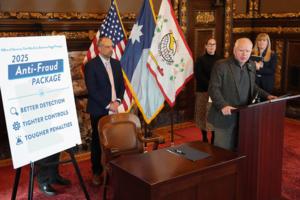
In public, DeSantis and his spokespeople said the state had a duty to educate Floridians about the amendments.
“It is not electioneering,” DeSantis said in September last year. “It’s things that can absolutely be done through these public service announcements. And I’m glad they’re doing it.”
The ads were not public service announcements, which are aired for free at a station’s discretion, according to ad buyers interviewed by the Herald/Times.
In fact, different organizations disagreed on how to define them. The Florida Association of Broadcasters labeled theirs as “non-commercial sustaining announcements.”
The media-tracking firm AdImpact labeled about a quarter of the state’s television ad spending, about $1.5 million by the Agency for Health Care Administration, as political.
The agency’s ads, which were co-sponsored by other departments, appeared to directly address political ones aired by Amendment 4’s sponsors. The state’s ads mentioned “lying” and “misinformation” and referred viewers to the state-run price transparency website claiming that Amendment 4 “threatens women’s safety.”
On Facebook, state agencies ran ads in the weeks leading up to the election and expiring on Election Day or within a week afterward, according to analytics from the social media platform. Facebook categorized the ads as “social issues, elections or politics.”
“To me, it sure sounds like they took money intended for other purposes and clearly used it to advocate for a desired outcome for these amendments,” said Chris Brimer, a partner at Atlanta-based ad placement firm Canal Partners Media.
Florida law makes it a misdemeanor for an employee or officer of the state to use their official position to interfere with an election or influence someone’s vote. The penalty is up to a year in jail. In a lawsuit last year, a Leon County judge wrote that state agencies have “budgetary authority to spend funds on public service commercials.”
To carry out the campaign, the Agency for Health Care Administration and departments of Education, Health and Children and Families all turned to the same company: Strategic Digital Services.
Invoices and state payment data show the four agencies all reached agreements with the company within three days of each other. Collectively, they paid the firm at least $16.4 million, according to the Herald/Times analysis.
Records also show the state and the Republican Party of Florida were using related companies to place their ads.
Invoices show Strategic Digital Services used a subcontractor called Total Video Placements to produce and place ads. That company shares a New Albany, Ohio, P.O. Box with Flexpoint Media, the firm that Uthmeier’s committee and the Republican Party of Florida worked with, according to Federal Communications Commission files.
Strategic Digital Services’ CEO, Joe Clements, did not say how much his firm was paid for last year’s campaign or what companies it worked with.
“All of our work on behalf of the State of Florida is tasked, directed, and approved by contract managers under the terms and conditions of each specific contract,” Clements said in a statement.
Secrecy surrounds spending
The five state agencies have not responded to questions. Four released few records and one agency released nothing.
The Department of Education, for example, spent $3.2 million on the campaign, spending data shows. But when asked for the contract and records related to that spending, it sent a link to the state’s public contracting website, where the department didn’t upload the contract. That website erroneously shows the department spent $304,920.
Reporters found the remaining $2.9 million by following the account and object codes listed on the contracting site through the state budgeting and payment systems.
The Department of Health spent $6 million on advertising, but hasn’t turned over any records except the contract. The Department of Transportation released records about its legal contracts related to the campaign. It has released no records and answered no questions about how it spent $4.4 million with RS&H.
None of the records the state has released give specific information about its strategy against the abortion initiative.
The $36.2 million of spending identified by the Herald/Times includes the administration boosting the marketing budget for the Florida Pregnancy Care Network by $5 million to run ads explicitly against Amendment 4. The board of the network of anti-abortion clinics refused and instead chose to run more neutral ads about the organization’s services and touting Florida’s services to pregnant women and families in the leadup to the election. Afterward, DeSantis proposed stripping the network of funding.
That total doesn’t take into account the cost of the DeSantis administration’s other efforts against the amendments last year.
His Department of State launched an extensive fraud investigation into the abortion amendment campaign, including sending police to knock on voters’ doors.
The governor’s Department of Health threatened to criminally prosecute television stations if they didn’t stop running an ad from the Yes on 4 campaign about Florida’s six-week abortion ban. The department’s general counsel abruptly quit on Oct. 10, refusing to send more letters that he said were prewritten by the governor’s office.
The Herald/Times found the state spent $407,615 on politically connected lawyers who charged up to $715 per hour to defend the state’s efforts.
What effect the state’s ads had on voters is unknown. Uthmeier’s committee and the Republican Party of Florida together spent $24 million against the marijuana amendment and $26 million against the abortion amendment on television and cable, according to AdImpact.
AdImpact data shows state agencies spent $3.1 million against the marijuana amendment and $2.9 million against abortion on broadcast television. That does not include expenses like creating ads and running them on social media platforms.
The state only provided journalists invoices for a third of the agencies’ spending. Those records detail $4.9 million for digital advertising.
The state’s ads had an outsized financial impact. Because broadcasters did not classify them as political, the state received heavy discounts to air at least some of them. The Florida Association of Broadcasters, for example, guaranteed the Department of Transportation a minimum of $4 of air time for every $1 it spent, a standard rate when it works for state agencies and nonprofits.
The committee behind the pot amendment estimated that by late October last year, the state had aired 13,000 TV ads, 5,000 radio spots and ads on other platforms against them worth more than $50 million.
At the time, the defeat of both ballot measures was considered a major political comeback for DeSantis, who had warned that their passage would “make Florida more blue.”
Campaign had lasting effects
After last year’s failure, the backers of the abortion initiative dissolved their committee. The leader of the campaign did not respond to phone calls and text messages for this story.
But marijuana company Trulieve is again backing an effort for recreational pot to be on the ballot next year. The campaign, Smart and Safe Florida, twice sued the DeSantis administration this October over what it said were improper attempts to undermine its efforts. In one lawsuit, a judge backed the state’s decision to toss more than 200,000 petition signatures in support of the amendment.
Pointing to the administration’s campaign against last year’s abortion and marijuana efforts, lawmakers this year passed a provision in a larger bill that bans state government from spending money fighting future amendments. The legislation specifies that the ban is in effect even if the state says it’s simply spreading “factual information.”
The provision was added by Sen. Jennifer Bradley, a Republican from Fleming Island, before lawmakers knew the scope of the state’s spending.
Last month, the Herald/Times shared its findings with her.
“That’s why I filed the amendment,” Bradley responded.
Republican National Committee chairperson and Sarasota state Sen. Joe Gruters called the DeSantis administration’s use of taxpayer dollars in the campaign “undemocratic and a violation of Florida law” last year. In a recent interview, he said he stood by his statements.
“It’s just wrong,” he said.
DeSantis has acknowledged that a majority of Floridians supported the two amendments on last year’s ballot. But he took credit for defeating both of them, saying in October that he wasn’t about to sit back and do nothing.
“We dug in,” he said. “We barnstormed the state.”
The timing of the advertising spots underscores the precise, targeted nature of DeSantis’ barnstorming effort. Television ad records reviewed by the Herald/Times show that the Agency for Health Care Administration, the Department of Health and the Department of Children and Families ramped up their ad buys in late September of last year, as election season hit high gear and voters began receiving mail-in ballots.
By Election Day, those ad buys had come to an end.
_____
(Herald/Times Tallahassee bureau reporter Romy Ellenbogen contributed to this report.)
_____
©2025 Miami Herald. Visit miamiherald.com. Distributed by Tribune Content Agency, LLC.


Comments