Ukraine allies to meet as Kyiv sends draft plan to Trump
Published in News & Features
NATO Secretary General Mark Rutte warned Russia will come for the rest of Europe if its warmongering is not checked now, just moments before Ukraine’s allies were slated to discuss U.S. President Donald Trump’s latest peace push.
“We need to be crystal clear about the threat,” the military alliance leader said in a speech Thursday in Berlin. “We are Russia’s next target. And we are already in harm’s way.”
Rutte painted a stark picture of what’s at stake for the continent as Moscow continues to press its maximalist demands for territory and NATO restrictions in return for a vague promise to end its full-scale invasion, currently heading into its fourth winter.
“Russia has brought war back to Europe,” Rutte said. “And we must be prepared for the scale of war our grandparents and great-grandparents endured.”
Rutte’s remarks come as Europe frets over what the Trump administration may do in its ongoing talks with Russia over the war. Trump is pressuring Kyiv to make concessions that many in Europe feel will leave not just Ukraine, but the entire continent, exposed to future Russian aggression.
The prospect has sent European officials into a flurry of activity. On Thursday night, leaders from more than 30 countries that are part of the so-called coalition of the willing will hold their second virtual meeting this week, Ukrainian President Volodymyr Zelenskyy said in a video address.
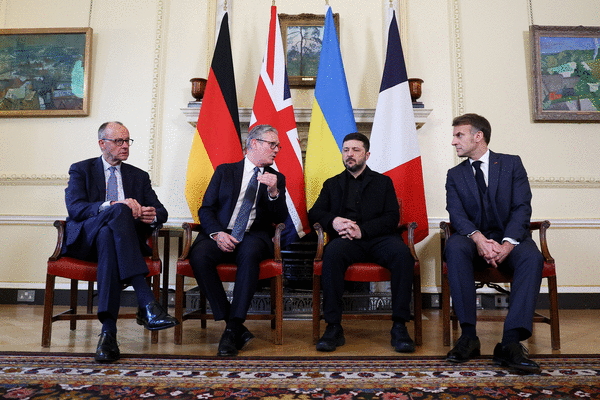
Allies will discuss the state of peace talks and the latest draft plan that Ukrainian officials sent to Washington overnight, people familiar with the planning said. U.K. Prime Minister Keir Starmer, French President Emmanuel Macron and German Chancellor Friedrich Merz are also expected to brief participants on an exchange they had with Trump on Wednesday, the people said on condition of anonymity as the talks take place behind closed doors.
Merz has said he was “relatively optimistic” after the “very constructive” exchange with Trump. A meeting may be held in Berlin at the start of next week to keep discussing the issue, he added.
“Above all, it’s about the territorial concessions that Ukraine is ready to make — but that’s a question that the Ukrainian president and the Ukrainian people must answer,” Merz said in Berlin after meeting with Rutte. “We made that clear to President Trump.”
Zelenskyy submitted a new version of a peace plan to the White House, following discussions with key European partners this week. The 20-point draft is a “fundamental document” to end the war, Zelenskyy said. Ukraine also developed two additional proposed agreements from the plan, addressing U.S. security guarantees and future recovery, he said.
“We are actively working on the key steps – and they must be doable steps,” Zelenskyy said.
New election
Trump has stepped up pressure on the Ukrainian leader to accept his peace plan, reinforcing a call for Zelenskyy to organize presidential elections. The vote — currently restricted under martial law — would be possible if the U.S. and Europe ensure security in Ukraine, Zelenskyy said earlier this week. He met with lawmakers to discuss changes to the election law.
Meanwhile, the warring parties continued to carry out aerial strikes. Ukrainian forces hit the Filanovsky offshore platform in the Caspian Sea, owned by Lukoil PJSC, according to a person familiar with the attack. The platform suffered at least four strikes, halting its operations, the person said.
The Russian Defense Ministry said on its Telegram channel that air defenses downed 287 Ukrainian drones overnight, including 40 in the Moscow region. Russian aviation authorities imposed temporary restrictions on flights at Moscow’s Domodedovo and Vnukovo airports, the state-run Tass news service reported Thursday.
In Ukraine, energy infrastructure in the central city of Kremenchuk and in the Black Sea port of Odesa in the south came under attacks overnight, according to local governors.
The European Union in the meantime is close to reaching an agreement on Friday to extend the bloc’s freeze on Russian assets using emergency powers — a key step toward tapping the funds to help Ukraine.
The issue has become a major sticking point in E.U. attempts to secure a €90 billion ($105 billion) loan for Ukraine using immobilized Russian central bank assets. All 27 E.U. member states currently must renew the asset freeze every six months, leading to concerns that Hungary or anyone else could veto and give Moscow a sudden claim to its funds.
This is happening against the backdrop of unprecedented tensions with the U.S., with Washington’s new national security strategy blasting Europe and Trump calling the continent “weak.”
In Berlin, Rutte said U.S. views of its allies has been sullied by “this big irritant of the Europeans and Canadian allies not spending as much as the Americans” within NATO.
“That is now dealt with,” he added, saying the shift to Europe doing “more of the heavy lifting” was underway.
He denied a Reuters report from Friday claiming the U.S. has given Europe until 2027 to take over the decisive bulk of NATO’s conventional defense capabilities, threatening to withdraw from some of the alliance’s mechanisms if it didn’t.
----------
—With assistance from Alberto Nardelli, Iain Rogers, Maxim Edwards and Andrea Palasciano.
©2025 Bloomberg L.P. Visit bloomberg.com. Distributed by Tribune Content Agency, LLC.





Comments