Michigan lawmakers cut funding for autism program amid push for road projects
Published in News & Features
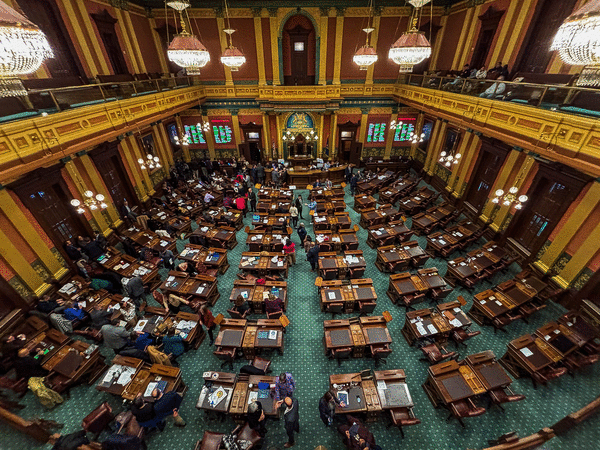
The budget that Michigan lawmakers approved last week eliminated a $2 million program that's been helping families and adults dealing with autism in the state for a decade.
Members of the Legislature argued the move was part of a larger effort to reduce spending and direct more money to road projects. However, supporters of the Autism Alliance of Michigan's navigators program said the decision would likely leave parents facing a child's autism diagnosis without guidance from specialists to whom the state has provided access for years.
“How do you decide families with autism are less important than roads?” asked Colleen Allen, president and CEO of the Autism Alliance of Michigan.
About 1 in 31 children born in 2014 has been identified as having autism spectrum disorder, according to estimates from the Centers for Disease Control and Prevention.
Since 2015, both Republicans and Democrats in Michigan have funded the navigators initiative, which has been operated by the Autism Alliance of Michigan, a nonprofit organization based in Southfield. Lawmakers have increased the level of investment from $500,000 to $1 million and then, to $2 million in 2023, Allen said.
The goal of the program, included in the state Department of Health and Human Services budget, is to provide families with support, professional consultation and case management. About 4,000 families are served each year by navigators, Allen said.
Navigators help young families who are asking what it means for a child to be on the autism spectrum and 80-year-old parents questioning who's going to take care of their adult child with profound autism once they die, Allen said.
“That’s what’s gone," Allen said of the funding cut. "I don’t know where families go next."
The Republican-controlled House didn't include the money for the navigator program in its initial budget proposal. A spokesman for House Speaker Matt Hall, R-Richland Township, didn't respond Monday to a request for comment on why the funding was dropped from the final plan.
In a Monday interview, Allen said she still wasn't sure why the $2 million was eliminated from Michigan's budget. She found out Thursday afternoon — just hours before the final votes in the Legislature that night — the program's funding had been chopped out of the spending plan, she said.
The $2 million represents about half of the Autism Alliance's budget, and layoffs are "very likely" to result from the lawmakers' decision, Allen said.
Former Lt. Gov. Brian Calley, a Republican, is the chairman of the Autism Alliance's board of directors. His daughter Reagan was diagnosed with autism when she was 3 years old. Calley said he discovered the government systems that face people on the autism spectrum are complex and difficult to understand.
Calley, whose wife is former state Rep. Julie Calley, said he thought to himself, "If it was this difficult for a person as well-connected and well-resourced as me, then it must be darn near impossible for other people."
"Out of my family’s experience, the Autism Alliance navigator was born," Calley said. "Since then, thousands of families received the same help, support, and guidance that Julie and I did.
"That last-minute cut from the budget was a real blow. I’m still trying to process why this has happened."
Senate Appropriations Chairwoman Sarah Anthony, D-Lansing, said there were many cuts to programs made last week as lawmakers sought $1.5 billion more in road funding.
"Next year, you’re going to see even more reductions," Anthony predicted of the state's financial situation.
However, lawmakers also voted last week in support of a 24% new tax on wholesale marijuana to create additional revenue and approved funding for an array of projects, including $250 million in new funding for a program that aims to provide cash assistance to households with expectant mothers and very young children.
Last week's votes came after lawmakers missed their self-imposed July 1 deadline to approve a budget and used a one-week extension to keep state government open after the new fiscal year began on Oct. 1.
The funding for the Autism Alliance program was included in the initial negotiated plans for the year's spending between the House and Senate, according to two sources with direct knowledge of the conversations who requested anonymity to speak about the private discussions.
The sources said the funding allocated was later taken out when the negotiations advanced to their final stages among the state's top leaders: Gov. Gretchen Whitmer, Hall and Senate Majority Leader Winnie Brinks, D-Grand Rapids.
The "chaos around decision-making in Lansing" has been frustrating, Allen said.
She's now asking individuals and philanthropic organizations to help fill the financial hole the Autism Alliance is facing.
This is not the first time that the autism navigator program's funding has been in jeopardy or generated headlines.
In 2019, Whitmer, a Democrat, stripped nearly $1 billion from the Republican-led Legislature's approved budget, including $1 million allocated for the navigators program. Whitmer faced a political backlash, and the money was later restored through a separate spending bill.
Hall, who was a member of the House in 2019, was among those who publicly criticized Whitmer for cutting the $1 million for the autism program.
"The governor also took away money to support children with autism — eliminating more than $1 million from systems designed to help families find services," Hall wrote in a column on Oct. 14, 2019.
Author and former journalist Ron Fournier, a member of the Autism Alliance's board, said Whitmer and Hall have both been advocates for the autism community in recent years.
“I can’t for the life of me understand why Gov. Whitmer and Speaker Hall allowed this to happen," Fournier said. "This has to be a mistake. They could not have done this on purpose."
Fournier's son, Tyler, was diagnosed with autism when he was 8. He's now 28.
The navigators program has allowed anyone in the state to call and get help and find ways to access services, Fournier said. The work of caring for a person on the autism spectrum can be a full-time job, he added.
"Hopefully, they’ll come to their senses," Fournier said of the state's leaders.
Whitmer still has to sign the new budget into law, which she is expected to do in the coming days.
_______
©2025 www.detroitnews.com. Visit at detroitnews.com. Distributed by Tribune Content Agency, LLC.






Comments