Alleged Michigan church attacker said Mormons were 'the Antichrist,' Burton man says
Published in News & Features
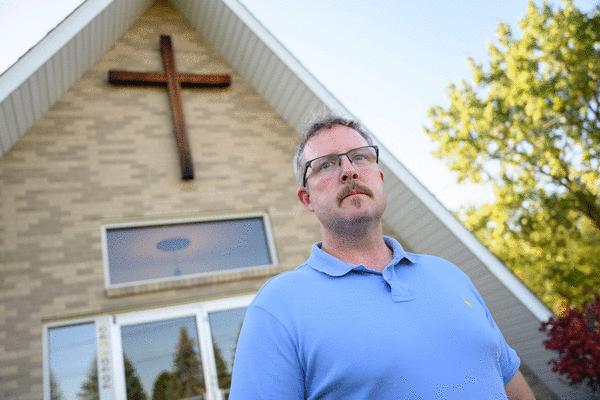
BURTON, Mich. — Two days before clouds of black smoke rose above Grand Blanc Township from an attack on a Mormon church, Kris Johns encountered a man who went on an anti-Mormon tirade that was so strong that Johns recorded a voice memo about his encounter.
Johns, who is a candidate for the Burton City Council, said Monday that he had spoken to "a guy, former Marine, (who) went to Iraq, and somehow, got to Utah." After 20 minutes of pleasantries, the conversation took a turn from the Second Amendment to anti-Mormon sentiments.
“It kept going to, ‘They’re trying to put people above Jesus,’ and ‘They’re not Christians,’" Johns said. “He did make the statement that ‘Mormons are the Antichrist.’”
The former Marine turned out to be Thomas Jacob Sanford, Johns said. The 40-year-old Burton man is identified by law enforcement as the one who drove his truck into the side of a Grand Blanc Township Church of Latter-day Saints, set it on fire and fired shots that killed two people and wounded eight. Two bodies were discovered late Sunday in the rubble of the church.
"He went on a tirade about the Church of Latter-day Saints. It was something else," Johns said on the recording on his phone. "And you know, I’m friendly with the Mormons, and I had to kind of (say), ‘Yeah, yeah, yeah’ to get off the porch. But man, he was something else."
When Johns said that he saw Sanford's face on the news less than a week later, "I told my wife, 'That is the guy. That is 1 million percent the guy.'"
Since Sunday morning, the FBI and Michigan State Police have interviewed Johns in their investigation into the attack, he said. Authorities said Monday that they don't have a motive for the shooting and fire at this time.
Michigan State Police Special Lt. Kim Vetter said Sunday that rumors about Sanford's motive are purely "speculation." Vetter said it may take some time to determine his actual motive.
Although a motive has not been identified, the attack is reminiscent of the extreme violence practitioners saw in the 19th century, one scholar said Monday.
"One of the reasons why it's especially kind of disconcerting for so many Latter-day Saints is that we largely believe that that era was over," said Taylor Petrey, chair of the Religion Department at Kalamazoo College. "They might be subject to prejudice and people saying mean things, but not being attacked in the way that we might see against other vulnerable religious groups."
The church has had members in Michigan for nearly as long as the religion has existed. Today, there are over 46,000 members in 94 congregations across the state, said church member Ben Kaiser of Frankenmuth. There are two missions in Michigan, one located in Detroit and the other in Lansing.
"Latter-day Saints have been in Michigan for a long time," Petrey said. "They have long, deep ties to Michigan, and I think that's one of the other reasons why it has felt particularly disconcerting for Latter-day Saints in Michigan. We see ourselves as belonging here and so to be attacked here, given our long and prominent history, adds a sense of despair."
A campaign encounter
Johns said his interaction with Sanford was "just one of 1,800 houses in the city to talk to" ahead of Burton's Nov. 4 council election. Johns said he decided to talk to Sanford because records showed somebody at the house had voted in the council primary.
“He said, ‘Don’t leave your car there; park in the driveway.’ And I had actually hit his mailbox backing up, and he was like, ‘Don’t worry about it,'" Johns said of Sanford.
Sanford's alleged actions starkly contrast with his interaction with Johns, who described him as "a gun guy" on first impression but said he was cordial. He said he shook his hand and interacted well with his daughter, who's autistic.
“This is a guy I’ve known maybe for three minutes, and he’s interacting positively with my child, no issues," Johns said.
Sanford quickly asked Johns about his views on the Second Amendment. He then told Johns his past: He was a Marine who served in Iraq, had a drug issue and moved to Utah.
Sanford served in the Marines from June 2004 to June 2008, according to records provided by the U.S. Marine Corps. He was deployed to Iraq from August 2007 through March 2008 and had the rank of sergeant, according to the records. His military occupational specialty was organizational automotive mechanic and vehicle recovery operator.
According to Johns, "that's when it stopped," and the conversation abruptly shifted to Mormonism. Johns explained he has a cousin who played football at Brigham Young University, a predominantly Mormon university in Utah, and that he had friends growing up who were Mormon.
“I know of the core — maybe not LDS 101, but maybe LDS 200 level," Johns said.
Sanford told him Mormons in Utah wanted to get his arm tattoos removed ahead of being part of a ritual in one of their churches, Johns said. From there, the criticisms of the religion got more pointed, Johns said.
Johns said his interaction with Stanford stuck out because of his focus on religion, not politics. Other than his mention of the Second Amendment and a Donald Trump sign outside his home, there was no mention of it, he said.
"He did not mention our current president, the former president, anybody. Charlie Kirk was not mentioned," Johns said. "And that was where it was after about 20 minutes of quiet pleasantries, kids, general background, it took a hard turn into religious beliefs.”
"I can count on one finger the religious conversations I’ve had, and it was really the only time religion has really been brought up.”
Less than a week after his interaction with Sanford, Johns was attending service at Solid Rock Community Church with his wife. His friend texted him during the service that the church in Grand Blanc had been attacked.
“From a very brief conversation a week ago, nothing would have indicated that this would have occurred less than a week later," Johns said.
When Sanford asked him about guns, Johns said he supports the Second Amendment of the Constitution. Johns said he still feels that way even after the attack — there are members of his church who conceal carry during Sunday service for safety, and he's thankful for that.
"This was symbolic, because what I gathered is, he was angry with somebody in Utah. Why attack an LDS church in Grand Blanc that has no connection? These are just things that we cannot policy and law our way away from," Johns said.
Asked what he believes the solution is going forward, Johns said he doesn't know what else could be done to stop the attack. But he said it's important for people to remain vigilant.
“It’s very distressing for people to be scared (about) the acts of extremely random efforts," Johns said.
History of the faith
Church of Latter-day Saints members base their beliefs on the revelations that founder Joseph Smith said were given to him by a series of heavenly messengers in the 1820s.
Practitioners believe that the authentic church was restored with these revelations to Smith. In addition to the Old and New Testaments, LDS members center their beliefs in the Book of Mormon and two other texts by Smith.
Some LDS beliefs depart from traditional Christian theology, including the denial of original sin (because people will be punished for their own sins), and that Jesus appeared in North America before his ascension to heaven. LDS members also believe in the godhead of the Father, the Son and the Holy Spirit, but that the Father and Son have physical bodies of flesh and bone.
The church began in upstate New York in 1930 and later established a religious community in Utah, where the church is now headquartered in Salt Lake City. Worldwide membership is estimated at over 17 million.
LDS members see themselves as Christians, Michigan State University Associate Professor of Religious Studies Morgan Shipley said Monday.
"They understand themselves as restoring Christianity," Shipley said. "They believe that at some point Christianity became perverted or lost and that the LDS church is restoring Christianity to its whole."
Shipley said that most mainstream Christian denominations see LDS members as Christian.
The history of anti-Mormon violence is where Kaiser’s mind went immediately Sunday morning when he was in worship services at the LDS Church in Saginaw and learned about what was happening at his uncle’s congregation in Grand Blanc Township.
Kaiser, 32, worried it could be a larger, coordinated attack on LDS congregations in the region at a time of the week when members would be gathered for what’s called the Sacrament Meeting. The Saginaw congregation is about the same size as Grand Blanc’s and would typically have 200 to 300 gathered for services on Sunday, Kaiser said.
“That did cross my mind. I know my church history very well, and I know my religion. Although we’re Christians, many believe we’re not, and a lot of animosity and violence has stemmed from that notion, among other reasons, throughout the existence of the restored church,” Kaiser said.
“I’ve never experienced any physical violence because of that, usually, it’s just verbal. But one of my first thoughts was, ‘Is he acting alone?’”
The Saginaw congregation went into lockdown, in part because of a threat that was made against the LDS church in Flint, which was evacuated, Kaiser said.
“The first thing we did … is we went in and knelt down and started to pray,” he said.
Religious tensions
LDS members have long been persecuted for their religious beliefs, Kalamazoo College's Petrey said. The religion's founder, Joseph Smith Jr., was assassinated, and practitioners faced violence that forced them out west in the late 19th century. In the late 20th century, Petrey said, tensions with evangelical Christian groups increased and still exist.
The event is being investigated as an act of "targeted violence," Reuben Coleman, special agent in charge of the FBI Detroit Field Office, said at a Sunday press conference.
While a motive has still not been determined as of late Monday, religious discrimination and violence against LDS members have existed for generations, Petrey said.
"It does raise the concern of 'Is this something we're going to have to deal with going forward?'" Petrey said.
The history of Latter-Day Saints existing on the fringe of American society has some lasting tensions today, he said.
Church members who fled out west to what became Utah in the late 19th century gradually assimilated into American life after the territory was claimed following the Mexican-American War. A 50-year "Cold War" with the U.S. government over the members' practice of polygamy led to the church members stepping away from the practice and falling in with traditional American life, Petrey said.
But some evangelical Christians continue to refer to the religion as a cult and have tried to diminish members' reputations, he said.
When former U.S. Sen. Mitt Romney, son of former Michigan Gov. George Romney, ran for president as a Republican in 2012, evangelical pastors railed against him for his religion, calling it demonic and satanic, Petrey said.
During the 2012 campaign, Romney delivered the commencement speech at Liberty University in Virginia, a home of evangelical Christians and founded by the Rev. Jerry Falwell, which acknowledged his Mormon faith differed in some respects from traditional Christianity. The speech drew praise from Tony Perkins, president of the Family Research Center.
The conservative evangelical backlash to LDS is a little contradictory, Petrey said, because LDS members have largely embraced right-wing politics and have aligned with members of the religious right politically.
"There's this weird tension," Petrey said. "They're like 'frenemies.' There's a close political alliance, shared social values. … But there's an ongoing tension that continues to be expressed, in some sense like a sort of religious rivalry."
Shipley, who teaches an MSU class on religion's relationship with violence and peace, said humans find ways to justify their violent acts. These violent acts are often connected to enhancing someone's sense of comfort, their sense of privilege or other dynamics that solidify their identity, he said.
_____
Staff Writer Beth LeBlanc contributed.
_____
©2025 The Detroit News. Visit detroitnews.com. Distributed by Tribune Content Agency, LLC.





Comments