The next big question for the USMNT: Managing yellow cards in the World Cup group stage finale
Published in Soccer
IRVINE, Calif. — Until now, the U.S. has played only one game in a World Cup that didn’t matter in the standings: in 1998, when it was eliminated from advancing before the group stage finale.
On Thursday, the total will rise to two. But this time, it will be because the Americans have already clinched first place.
That makes for a very different vibe, not just from this team’s past but from most teams at any World Cup. It also makes for a serious question: How many regulars should rest, and how many should play to stay in rhythm?
This was the question of the day as the Americans returned to practice on Monday.
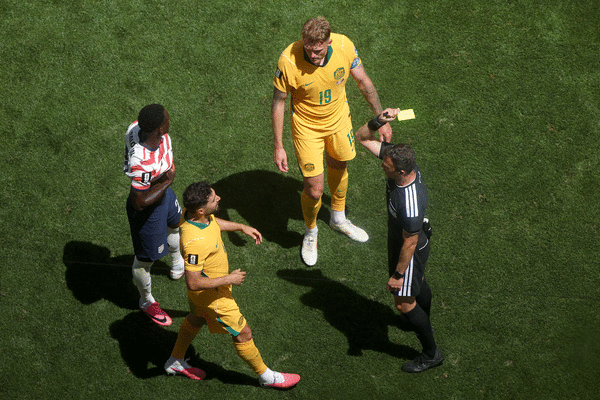
Common sense says players on yellow cards should sit, because if they get booked again they’ll be suspended for the round of 32 games when they’re really needed. Those are defenders Chris Richards and Antonee Robinson, midfielder Tyler Adams, and striker Folarin Balogun. All four are big-time players.
We won’t hear from manager Mauricio Pochettino until Wednesday. We might hear from Richards, Robinson or Adams before then. We did hear from Balogun on Monday, when the U.S. returned to practice. He and Alejandro Zendejas met with the media.
“I want to play every game — it’s the sort of player I am,” Balogun said. “It’s what’s got me to where I am, being available. I think the most important thing for a professional athlete in any sport is to be available, and I’m no different.”
But he quickly turned from there to pragmatism.
“So of course I want to play, but it’s also important to be smart,” he said. “I wouldn’t want to pick up a yellow card and miss the round of 32.”
Balogun also said the team’s overall focus for the game remains on winning.
“The most important thing is to go out there and win,” he said. “Regardless of whatever team the coach decides to play, the objective and the aim is to go out there and win. Three wins from three games, it’s an opportunity to create history, and to put a positive message out there — not just for ourselves, but toward other teams.”
Pulisic returns to practice
Star playmaker Christian Pulisic was back on the field in practice for the U.S. men’s soccer team on Monday, taking part for the first time since before the tournament opener against Paraguay.
That was a good sign as the Hershey, Pa., native finishes recovering from the calf injury that kept him out of the second group stage contest against Australia. But it’s just one step, and practice was open to the media only for the first 15 minutes. So we don’t know what happened after that.
Whether Pulisic should play against Türkiye is another debate. If he’s fit, a few minutes could do him good, but it will be a risk. For now, it was a good sign to see him making progress.
The other injury news is that midfielder Cristian Roldan is day to day with a muscle strain. If he can’t play against Türkiye, that will leave the U.S. shallow.
Immigrants’ success stories
The diversity of the United States means players come from a variety of backgrounds and locations. That thread links Balogun, who was born in New York to Nigerian parents and grew up in England, to Zendejas, who grew up on both sides of the Texas-Mexico border in El Paso and Juárez.
“It is truly an honor and a source of pride to be here representing the entire Latino community,” said Zendejas, who shares that honor with other players including Ricardo Pepi and Roldan. “It’s a dream come true — for [them] just as much as for me — to be here and show people that dreams can become reality."
Balogun called himself “proud to be American and to represent America.” He knows well that, as he said, “the story has picked up a bit of attention, but I think it’s expected. We’re at the World Cup, and it’s an opportunity for the fans to get to know more about us as players.”
Zendejas, by the way, wore an eye-catching 1994 World Cup throwback hat as he spoke. His sponsorship deal with Adidas got him it for free; it costs $40 for the rest of us.
“I don’t know much about this World Cup — I should but I don’t,” he quipped, knowing that tournament was played four years before he was born.
Antonio Freeman stops by
Alex Freeman’s fast rise with the U.S. team has no bigger fan than his father, former Philadelphia Eagles and Green Bay Packers wide receiver Antonio Freeman. When Alex scored the game’s second goal against Australia, he achieved the rare feat of scoring a World Cup goal in a stadium where his father scored two touchdowns 30 years earlier.
Antonio stopped by Monday’s practice to talk with the media and share his joy.
“I’m sure Alex has heard enough from other people about my success and my moments,” he said. “I don’t really talk about those moments too much. But it was definitely a full-circle moment. to just have a father-and-son combination in any sport have an impact on a game in the same stadium, same state, it’s pretty amazing.”
He called it “a credit to all the work that Alex has put in, the commitment that he’s made. This is his ride, and I’m just happy to be his biggest supporter.”
And what was the father’s message to his son after the game?
“He just continued to amaze me, and that’s all it is,” he said. “When I see him, it’s like, ‘Yeah, boy, that’s what I’m talking about!’ — that’s our little thing. But just keep working, Alex, keep being you. People love who you are, don’t change, just keep working hard.”
He also praised soccer’s growth in the United States, saying this World Cup “has really heightened the awareness in the U.S., and people from all walks of life are getting involved, rallying behind the [U.S.] team.”
©2026 The Philadelphia Inquirer, LLC. Visit at inquirer.com. Distributed by Tribune Content Agency, LLC.




Comments