Tom Krasovic: Do you believe in miracles? Hot start has US in World Cup conversation.
Published in Soccer
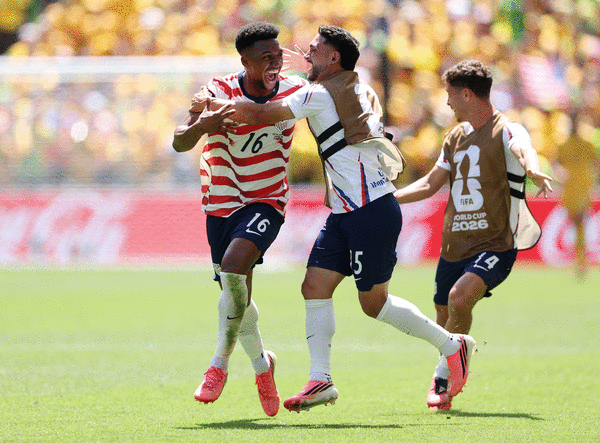
SAN DIEGO — Even if it feels a little staged, it makes for a fun and uniquely American angle to this World Cup.
I’m referring to the “Miracle on Ice,” said to inspire the folks who now aim to work a “Miracle on Grass.”
“Why not us?” asked United States soccer coach Mauricio Pochettino, evoking 1980, Lake Placid and Olympic gold.
Pochettino chose well in adopting the mantra of United States hockey coach Herb Brooks and his team.
The question injects confidence in players, yet its suggestive nature keeps things light.
The Argentine soccer man took the U.S. job in September 2024, bringing high credentials to a team that hadn’t won much of anything. He’d played for Argentina, a powerhouse, and in Europe, he’d captained or coached a number of crown-jewel clubs.
Much tactical work needed to be done with the U.S. program. But, as we’ve seen in the past two weeks, Pochettino inherited a talent pool that was more athletic than any of its group stage opponents.
In dropping the “why not us?” line into a May 26 interview with Fox Sports, two weeks ahead of his team’s Cup opener, the coach introduced a bold way of looking at American men’s soccer. Although he isn’t a Yankee, he knew he was invoking the American hockey upstarts who’ve inspired movies, documentaries and books.
Pochettino asked the same question of his players.
Why not us?
In the aftermath of the U.S. playing more like the Europeans do the past two weeks, a related question now arises:
Do you believe in miracles?
The United States has won back-to-back group stage games in a World Cup for the first time in 96 years. The reward: a July 1 Round of 32 match in Santa Clara, Calif. That’s regardless of what happens Thursday in Inglewood, Calif., when the U.S. faces Türkiye in its group stage finale.
Miracles is aptly plural as we briefly ponder the U.S. actually raising the trophy July 19 in New Jersey.
At some point, the U.S. would encounter teams that boast advantages in more than one key aspect. Prominent on that list are France, Argentina, England and Spain.
So, let’s take a long hydration break for now.
While a soccer medal goes to the creators of the “Miracle on Ice” commercials we’re seeing in World Cup telecasts, it is overly ambitious to map out that surreal journey.
“Too early,” said Brian Quinn, local soccer expert.
“Teams start well and then fall away; teams start slow and get better,” added Quinn, a former San Diego Sockers midfielder who appeared in 48 matches with the U.S national team and coaches the University of San Diego men.
“But,” the Belfast, Northern Ireland, native added, cracking the door open, “one of the keys to winning the Cup is to control the game. So, if they can (continue to) do that, then who knows? Got to stay healthy.”
Rather than the “Miracle on Grass,” here’s a different bright scenario to latch onto:
The Americans win the elimination game in Santa Clara and another one in Seattle, booking their first quarterfinals since 2002 and making it four wins in four high-stakes games on the West Coast, one of the planet’s spectacular regions.
The “how” has been impressive.
Before enthusiastic crowds that filled NFL venues in Inglewood and Seattle, the U.S. showed off superior speed and quickness, supplemented by contact balance and play strength. It built halftime leads of three and two goals, defeating Paraguay 4-1 and Australia 2-0.
Quinn, attending Friday’s match, saw that the blitz against Paraguay wasn’t a one-off.
“The U.S. again started with intensity and got their reward early by being aggressive and sharp,” he said of the 11th-minute own goal that, coupled with a similar play in the opener, made the Americans the first World Cup team to get own goals in its first two matches.
The former midfielder singled out midfielders Tyler Adams and Weston McKennie for “ruling the roost” and winning “practically every individual duel.”
“Australia struggled the whole half as they could not connect any sequences of passes,” he said.
In Santa Clara, the Americans will be favored against either No. 55 Qatar or No. 64 Bosnia and Herzegovina, as the analytics models project.
Belgium, ranked ninth, would be the most probable opponent if the U.S. makes it back to Seattle for the Round of 16.
Presumably, Pochettino wouldn’t start a lineup anything like the one he sent out for the March exhibition that Belgium won in Atlanta, 5-2. U.S. stars Folarin Balogun and Christian Pulisic didn’t enter until the 71st minute, and other mainstays also began the match on the bench.
If the West Coast thrill ride continues for two more matches beyond Thursday’s tune-up, the U.S. would be within two wins of the trophy match. It would be played some 275 miles from the “Miracle On Ice.”
For now, the ice stays in the lemonade.
____
©2026 The San Diego Union-Tribune. Visit sandiegouniontribune.com. Distributed by Tribune Content Agency, LLC.






Comments