Mark Zeigler: United States' luminous World Cup performance could be the start of special summer
Published in Soccer
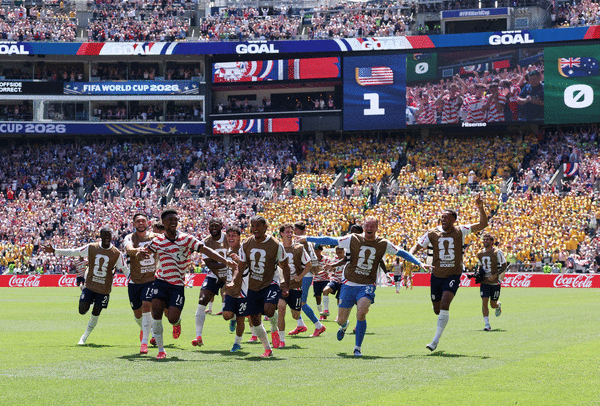
SEATTLE — FIFA has renamed it Seattle Stadium during the World Cup, but the NFL venue hosting a half-dozen matches is better known as Lumen Field.
Lumen Technologies has the stadium naming rights, part of a 15-year, $162.7 million deal that extends through 2033. It’s a company that began with humble beginnings as Oak Ridge Telephone Company in a tiny town in northern Louisiana, with 75 paid subscribers when it was sold in 1930 for $500.
It has morphed and changed in the decades since, mergers, acquisitions, divestments, expansion, rebranding, restructuring, to its current market capitalization of $8.4 billion.
Lumen Technologies is not an official World Cup sponsor, so FIFA, in its relentless pursuit of the almighty dollar, has scrubbed any trace from the 69,000-seat stadium. The flight path to Sea-Tac airport takes you over downtown, and all you can see on its roof is a giant “FIELD.” The Lumen is covered.
But on the grass below Friday, the company’s arc of progress was embodied in the guys in wavy red- and white-striped jerseys.
Humble beginnings to, suddenly, a Fortune 500 company.
This is your U.S. men’s national soccer team, once an international doormat, stomping on its second World Cup opponent, fueled by another thunderous crowd, looking very much like a contender that will be sticking around for a while this summer.
Or put another way: There’s a high level of luminescence.
If last week’s 4-1 thumping of Paraguay was dismissed by some as an overmatched opponent with questionable tactics, the clinical and convincing 2-0 win against Australia here pushes the Space Needle from fluke toward force.
This is what the national team program has always aspired to, as ambitious as it seemed after failing to qualify for the World Cup out of soccer’s softest region as recently as 2018: a free-flowing, offensive-minded, confident, swashbuckling, backheeling unit that captures the imagination of an increasingly soccer-literate nation starving for global relevance on the men’s level.
“We felt something before the World Cup even started,” said defender Alex Freeman, whose leaping header gave the Yanks a 2-0 lead at halftime. “Now that we’ve won two games and we’ve been consistently winning and consistently playing well, I think our confidence is above the roof.
“For us, it’s how can we give more. And more and more and more.”
Tim Ream, the 38-year-old defender who made his national-team debut in 2010, smiled.
“I don’t think it’s surprising to any of us,” he said. “We’ve known what this team was capable of if we put everything together on both sides of the ball. People can say whatever they want and people can be surprised, but the pieces have always been there. It was just putting them all together.”
Fans inside Lumen Field, known as one of the loudest venues on the planet, were already sending chants of “U-S-A, U-S-A” echoing off Elliott Bay long before kickoff. They reared back and belted out the anthem. They booed moments after kickoff when a corner kick wasn’t awarded, then again for a hard foul by the Aussies. They never sat down.
They sang the chorus of Jon Bon Jovi’s “Livin’ on a Prayer” so loudly that you couldn’t hear the music.
After the final whistle, U.S. players didn’t immediately head to the locker room, taking a lap around the field while 69,000 serenaded them with John Denver’s “Take Me Home, Country Roads.”
They completed the lap … and then took another.
This wasn’t your ordinary victory celebration. This was something different, something special, something brewing.
The Socceroos, in some ways, provided the perfect opponent, and contrast. This was how the Americans once played — safety first, defending, defending, defending, blasting long balls forward, trying to win free kicks and score on set pieces, pragmatic more than emphatic.
That’s how soccer’s minnows learn to swim with the whales. Going from a dog paddle to butterfly is exponentially more difficult, though: controlling possession and being the protagonist, creating, innovating, improvising.
U.S. Soccer has been chasing that elusive chalice for decades, hindered by a pay-to-play youth development system that creates players in test tubes and not in the organic atmosphere of the streets, burdened by a 30-team professional league still in its infancy that hasn’t yet reached the sport’s highest levels.
But more and more players are heading to Europe earlier and earlier. Nine of the 11 starters currently play for clubs there, and four of the five subs. England, France, Scotland, Germany, Spain, Italy, the Netherlands.The bulk of the roster also has a World Cup on their resumes. And they’re coached by a crafty Argentine, Mauricio Pochettino, who has played in a World Cup himself and worked for some of the planet’s biggest clubs (and who makes $6 million per year).
There’s also a maturity, sophistication and poise to them that was lacking in past iterations of the national team. The goals Friday weren’t works of art — another own goal awkwardly bundled into the net by Australia defender Cameron Burgess, and Freeman’s header off a deflected shot — but the work rate was.
They also showed they can win without talisman Christian Pulisic, who sat out with a calf injury. Pochettino inserted Ricardo Pepi, tweaked the formation, and they got their first shutout in 10 matches.
“A really professional performance from us,” forward Folarin Balogun said.
As big as Lumen Technologies has become, it isn’t currently profitable. The U.S. men reflect that aspect, too. They beat Paraguay and Australia, neither in the top 20 of the FIFA world rankings, and probably won’t face someone who is until the round of 16 in three weeks. Judgment Day won’t come until then.
“They’re a quality team, but it’s the World Cup,” Australian midfielder Aiden O’Neill cautioned. “Everybody’s pretty good.”
Two victories in two games clinched passage to the knockout stage and put them in pole position to win Group D, which draws a third-place team — think Bosnia and Herzegovina — in the round of 32 on July 1 in Santa Clara.
Win that, and they’d be right back in Seattle for the round of 16 against, if form holds, 10th-ranked Belgium. They played in a March friendly in Atlanta. Belgium scored four times in 23 minutes and won 5-2.
This is the same U.S. roster, but not the same team.
This feels different.
“It’s just kind of a building thing,” Ream said. “There’s not one specific moment. You take moments from all the games, from all the training sessions, and you just build with it. … You start to realize and put things together that, you know what, we have all the tools, all the pieces to do what we want to do.
“It’s something we’ve been trying to do for a long time, and now we’re doing it.”
No longer livin’ on a prayer.
____
©2026 The San Diego Union-Tribune. Visit sandiegouniontribune.com. Distributed by Tribune Content Agency, LLC.






Comments