'We want to lift the trophy.' US makes history in World Cup win over Australia.
Published in Soccer
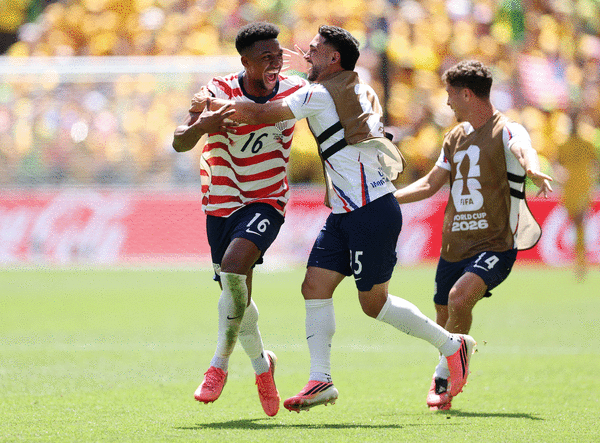
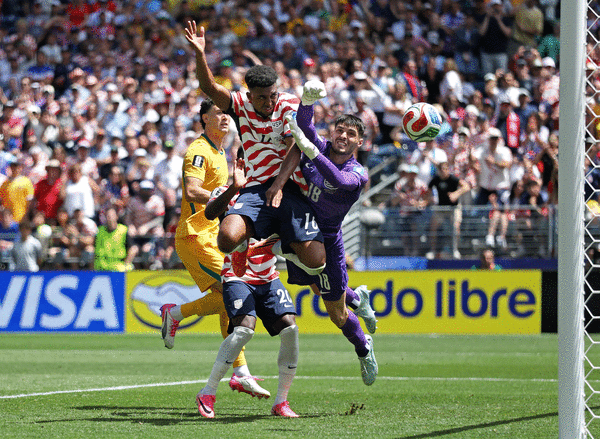


SEATTLE — The World Cup is only a little more than a week old, but it’s already a historic one for the U.S.
With Friday’s 2-0 win over Australia, the U.S. matched its best World Cup performance ever with two victories. Their six goals match the most the U.S. has ever scored in the group stage and its goal differential of plus-five is also its best ever in the tournament. The U.S. also clinched a spot in the round of 32.
Most impressive of all, however, is how the U.S. achieved most of that without their best player, Christian Pulisic, who had an electric first half in the U.S. opener against Paraguay but hasn’t seen the field since.
“We’ve known what this team is capable of,” captain Tim Ream said. “I don’t think any of us are surprised. The pieces have always been there. It was just putting them all together.”
Australia coach Tony Popovic agreed.
“There are no surprises in what they did,” he said. “It’s not surprising because their quality is clear, their power is clear, their athleticism is clear.”
It may not have been surprising, but it was historic. The only time the U.S. won consecutive games at a World Cup was in 1930, when the tournament had just 13 teams. That was also the last time the U.S. won its group.
For defender Chris Richards, the milestones are nice. But he said the team didn’t come to the World Cup to rewrite the record books. If they’re going to do something no U.S. team has ever done before, they might as well think big.
“Obviously we take it one game at a time. But every game, every tournament we play, we want to win,” he said. “So I don’t think it’s ridiculous to say that we want to win it.
“A lot more games before we get to that moment. But we want to lift the trophy by the end of this.”
The strength of this U.S. team, Ream said, is its camaraderie, which is what coach Mauricio Pochettino focused on when he selected his roster.
“The right 26,” he said, “not the best ... 26.”
The locker room chemistry has proven Pochettino got the mix right.
“I’ve told these guys that this is the most fun, special, enjoyable group that I’ve been a part of,” said Ream, at 38 the oldest player on the roster. “There’s something about this one that just feels different.
“Just the different personalities, the way everybody meshes, the way everybody fits together, it’s really enjoyable.”
And successful. In its first two games in this tournament, the U.S. has taken twice as many shots and completed twice as many passes as their opponents and possessed the ball for nearly 120 minutes of the 180 they played.
So while Pulisic, who is nursing a calf injury, was missed, he wasn’t needed.
The Americans didn’t need much help, but Australia gifted the U.S. its first goal anyway when defender Cameron Burgess deflected in a cross from Folarin Balogun in the 11th minute, igniting a red, white and blue-clad crowd of 66,925 inside Lumen Field and tens of thousands more who gathered outside the stadium and at viewing parties across the city.
The first U.S. score in its opener with Paraguay came on an almost identical own goal, with Paraguayan midfielder Damián Bobadilla getting his right foot on a pass Weston McKennie had aimed at Balogun. The U.S. is the first team in World Cup history to get own goals in consecutive matches.
Australia tried to neutralize the Americans’ superior speed and technical abilities by getting physical, rough play that German referee Felix Zwayer largely allowed. But Australia paid dearly for that just before the intermission when Alex Freeman, who was leveled by Australia’s Paul Okon-Engstler moments earlier, climbed off the turf to head in a loose ball to give the U.S. a 2-0 lead at the break.
“I got hit in the head pretty hard,” Freeman said. “We knew they were going to be physical. For us, it was how can we be physical first?”
The scoring sequence started with a free kick following a foul by Burgess. Antonee Robinson left-footed the ball to an unmarked Sergiño Dest at the top of the box, a shot that was blocked in the wall, then arced toward the goal. Freeman and Balogun raced Patrick Beach to the ball, with Freeman getting there just ahead of the Australian goalie to nod it in.
Robinson and Dest were also involved in the build-up to the own goal. Australia tried to make a game of it in the second half, but it had too big a hill to climb and the U.S. never let it get close to the top.
Now that the Americans are on to the next round, there’s a temptation to look beyond next week’s group-stage finale with Turkey and ahead at which teams might be looming in the knockout rounds.
Balogun said that’s a temptation he’s avoiding.
“The next focus for me is just the Turkey game,” he said. “Whether we’re through or not, to me it doesn’t matter. We have to go out there and put [on] another performance.”
And if they put up another performance like the first two, the U.S. will not only make more history. It may get other teams looking ahead to the next round, fearing they might have to play the U.S.
“If we want to win and be one of the good teams, dreaming big, we only need to talk about the U.S. men’s national team and not the [other] names,” Pochettino said.
That’s something else that’s never happened before.
———
Deputy Sports editor Ed Guzman contributed to this report.
©2026 Los Angeles Times. Visit latimes.com. Distributed by Tribune Content Agency, LLC.






Comments