Rifle or shotgun? Minnesota deer hunters face a new map this fall.
Published in Outdoors
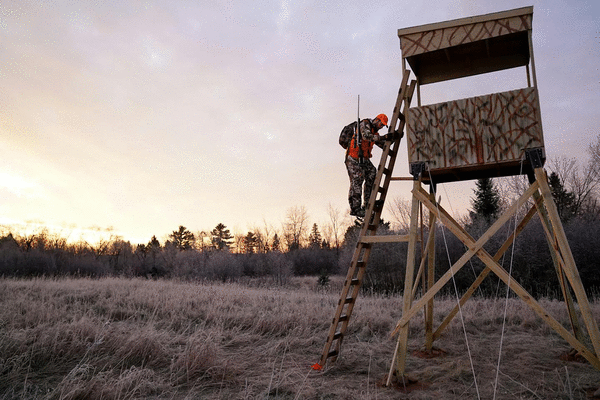
MINNEAPOLIS — For decades, when it came to shooting a deer in Minnesota, your gun of choice — shotgun or rifle — was determined by where you hunted.
A squiggly line slanting across the state’s midsection demarcated a “shotgun-only” zone to the south and west, where muzzleloaders and handguns were also allowed but rifles were banned, and an any-firearm zone to the north and east, where rifles were the norm.
Last year, the Legislature eliminated the dividing line, opening the door for unity across the land.
Except that didn’t happen.
As the state’s firearms deer hunting seasons approach, the rifle-shotgun map is a patchwork — shaped by strong feelings rooted as much in habit as ballistics.
The original rifle ban was adopted in 1942 as a way to increase the flagging population of deer in Minnesota’s farm country by making hunting harder; shotguns firing a slug — essentially a large bullet — were less accurate than rifles. But over the years, many assumed it was safer, since shotgun slugs travel slower than rifle rounds.
Shotgun accuracy has since improved to the point where they can equal rifles for the distances most Minnesotans shoot. In 2013, Wisconsin lifted its shotgun-only requirement for the southern portion of its state and has not witnessed an increase in mishaps.
But the safety argument holds sway for many in Minnesota. Knowing that some folks would prefer to keep things as they were, lawmakers allowed counties to declare themselves shotgun-only.
Brown, Cottonwood, Dodge, Faribault, Houston, Jackson, Kandiyohi, Nobles, Pope, Rock and Watonwan counties will keep the rifle ban in place. In addition, Clay and Wilkin counties will ban rifles in part of their jurisdictions.
Public hearings during the winter and spring across much of the shotgun-only zone were impassioned, and in many of those counties, the majority of voices wanted to keep the rifle ban.
“This has probably been the most contentious issue in at least 10 years,” said Brian Hov, county coordinator for Faribault County, where concerns over safety carried the day. “I think our county wanted to err on the side of caution, to kind of see how it goes.”
Each county must renew its rifle ban annually or it will expire.
The youth and early antlerless deer seasons run from Oct. 15 to 18, and the statewide firearms season begins Nov. 7.
Two years ago, one of the metro’s largest — and most idyllic — tracts of undeveloped land opened to public hunting on part of a former cattle ranch in Washington County.
Keystone Woods Wildlife Management Area covers more than 1,800 acres of rolling grassland, dotted by wetlands with a few groves of hardwoods. There are places in the expanse where it feels like you’re in the prairie pothole region of western Minnesota or the Dakotas.
So, the question on many hunters’ minds: How long until the crowds arrive?
The answer: It’s crowded already.
On the archery opener, a half-dozen vehicles were stationed at one parking lot close to an attractive stand of hardwoods. On Saturday’s duck opener, many of the easily accessible potholes appeared to have been claimed hours before first light, and slow-moving vehicles could occasionally be spotted trolling the area, looking for a vacancy.
Those who managed to secure a setup had the chance to lure in small groups of wood ducks and mallards.
No one thought 2026 would be a banner year for ruffed grouse hunting, and early reports from the field are making good on those low expectations.
“Folks are seeing birds, but just not as many,” said Dawn Plattner, the DNR’s area wildlife supervisor in Grand Rapids, Minn. “Even just driving around this summer, you could tell there were far fewer birds and the brood sizes are smaller.”
Spring drumming counts — a general index for the bird’s population — suggested grouse numbers had fallen for the second straight year.
That wasn’t a surprise, since the bird’s population notoriously rises and falls on a roughly 10-year cycle for reasons scientists don’t fully understand, and grouse are on the downward slide after a peak two years ago.
Charlotte Roy, the DNR’s grouse project leader, said the state’s population appears to be healthy, despite West Nile virus infecting large numbers of birds.
“Our drumming survey data do not indicate that the population is declining because of WNV or any other factor,” Roy said in an email.
For the third straight year, the DNR is asking grouse hunters to log their hunts via the agency’s upland bird hunting diary.
____
©2026 The Minnesota Star Tribune. Visit startribune.com. Distributed by Tribune Content Agency, LLC






Comments