Adam Minter: The US women's hockey team should call Trump's bluff
Published in Olympics
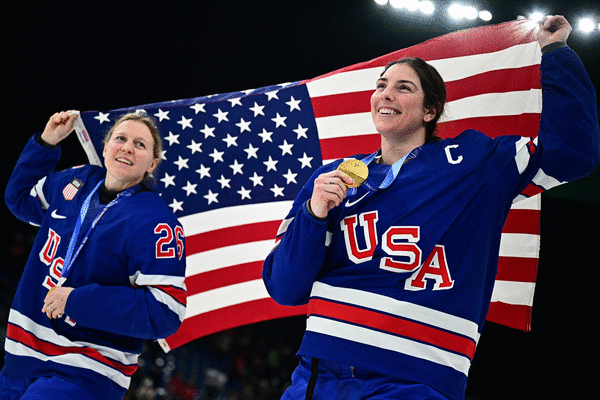
Every team that wins a championship tends to get the same question: When are you going to the White House? For the gold medal-winning United States women’s Olympic hockey team, the better question might be: Is it worth it?
President Donald Trump certainly thinks so — for his own selfish reasons. He joked to the men’s team that he’d “probably be impeached” if he didn’t invite the women to Washington.
With that quip, he told the women exactly where they stood. They’re afterthoughts, not heroes deserving recognition equal to what he had offered the men.
So when USA Hockey says, officially, that a White House visit is “TBD,” the hesitation is more than understandable. Although Front Office Sports reported that the team has cited scheduling and timing as reasons, the players also know an appearance would lend their hard-earned credibility to a president who views them as second-tier political obligations.
That leaves Team USA with an opportunity. If Trump wants the glow of their gold medals, they should ask for real, tangible presidential support for women’s sports in return.
They have the nation’s attention, the sport’s momentum, and the moral high ground, which gives them leverage.
Compared to men, female athletes rarely have the opportunity to visit the Trump White House. In fact, the president didn’t host his first standalone White House event for a women’s champion until he was more than two years into his first term. Subsequent invites have been sporadic, especially compared to those of his predecessors, who regularly hosted women’s champions.
If indifference were the story, that’d be bad enough. But in 2024, he cast himself as a defender of female athletes by stoking fear and anger around transgender participation. It was a cynical gambit that did nothing — nothing — to uplift or promote women’s sports. Instead, it treated women’s sports as a front in a culture war, not as pursuits worthy of the same attention and investment as their male counterparts.
That moment and Trump’s joke with the men’s team fit a pattern of slights that transcends just one president and his troubling relationship to women and sports.
Hockey tells that story well. In Minnesota, the state responsible for many Team USA players, girls and women have been playing organized hockey since at least 1901. But, unbelievably, the state didn’t sanction girls’ high school hockey until 1994, long after Title IX was supposed to guarantee equal opportunity. Today, Minnesota has more than 100 varsity girls’ hockey programs and serves as proof of what can happen when institutions invest in women’s sports.
Still, old habits die hard in the traditionally male-centered world of hockey. Since 1998, Team USA’s women have outperformed the men at the Olympics, winning three gold medals (including in 2026), four silver and one bronze. Yet in 2017, amid this run, many national team players didn’t earn a living wage and had to threaten a boycott of the World Championships to secure a fair contract from USA Hockey. Needless to say, Team USA’s men, most of whom had National Hockey League contracts, didn’t have that problem.
And these slights aren’t going away. Despite measurable progress toward equity in recent years, female athletes still contend with pay gaps, unequal resources, and a lack of media coverage across sports.
A president can’t fix every entrenched inequity in sports, but Trump has the power and the platform to make meaningful contributions to closing gender gaps. So rather than outright declining Trump’s invitation, Team USA’s women should publicly lay out three conditions for the White House to meet.
First, signal a serious push for Title IX enforcement. Under the Trump administration, the law has been partly repurposed as a cudgel against a handful of transgender athletes, rather than as a tool to expand access and resources for girls and women to play sports. Any president who truly values gold medals can hold schools and colleges accountable for equal resources, facilities and coaching. To do that, Trump should order the reopening of the Department of Education’s Office of Civil Rights offices that were closed by his administration last year. Restoring full staffing levels in them is also key.
Second, fund the participation pipeline. The difference between being idle and playing a sport often comes down to access. Communities with more ice time, more training facilities, and more coaches ensure that girls aren’t squeezed out by boys’ programs. Federal grants and public partnerships for sports infrastructure, especially in under-resourced communities, would strengthen equity and future medal counts.
Third, use the presidency to help female athletes get a fair deal. That means backing professional athletes in labor disputes, leaning on broadcasters to give women’s championships better time slots, and celebrating championships with the same gusto reserved for Super Bowl teams.
Any one of these asks would essentially call the bluff of a president who fancies himself a defender of women’s rights but has routinely proven the opposite. Team USA has given the country everything that could be asked of it. They owe the White House nothing. But if they do decide to show up for Trump, they shouldn’t shy away from first asking him: Are you ready to show up for us?
———
This column reflects the personal views of the author and does not necessarily reflect the opinion of the editorial board or Bloomberg LP and its owners.
———
Adam Minter is a Bloomberg Opinion columnist covering the business of sports. He is the author, most recently, of “Secondhand: Travels in the New Global Garage Sale."
©2026 Bloomberg L.P. Visit bloomberg.com/opinion. Distributed by Tribune Content Agency, LLC.






Comments