Mike Vorel: Hilary Knight, Alysa Liu and others make these Winter Olympics human
Published in Olympics
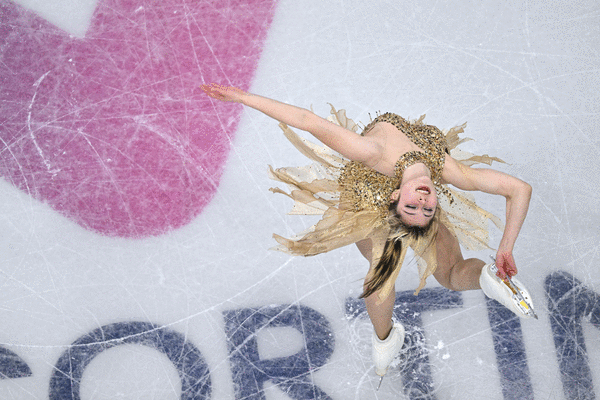





There’s something refreshing about the 2026 Winter Olympic Games.
Strangely, it’s not the sports.
Don’t get me wrong: the sports are great. Figure skating is a fickle marriage of athletic precision, artistic expression and unflinching mental fortitude. Hockey is 60 minutes (or more) of concentrated physicality. Curling is an unexplainable unicorn, majestic in its monotony, impossible to ignore. Any one of the ski or snowboard events, if tried by yours truly, would result in a trip to an Italian hospital, and a forced retirement.
But in an era when sports are increasingly sanitized, scrubbed clean of authentic emotion and relatability, packaged and sold to the broadest possible audience, personality replaced with sponsorships sewn to your sleeves, these Olympics have been human.
Messy, imperfect, inspiring, humorous, occasionally cringeworthy, heartbreaking — human.
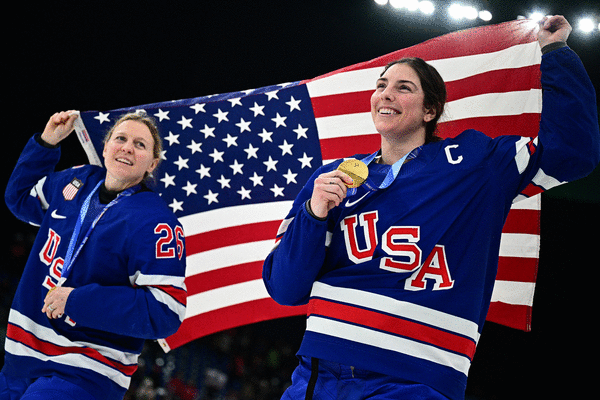
Take USA women’s hockey coach John Wroblewski, who smiled and cried in a red and blue tie Thursday after Megan Keller’s overtime goal against Canada gave the Americans gold. Or Team USA captain and Seattle Torrent standout Hilary Knight, who tipped home the game-tying goal with barely two minutes left a day after announcing her engagement to American Olympic speedskater Brittany Bowe.
Take 20-year-old Alysa Liu, who once retired from figure skating before returning to the sport. On Thursday, she unfurled a flawless free skate, the capstone of her career, then shouted “That’s what I’m [expletive] talking about!” into the camera as she coasted off the ice. She jumped into the arms of her coaches — a tidal wave of transparent, genuine, unedited joy. She won a gold medal with highlights in her hair and a glowing grin on her face, with unburdened authenticity.
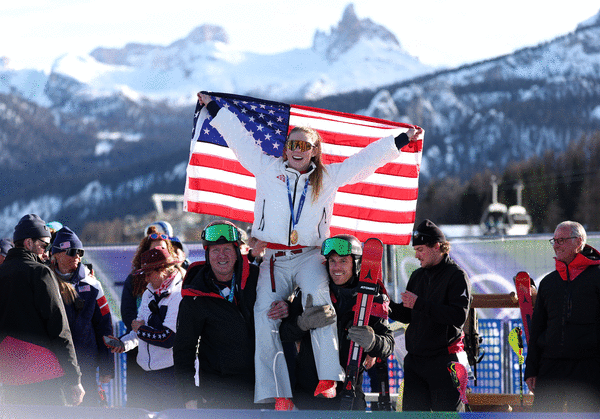
Take Mikaela Shiffrin, the greatest slalom skier ever, who grabbed her first Olympic gold medal in eight years Wednesday. This time, she did so without her dad — Jeff Shiffrin — who died in February 2020 after slipping off the roof of their Denver home.
She spoke remarkably, bravely, about grappling with grief, and the holes our loved ones leave behind. For others, that interview will matter more than any medal.
“This was a moment I have dreamed about. I’ve also been very scared of this moment,” the decorated 30-year-old American said. “Everything in life that you do after you lose someone you love is like a new experience. It’s like being born again. I still have so many moments where I resist this. I don’t want to be in life without my dad. And maybe today was the first time that I could actually accept this reality — instead of thinking I would be going into this moment without him, to take the moment to be silent with him.”
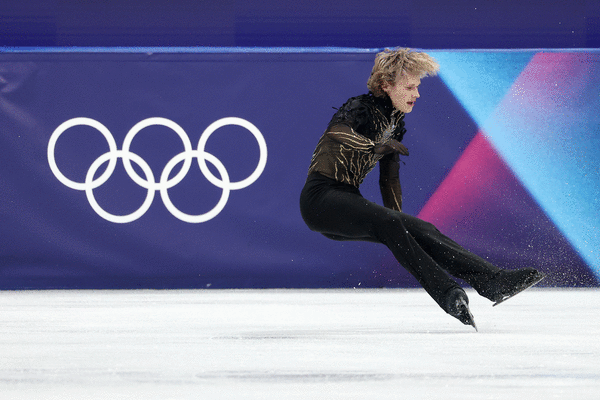
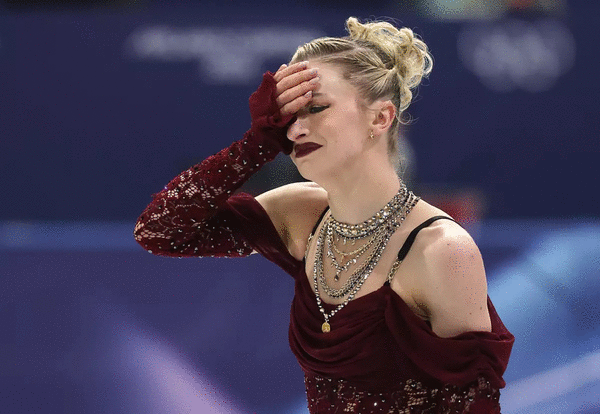
In these Olympics, the silence has been stunning. The silence after American figure skating force Ilia Malinin, dubbed “The Quad God” for his incomparable quad jumps, fell twice during a devastating free skate. The silence after another American figure skating favorite, Amber Glenn, bailed out of a jump and fell to 13th place for the infraction. After completing her short program, the 26-year-old Texan burst into tears.
In both cases, years of uncompromising commitment melted on the unforgiving ice.
But the bounce-back offered a larger lesson.
Glenn finished fifth, on the back of a freeing and redemptive free skate. And the 21-year-old Malinin, who hadn’t lost a competition since 2023, left Milan with an altered outlook.
"The person who came [to the Olympics], he's been turned into dust," Malinin told The Washington Post after earning team gold and finishing eighth individually. "I came out a different person [with] a different perspective, different mindset."
In a voice-over recorded to soundtrack his ill-fated free skate, Malinin says: “The only true wisdom is in knowing you know nothing.”
Now, he knows just how much he didn’t know.
These Olympics have also been messy — marred by cheating scandals of all shapes and sizes. Male ski jumpers were rumored to receive penis-enlarging injections before being fit for their suits, enlarging said suit’s surface area to act as an expanded sail. (None of the competitors was directly accused.)
Both the Canadian men’s and women’s curling teams were accused of cheating, however, by supposedly “double-touching” their respective stones. And after winning a bronze medal in the 20-km individual biathlon Feb. 10, Norway’s Sturla Holm Lægreid didn’t accuse anyone of cheating. He confirmed his own infidelity.
“Six months ago, I met the love of my life — the most beautiful, wonderful person in the world. And three months ago, I made the biggest mistake and cheated on her,” Lægreid confessed in a viral interview. “And that’s all I’ve been thinking about for a week. And it’s been the worst week of my life. So I had a gold medal in life.”
The public admission, apparently intended as a peace offering to his former partner, has not resulted in Lægreid regaining his gold medal. According to Norwegian television outlet VG, his relationship remains over.
So, yes: these Olympics have been rife with reality television twists. In an era ruled by media training and robotic marketability, they’ve also been refreshingly real. We’ve watched Shiffrin find acceptance on a mountain in Milan. We’ve watched Malinin and Glenn stand after falling, which we all must do. We’ve watched humans shoulder the pressure of improbable dreams.
We’ve watched sports. But it’s the imperfect, persevering, relatable humanity that I’ll remember.
© 2026 The Seattle Times. Visit www.seattletimes.com. Distributed by Tribune Content Agency, LLC.






Comments