Jordan Stolz takes silver in Olympic 1,500 meters; China's Ning Zhongyan wins gold
Published in Olympics


MILAN — Even for Jordan Stolz, making history is not as easy as one, two, three.
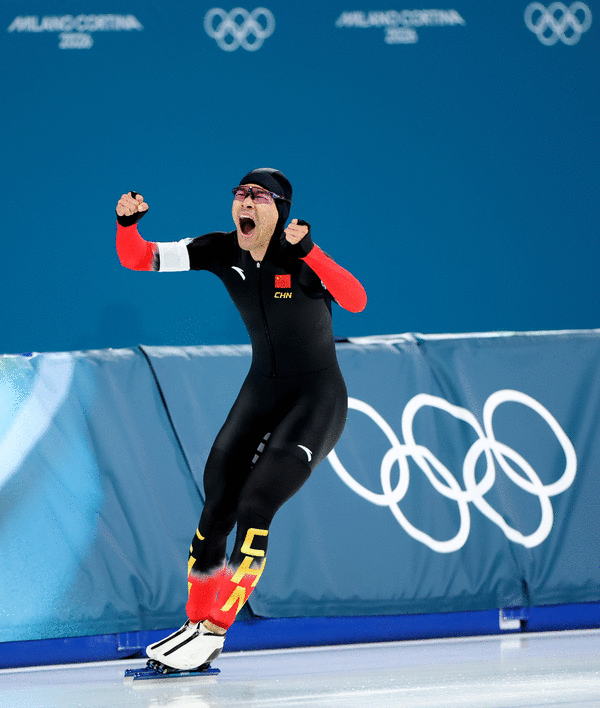
The 21-year-old star's quest for a speedskating triple crown came up short in the 1,500-meter race Thursday as Stolz settled for silver behind China's Zhongyan Ning at the Milan-Cortina Games.
Ning set an Olympic record, blazing the oval at Milano Speed Skating Stadium in 1 minute and 41.98 seconds. Already a two-time gold medalist in the 500 and 1,000 meters, Stolz had the fastest final lap out of the top eight athletes, but finished 0.77 seconds behind Ning at 1:42.75.
"Ning had the race of his life," Stolz told reporters, "and he definitely earned it today."
Stolz became the second U.S. man to win the 500 and 1,000 meters in the same Olympics last week, joining five-time gold medalist Eric Heiden's effort in 1980. Stolz set Olympic records in both his gold-medal wins, but he said after the 1,000-meter race that he had special eyes on the 1,500. Called the "king's race," the distance is considered the premier prize of the sport because it combines both speed and endurance.
Stolz saw Ning's record time and thought, with a perfect race, he could still catch it. But once he saw his first split, Stolz knew it wouldn't be that day.
"I did not have it today, not sure why," Stolz said. "Probably just from all the events. I am sure there are different factors that go into that, which affect my body. Either way, it was still a good race, still happy with silver, and I still have two golds."
Watching from the center of the oval, Ning clasped his hands in prayer during the final race. When the final time flashed across the screen, his coach held Ning's hands in the air. He began to sob. The 26-year-old earned his first Olympic gold medal after earning bronze in the 1,000 and the team pursuit in Milan and finishing seventh in Beijing.
"After the Beijing Winter Olympics, the level in speedskating just kept getting higher and higher," Ning said through an interpreter. "It felt like there was a mountain in front of me, and no matter what I did, I just could not get past it. But I never stopped believing in myself. I kept telling myself to stay patient, to keep putting in the work, to trust that all the effort would add up one day. Today was that day."
Stolz, who will still race in the mass start Saturday, hugged Ning on the ice after the race. The first Chinese man to win the 1,500 meters, Ning was still in shock at the moment. His time was the eighth Olympic record set at Milano Speed Skating Stadium.
When athletes heard the Games would be contested on a temporary track built inside a convention center, they thought the conditions would be slow and heavy. Instead, the pace has been so competitive that setting an Olympic record has not always guaranteed a medal: The Netherlands' Joep Wennemars also cleared the previous Olympic record but didn't make the podium in fourth place.
Nuis and Stolz had no answer for the inexplicably fast paces in an environment that lacks the climate control and steady temperature present at the sport's other top tracks. But when considering the records on the men's side, Ning said he was sitting next to one reason.
"From Beijing to Milan, in the last four years, a super talent appeared," Ning said. "And the appearance of this guy shocked all of us. Because of him, we train even harder and try to surpass him."
Pressing a live interpretation device to his ear to listen, Stolz smiled.
"Thanks," he said with a bashful laugh.
©2026 Los Angeles Times. Visit latimes.com. Distributed by Tribune Content Agency, LLC.






Comments