Robert Lloyd: Winter Olympics opening ceremony was a sleek Italian spectacle, as only they could deliver
Published in Olympics
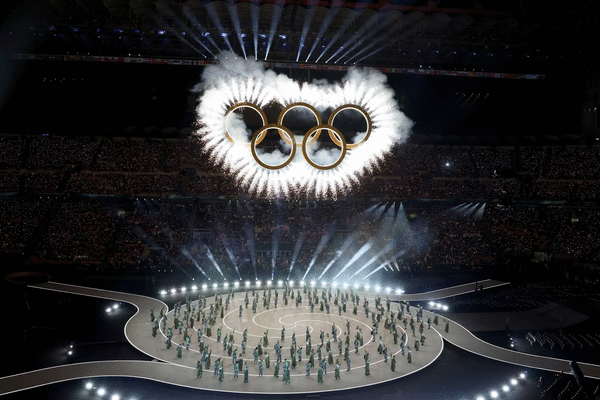
The Olympics are back, wearing their warm Winter Games gear. Although there were will be a couple of weeks of sports competitions to come, none are possible without an opening ceremony, a combination of solemn official protocol with a fantastic representation of the host country's culture and character, evoking the Olympic spirit itself. There are few opportunities to mount an entertainment of this scale — not even a Super Bowl halftime show can compare.
This year we are in Italy, for the bi-metropolitan Milan-Cortina games, held in the city's San Siro Stadium and in the north where the mountains are. The ceremonies, too, were split geographically, with Olympic cauldrons in both cities, with the athletes' parade further shared with Livigno and Predazzo, national delegations divided according to where their events would be held.
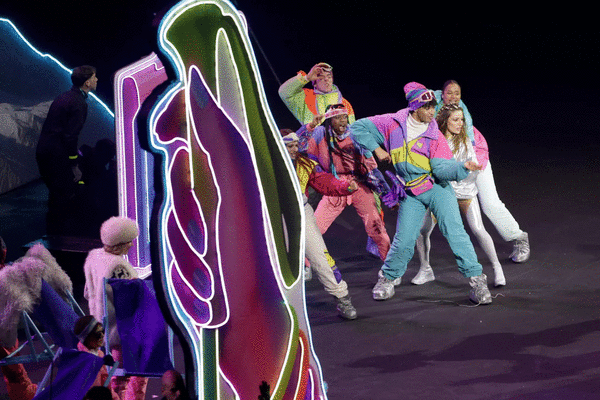
The main business took place in the arena. Directed by Marco Balich, who specializes in big shows, it was elegant, in a sleek, clean-lined Italian way, and over the top, also in an Italian way. Color played a great part, the program beginning in white (a balletic interpretation of Antonio Canova's sculpture "Psyche Revived by Cupid's Kiss"), moving to black and white (a nod to Fellini's "La Dolce Vita" and its paparazzi), and then to a riot of color, as giant floating tubes of paint sent streams of colored fabric stageward.) There were dancing human bobbleheads of opera composers Verdi, Puccini and Rossini, as if they were mascots for Team Rigoletto, Team Tosca and Team William Tell. There were dancing gladiators and moka pots, a phalanx of runway models dressed (in Armani) in green, white and red, to represent the Italian flag.
In white and shiny silver, with an ostrich feather boa and a reported $15 million worth of diamond jewelry, there was a statuesque, statue-still Mariah Carey, who is not Italian, but sang in Italian, the standard "Nel blu, dipinto di blu," known here as "Volare," which merged into her own "Nothing Is Impossible." (She must by now be accounted a citizen of the world.) Why did I find this so moving? I am not someone who ordinarily cares anything about Carey, but she was marvelous in this context.
The parade of nations is also a fashion show; for whatever reason, the cold weather gear is generally better looking than the togs of summer. (As usual, Ralph Lauren designed the American outfits — white puffy jacket with knit caps of a Scandinavian pattern.) As ever, the countries arrived alphabetically (apart from Greece, who always gets to march first; Italy, coming in last as the host country; France, in penultimate position as the host of the next Winter Games; and the U.S., third to last as the host of the games, in 2034, after that). It makes neighbors of Lebanon, Lichtenstein and Lithuania, and so on, equal in standing if not in size. (I have a special fondness for the small delegations from the less imposing nations.) There was an especially big hand for the Ukrainian team, dressed in their national colors.
The second half opened with a cartoon in which an animated Sabrina Impacciatore (of "The White Lotus" and, "The Paper," which NBC happily did not cross-promote), traveled backward through previous Winter Games before coming to life to lead an energetic production number that traveled back to now. (She should get some sort of athletic medal for this performance.) The Chinese pianist Lang Lang accompanied Cecilia Bartoli singing the Olympic anthem, and the great Andrea Bocelli, flanked by strings, offered a thrilling reading of Puccini's "Nessun Dorma." Surrounded by dancers, the Italian rapper Ghali read an antiwar poem by Gianni Rodari.
The theme of the evening, and of evenings going forward, it is hoped, was "Armonia," or harmony, not just between the city and the country (expressed symbolically through dance), but, as a series of speeches made clear, among everybody, everywhere.
"At a time when so much of the world is divided by conflict, your very presence demonstrates that another world is possible. One of unity, respect and harmony," said Giovanni Malagò, president of the organizing committee, addressing the athletes. Kirsty Coventry, the first female president of the IOC, noted that while Olympic athletes are fierce competitors, they "also respect, support and inspire one another. They remind us that we are all connected, that our strength comes from how we treat each other, and that the best of humanity is found in courage, compassion and kindness."
And then there was Charlize Theron, of all people, quoting her countryman Nelson Mandela: "Peace is not just the absence of conflict; peace is the creation of an environment where all can flourish, regardless of race, color, creed, religion, gender, class, caste or any other social markers of difference," This is, of course, exactly what some portion of this nation would call "woke," and though such divisions are not the exclusive province of the United States, it was easy enough to read this as a message delivered to the White House.
Finally, two Olympic torches were lit two Olympic cauldrons, in Milan and Cortina, their flames at the center of shape-shifting spheres. Almost inevitably, the ceremonies flirted with, or embraced, corniness at times, but even (or especially) when it was corny, it was terrifically affecting. I ran through half a dozen handkerchiefs over the course of the proceedings. Admittedly, I might be unusually susceptible to these things, but I doubt I'm the only one.
Let the games begin.
©2026 Los Angeles Times. Visit latimes.com. Distributed by Tribune Content Agency, LLC.






Comments