Preakness 2026: Napoleon Solo wins unprecedented race at Laurel Park
Published in Horse Racing
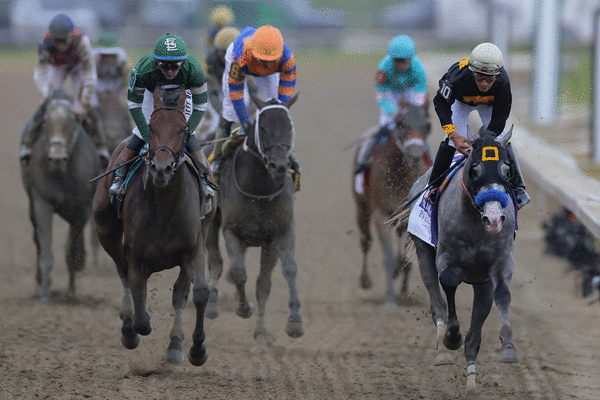
LAUREL, Md. — Adorned in a cerulean button-down and tan blazer, Napoleon Solo owner Al Gold strutted off the track and into the postrace news conference with a childlike whimsy.
He described the 3-year-old colt’s win of the 151st Preakness Stakes as “just [a] blank-ing awesome” race at Laurel Park. Gold’s eyes were affixed to a TV that replayed the finish. He smiled widely each time it showed Napoleon Solo crossing the line by 1 1/4 lengths in 1 minute, 58.69 seconds — the slowest winning time in the race since 1950, when Hill Prince finished in 1:59.20. Gold ignored multiple questions, partially because his hearing aid made it tough to understand, but he reveled in pointing out how jockey Paco Lopez checked his blind side eight times.
“Did anybody think this horse could go this far?” asked Gold, of Gold Square LLC.
Saturday’s Preakness was a clean race with no major traffic issues.
Napoleon Solo settled into second place behind the favorite and hometown hero, Taj Mahal, who finished in a disappointing 10th place. In the final stretch, Lopez made his move.
All Gold could think was, “hang on, hang on.”
Napoleon Solo ran a disappointing pair of races earlier this year. He fell flat, finishing fifth in both. That’s why Gold wasn’t so sure. That’s why Gold bit his nails watching Napoleon Solo emerge from the throes of the largest Preakness field in 15 years. Gold gave all the credit to Lopez, who was sharp and intentional in his late break.
“[My late grandfather] passed away a long time ago,” Lopez said. “He told me when I was a little kid, about 5 or 7 years old, he said, ‘Hey, Paco, you’re going to be a great jockey. … My grandfather told me all the time, ‘You’re the greatest jockey.’ I had the great horse this time for the moment.”
Behind Napoleon Solo (which paid $17.80 on a $2 bet) was Iron Honor, then Chip Honcho, a pair of race-day favorites who never sniffed the front of the pack.
Instead, trainer Chad Summers, who won his first Preakness in his first start, bear-hugged family and friends beside him. This win was the culmination of months of planning and nearly “400,000 phone calls,” which is why Summers told his peers this would be “the best performance of his life.”
“Nothing went right to start his 3-year-old year,” Summers said.
He was on a plane to Kentucky when the blacksmith called to share that there was something wrong with Napoleon Solo’s foot. It left a pit in Summers’ stomach. He flew back and they tended to the injury. Napoleon Solo wasn’t 100% for the Wood Memorial Stakes in early April, but he ran it anyway.
All those phone calls led to “Bob-Baffert-like” workouts, Summers said, then another ramp-up race with all eyes on Preakness.
Summers spoke faster than his horse ran. Gold was giddy. Lopez couldn’t find the right words to articulate what this win meant.
It was a wholesome trio who shared the Woodlawn Vase.
This Preakness felt different. Laurel Park looked vanilla. Because of massive ongoing renovations at Pimlico, the grandstand hushed, bereft of all its most classic features.
Attendance was limited to about 4,800 patrons, a much smaller crowd than the 60,000-plus of recent years in Baltimore. There were no infield festivities. No headlining concert. No running of the urinals. No Kentucky Derby winner vying to stay in Triple Crown contention. A traditional Preakness viewing experience, when the track hosting 14 races bisects brightly dressed spectators, feels that much closer to the action, which makes the sport unique. This was a more traditional, disjointed sports spectacle: everyone over here, the races over there.
“No infield, no crazy shenanigans,” said Dan Atkins, a 51-year-old patron wearing a suit adorned in $100 bills. “Just normal people.”
A stroll through the grandstand revealed what was to be expected with the lighter version of Preakness. Patrons filled the suites against the front-row glass, and crowds gathered outside along the white fence, but a race nicknamed “the people’s party” featured plenty of empty seats, too.
Racing officials are confident this is a one-off and next year, at a mostly renovated Pimlico (the grandstand won’t be completed), will signify not just a return to normalcy but a decisive stride into the future of horse racing in Maryland.
©2026 The Baltimore Sun. Visit at baltimoresun.com. Distributed by Tribune Content Agency, LLC.


Comments