Mike Sielski: The Flyers' high point as a franchise happened 50 years ago against the Soviets. A new doc tells the full story.
Published in Hockey
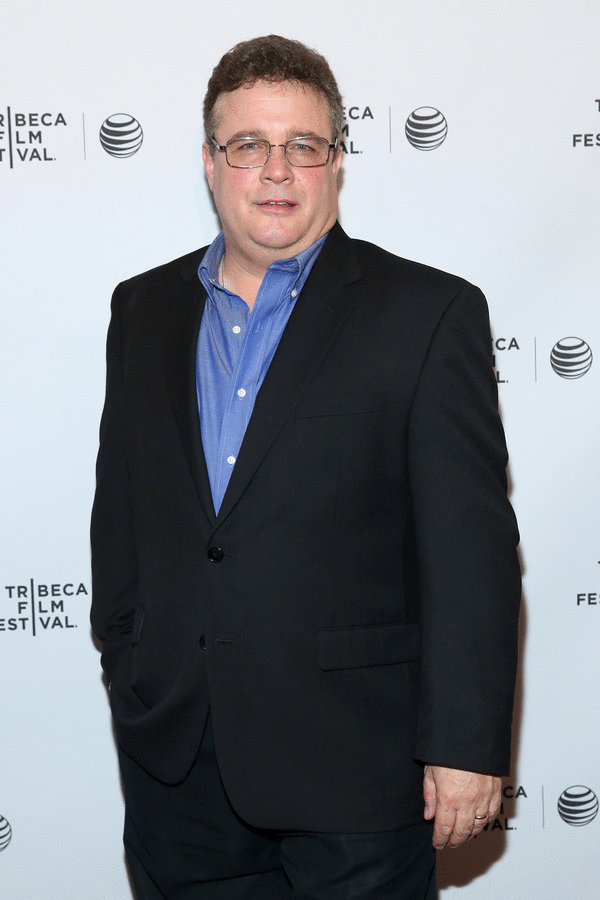
PHILADELPHIA — Joe Amodei attended a Flyers alumni golf tournament in 2022 as the guy he’d always been: a devoted fan who just wanted to hang with his heroes for an afternoon.
Having grown up in Northeast Philly, then Bucks County, he was in his early 20s when the Broad Street Bullies won their two Stanley Cups and, on Jan. 11, 1976, upheld the pride of North American hockey and struck a rhetorical blow for liberal democracy by pounding the Soviet Red Army team, 4-1, at the Spectrum.
By his mid-60s, Amodei had forged a career in the film-distribution business that had stretched more than two decades, but he’d never fulfilled his true dream: making a movie of his own. Then he found himself chatting with former Flyers forward Orest Kindrachuk at the tournament. Russia had invaded Ukraine just days before, and Amodei brought up the Flyers-Soviets game.
Wouldn’t you love to be playing the Russians now? he asked Kindrachuk.
Sure would, Kindrachuk said, adding a few choice, colorful expletives.
“And,” Amodei said later, “a light bulb went off in my head.”
Four years after that conversation, his dream is finally fulfilled. Cold War in Philly — a 77-minute documentary, directed by Amodei, about the Flyers’ victory over the Red Army — will debut at the Suzanne Roberts Theater on May 27. It’s the first full-length film treatment that the game has ever received.
Amodei — who had previously distributed the hit documentary Super Size Me and coproduced a bio doc about Clarence Clemons — made it a point to uncover new information and insights as he compiled footage, conducted interviews, and tracked down the surviving members of that ’75-’76 Flyers club.
“Everybody knows they won the game,” he said. “If you don’t know that, then you’ve been living under a rock. So my goal with each player was to try to get at least one tidbit that no one ever heard of before, and I think we were able to do that.”
He took a seaplane to Vancouver Island to talk to Ed Van Impe, whose crushing check of Soviet star Valeri Kharlamov was the game’s most brutal and memorable moment — it inspired the Russians to leave the ice for 15 minutes in an attempted boycott.
He sat down with Larry Goodenough, who scored the game’s final goal, after Goodenough had whipped up some homemade sausage sandwiches to share for breakfast.
He got one of the final interviews with Bernie Parent before Parent’s death last September, and he coaxed a noteworthy admission from the goalie: Parent considered his absence from the Red Army game — he had undergone a neck operation before the season and had suffered a setback in his rehabilitation — to be the greatest regret of his career.
What Amodei didn’t do was go to Russia or spend a ton of time pursuing anyone connected to the Red Army team. “I tried to stay away from anything political,” he said. “I mean, the film reeks of politics just because of who the Flyers were playing” … and because of how the Flyers themselves regarded and talked about their opponents.
Three days before the game, Bobby Clarke told the Philadelphia Daily News’ Stan Hochman, “I hate those [SOBs].” Fred Shero, the Flyers’ head coach, was more measured but just as pungent in his criticism of the Soviet Union’s Communist system: “I don’t believe in … the way they live. … That is, the way they’re forced to live. And I don’t believe in the way they train their athletes. They take you off the streets and train you as an athlete. They give you the best of everything, sure, but that’s your life and that’s it. That’s OK for training horses or dogs, but not men.”
Bold words, especially in the midst of the Cold War, but the Flyers backed them up. “Somebody said to me, ‘You know, it’s the last really important game that the Flyers won,’” Amodei said. “These guys brought a positiveness to Philadelphia that none of us had ever felt before when it came to the world of sports.”
The victory over the Red Army came less than eight months after they had won their second Stanley Cup and in the midst of a regular season that was, by points percentage (.738), the best in their history. The story that Amodei’s documentary tells, really, is that of the Flyers’ journey to their apex as a franchise, to the brief period when they were the greatest hockey team in the world. It’s a moment they’re still chasing, more than a half century on.
———
“Cold War in Philly” premieres at the Suzanne Roberts Theater, 480 S. Broad St., on May 27. Ticket packages range from $75 to $1,000. On May 28, the documentary screens at the Philadelphia Film Center, 1412 Chestnut St., at 7 p.m.; tickets are $21.50. Information: coldwarinphilly.com.
©2026 The Philadelphia Inquirer. Visit inquirer.com. Distributed by Tribune Content Agency, LLC.



Comments