Vahe Gregorian: How the Chiefs amplified the moving Berlin Wall exhibition at KC's Union Station
Published in Football
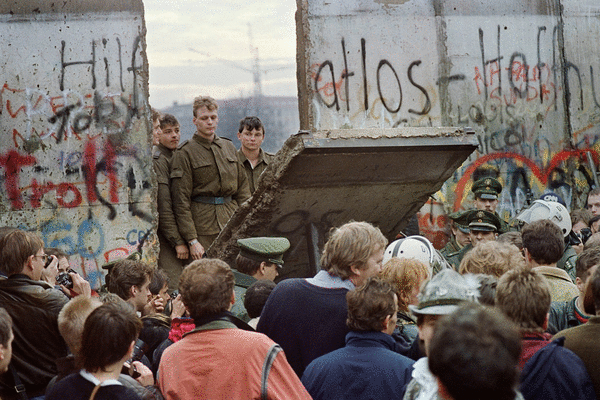
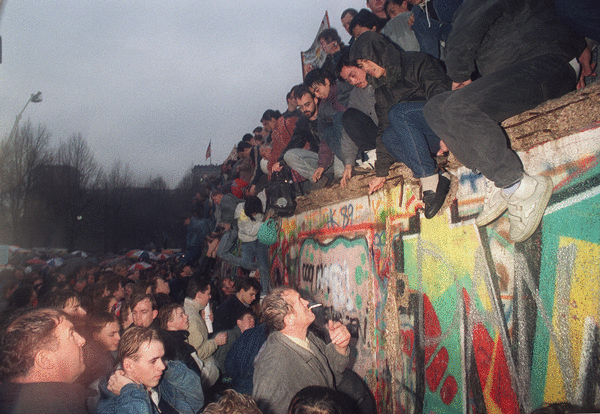
KANSAS CITY, Mo. — When Union Station officials ushered in “The Berlin Wall: A World Divided” exhibition, they sought to do what they do with every traveling presentation: incorporate uniquely regional and Kansas City flourishes.
So it features such elements as a look at British Prime Minister Winston Churchill’s 1946 “Iron Curtain” speech in Fulton, Mo. — a place that’s hard to mention here without noting it also was the hometown of Helen Stephens, the “Fulton Flash.”
At the 1936 Berlin Olympics, she set the women’s world record in the 100-meter dash, earned gold on the 4x100 relay team and further distinguished herself by giving Hitler the cold shoulder.
The gallery includes a look at the pivotal role of President Harry S. Truman, whose remarkably consequential presidency included the post World War II rebuilding of Europe through the Marshall Plan and conducting the Berlin Airlift in 1948.
And it showcases elements of Kansas City during the Cold War, including archival images from The Kansas City Star detailing how it shaped life here. Among front pages of newspapers around the world reacting to the fall of the wall on Nov. 9, 1989, was The Star headline: “Madness! Madness!” at the Wall.”
But another fascinating Kansas City connection, that of a punctuating bookend, was on display Tuesday — timing that moved former Chiefs Deron Cherry and Bill Maas.
As part of the 1990 Chiefs, they traveled to Berlin for a preseason game that enabled them to witness the embryonic phase of the reunification of Germany and absorb the historic implications that have stayed with them ever since.
Among those enduring convictions are a certain appreciation of freedom and democracy perhaps too easily taken for granted by some.
“I thought about it this morning when I woke up …” Maas said during a Q-and-A session before touring the exhibition. “How fitting is it that we’re here talking about (this) today, Election Day, because those people never had a say-so.
“Some of them, their entire lives, never had a say-so. They were told what to do and how to do it.”
Timed with the NFL’s Salute to Service week, Chiefs Ambassadors Maas and Cherry were part of a contingent including U.S. Marines and current Chiefs linebackers Jack Cochrane and Cole Christiansen — a U.S. Military Academy graduate. The exhibition has been extended into early January.
At one point during the tour, Cherry spoke with Cochrane and Christiansen as they stood before an illuminated installation of six original sections of the ominous wall preserved by the Berlin Wall Foundation.
Its presence no doubt took Cherry and Maas back to the trip embraced by visionary franchise founder Lamar Hunt as part of the NFL global initiative “American Bowl” series of preseason games intended to grow the game in ways that have burgeoned in recent years.
The Chiefs played in four of those, including twice in Japan, once in Mexico and the one in Berlin against the Los Angeles Rams that also marked the first NFL game in continental Europe.
According to The Star at the time, the game was promoted as “one of the main parts of the American way of life such as Coke, chewing gum and Cadillac.”
During the week-long trip, the American way of life reverberated anew with the Chiefs’ entourage — including Chiefs co-historian Mike Davidson, who then was the club’s equipment manager.
On a logistical scouting trip months before the Aug. 11 game, Davidson ventured through the Brandenburg Gate — where U.S. President Ronald Reagan three years before had stood and declared, “Mr. Gorbachev, tear down this wall!”
As he spoke Tuesday, Davidson thought of the yet-chilling scene there in 1989: The White Crosses memorial commemorating those who’d been killed trying to escape through what became known as the “Death Strip” over the nearly three decades the nearly 100-mile wall stood.
Recalling a similar scene at Checkpoint Charlie, Maas called it “an everlasting impression.”
One cross, Davidson recalled with abiding lament, stood for a victim who died just months before the wall came down.
Among those with whom Davidson ventured into the former East Berlin was then-Chiefs coach Marty Schottenheimer, who told The Star in 1990 “I would think everyone would want to experience the social change that is going on.”
Profound as the change was, though, it also was halting — a reflection of how deep-rooted and terrifying the past had been.
Davidson remembered walking a few blocks across when their guides became uneasy at the sight of armed soldiers and decided it was best to take their visitors back.
“It was a very strange feeling,” he said. “In a way, you almost felt like a prisoner. Just in a way.”
Then he said something later echoed by Maas and Cherry. A literal darkness hovered on the east side, a starkness that symbolized the figurative darkness that couldn’t immediately be purged.
“The difference between East Berlin and West Berlin at that time was night and day,” Maas said. “East Berlin was like a black and white movie. The people’s faces were primarily expressionless. They just kind of walked in a daze and a stare.”
But the group also could see an awakening of sorts.
When youngsters saw them on a bus tour, Maas said, their joy and gratitude toward them “was like we liberated them” ourselves.
On a river ride on a barge for the occasion named “Big Chief” and elsewhere, Cherry remembered being treated as if they “were the biggest celebrities in the world” as they were cheered by East Berliners “just so excited to see somebody different.”
Particularly when he took his own shot at the wall.
He felt a special pride in being American and a living symbol of freedom as he struck the wall. Hunt later presented encased pieces of it throughout the organization, which made its 1990 team Christmas card a photo of players Jonathan Hayes and James Saxon in uniform at the wall with a young boy from East Germany.
“Peace to you this and every season,” it read.
In that spirit, Cherry also felt something else lasting from the trip — a deeper realization of the significance of perspective.
The notion was sparked by the broader experience but also an occasion he had during the trip to speak with Soviet soldiers through a translator. As he put it to The Star back then, “You don’t really know about someone until you meet them. They were very friendly, and you got the impression that it was almost like they were in a place they really didn’t want to be.”
On Tuesday, he thought about what he called the dichotomy of watching the soldiers drink Coca-Colas — part of the American way of life, after all.
“We would understand each other so much better if we just put ourselves in somebody else’s position,” he said. “Because we don’t know what that person has gone through; we don’t know what their life experiences have been.”
During the week the Chiefs and Rams were there, they practiced against each other several times on the Maifield at the 1936 Olympic Stadium — a harbinger of the war to come that ultimately would lead to the Cold War.
While Cherry appreciated that the road to the stadium was named after Jesse Owens, whose four gold medals in 1936 were a repudiation of Hitler’s notion of racial supremacy, he recalled a sense of eeriness on those parade grounds that had been designed for Nazi rallies and parades.
The speaker system echoed the sounds of World War II movies and news reels.
“You could have been back in that time,” he said, “and you would have sworn it was the same guy talking.”
The Chiefs lost the game, 19-3, before an announced crowd of 55,429, roughly two-thirds full. Other than the many American servicemen and women, many fans didn’t know when to cheer.
But it still was part of the growth of the game globally, a movement the Chiefs have continued to drive by playing internationally and with their ambitions to become known as the “World’s Team.”
And it was part of something else substantial: testimony to bearing witness to history so as not to be condemned to repeat it.
“Can you imagine being on the other side of that wall,” Cherry said, “where you weren’t free?”
Thanks to this exhibition, you can in a way that still resounds as a reminder of the preciousness of freedom in a chaotic world. Something that became indelible to those Chiefs.
©2026 The Kansas City Star. Visit kansascity.com. Distributed by Tribune Content Agency, LLC.




Comments